Francis Picabia - Enjoyment, 1932
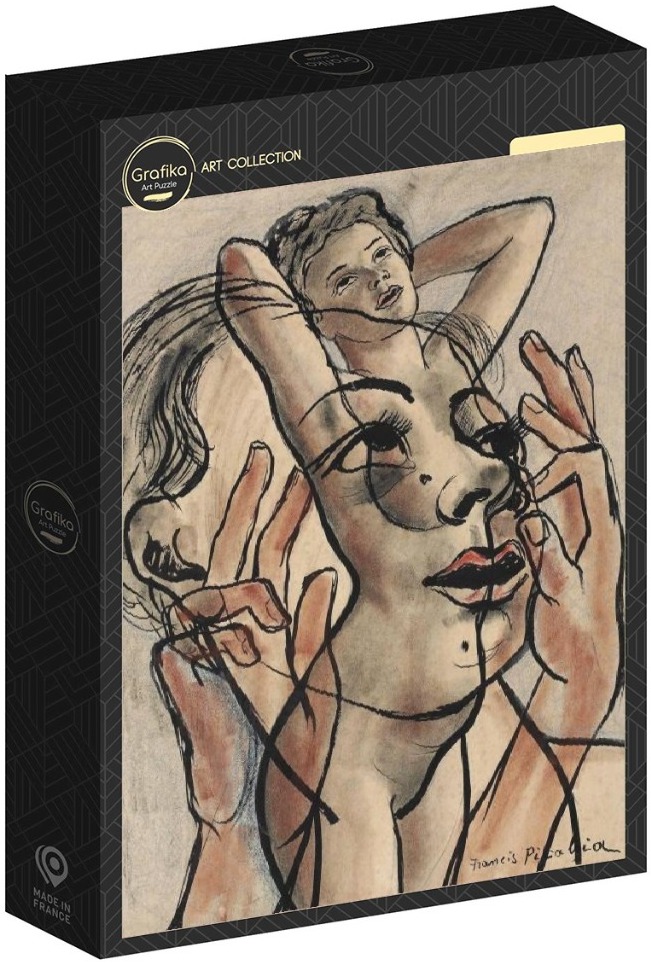
This surrealist artwork features a complex, dreamlike composition centered on overlapping human faces and hands. A large, prominent face dominates the foreground, with heavy, expressive black lines defining the eyes, nose, and lips. Behind this primary visage, a smaller face appears nestled within the upper portion, framed by raised arms. The entire scene is interconnected by loose, sweeping black ink lines that suggest limbs and anatomical forms, creating a fluid and slightly disjointed appearance.
Set against a neutral, beige-toned paper background, the composition feels sparse and intentional. The style is reminiscent of 20th-century avant-garde sketches, prioritizing raw emotion and abstraction over anatomical precision. The spatial layout is layered, pushing the figures forward and creating a sense of psychological depth rather than physical space.
The colour palette is intentionally muted, relying on the contrast between bold black outlines and soft, flesh-toned washes of peach and pink. The dark strokes provide a dramatic, graphic quality, while the subtle shading of the skin adds a tactile, human softness. The mood is introspective and enigmatic, characteristic of surrealist portraiture. The artist’s signature, "Francis Picabia," is visible in the bottom right corner, rendered in a simple, cursive script.
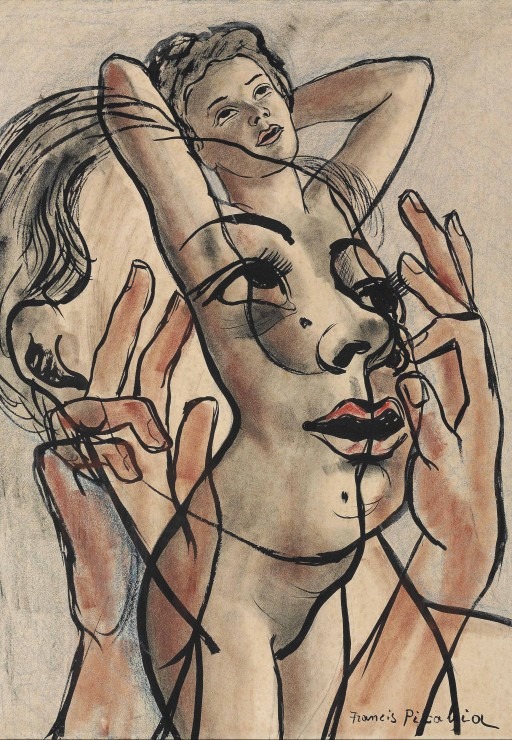
This surrealist composition features a complex layering of human forms, where faces and hands merge into a singular, dreamlike structure. A larger, central face with dark, expressive eyes and red-tinted lips dominates the foreground. Directly above this, nestled within the contours of the primary figure's arms, is a smaller, upward-gazing face. These figures are surrounded and partially obscured by multiple hands, whose fingers reach across the frame, creating a sense of tactile intimacy and psychological weight.
The work is rendered with bold, sweeping black ink lines that define the subjects' features while also weaving through the image as decorative or abstract paths. The monochromatic, muted palette relies on soft washes of beige, pale peach, and gray tones to provide volume and shadow. The background is a neutral, parchment-like shade that emphasizes the stark contrast of the ink work.
Overall, the mood is enigmatic and introspective. The composition lacks a clear horizon or physical setting, focusing entirely on the interaction of the overlapping anatomical shapes. The artist's signature, "Francis Picabia," appears in the lower right corner, written in a delicate, cursive script that integrates subtly with the surrounding linework.