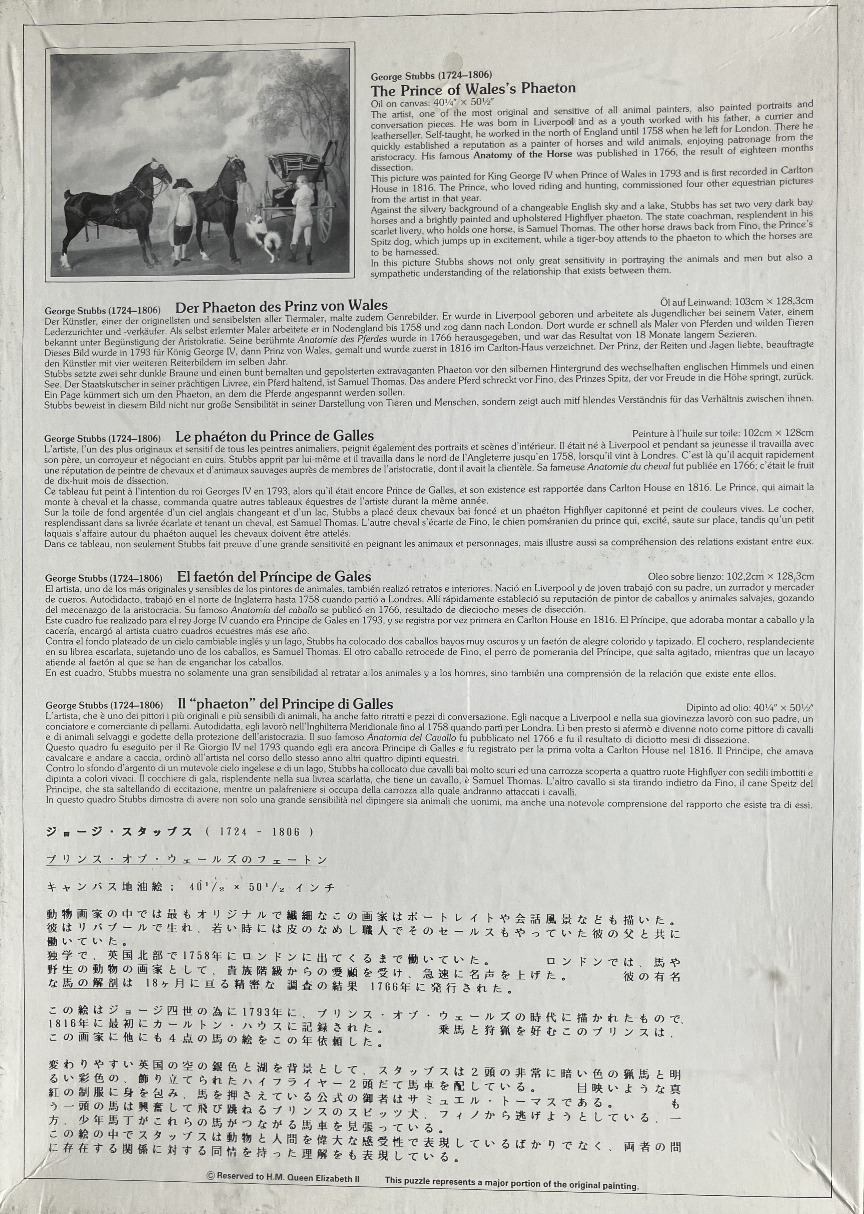
The Prince of Wales's Phaeton
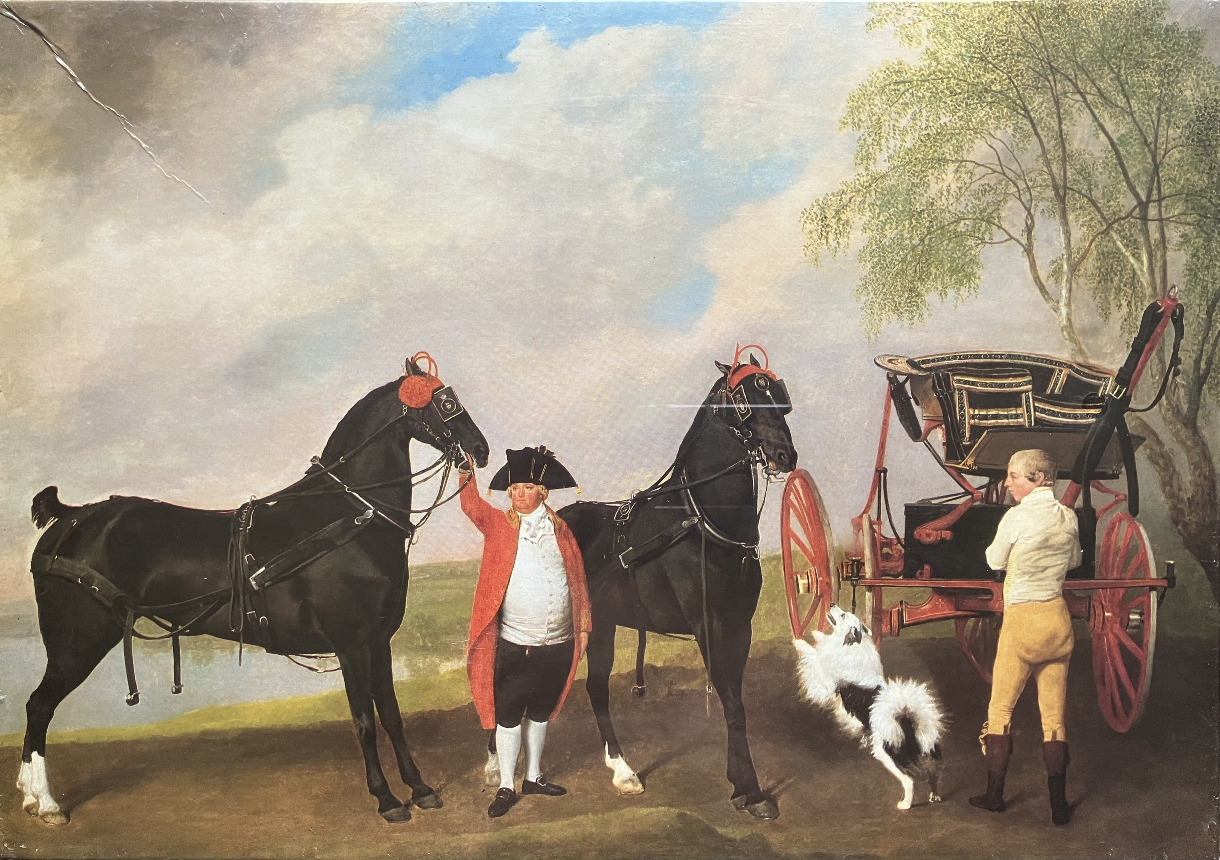
This 18th-century style oil painting depicts a stately scene featuring two shiny black carriage horses, a coachman, and a gentleman with a small dog. The coachman, positioned centrally between the horses, wears a striking red tailcoat over a white waistcoat, dark breeches, and a black tricorn hat. To the right, a gentleman in a white jacket and yellow breeches stands near a sophisticated black-and-red carriage with large, ornate wheels. A small, fluffy black-and-white spaniel stands on its hind legs near the carriage, looking up at the wheel.
The figures are set within a sprawling, open landscape under a bright, cloudy sky with patches of blue. To the far right, a large tree with light green foliage frames the scene, adding verticality to the composition. The ground is a muted, earthy tone, suggesting a groomed estate or field. The overall color palette is balanced, with the bold red of the coachman's coat and the carriage wheels providing vivid contrast against the dark horses and the lighter, naturalistic tones of the landscape.
The style is reminiscent of classic British portraiture and sporting art from the Georgian era. The focus is on the poise of the figures and the detailed rendering of the horses' harnesses and the carriage structure. The lighting is soft and diffuse, typical of a bright day, casting minimal shadows and creating a peaceful, controlled atmosphere. There is a visible horizontal crease and a light scratch across the upper left section of the image.
The central focus of this painting is a bright, ornate carriage, known as a phaeton, hitched to two dark-coated horses. A coachman, dressed in a vibrant red livery, stands beside them, firmly gripping one of the horses' bridles. To the right, a second horse recoils slightly, while a small, spirited dog jumps excitedly nearby, looking toward the carriage. A young attendant stands slightly behind the vehicle, overseeing the preparations for the horses to be harnessed.
The scene is set against a serene, expansive landscape featuring a pale, silvery sky and a calm, reflective lake in the distance. The composition is horizontally balanced, with the figures and the carriage occupying the foreground, while the open terrain stretches into the background. The lighting is soft and naturalistic, casting subtle shadows that define the musculature of the horses and the textures of the carriage upholstery.
Executed as an oil painting, the artwork exhibits the characteristic precision and anatomical accuracy associated with the artist George Stubbs. The palette consists of muted, earthy tones for the landscape and horses, contrasted sharply by the bright crimson of the coachman’s attire and the decorative flourishes of the phaeton. The overall mood is one of quiet activity and refined grace, capturing a moment of preparation in a rural estate setting.

This image features a solid, deep blue rectangular surface covered in white printed text and a single barcode. The overall composition is clean and minimalist, functioning as a informational panel with a vertical white line separating the left and right sections.
The left side contains text stating, "From a Painting in The Royal Collection," followed by "No 3915," "Made in England by Falcon Games Limited," and "Hatfield, Herts, England." On the right side, the text reads "1000 Puzzle," "Casse-tete, Palapeli, Pussel," the dimensions "72 x 51 cm" and "28 1/4 x 20"," along with a logo and a standard EAN barcode.
The visual style is strictly typographical and informational. The contrast between the stark white, serif and sans-serif lettering and the vibrant, uniform royal blue background creates a professional and classic aesthetic. There is no representational artwork or illustration, focusing purely on providing details regarding the source, size, and origin of the item.

The central focus of this historic oil painting is a dark, sleek horse-drawn phaeton carriage positioned in a manicured outdoor landscape. Two dark horses stand in the foreground, held by a groom dressed in a vibrant red coat and white breeches. A small, white and brown spaniel-type dog is captured in motion near the carriage wheels, adding a sense of life and domesticity to the formal scene.
The composition is anchored by the carriage and figures, set against a backdrop of soft, rolling hills and a light-filled, cloud-dappled sky. The artistic style is representative of 18th-century British portraiture, characterized by precise detail in the tack and carriage work combined with a romanticized, airy treatment of the natural environment. The palette is dominated by deep, polished blacks for the horses, earthy browns for the carriage, and crisp, natural light tones for the atmosphere. This classic scene captures the refined elegance and quiet activity of a traditional country estate.