Country Scenes
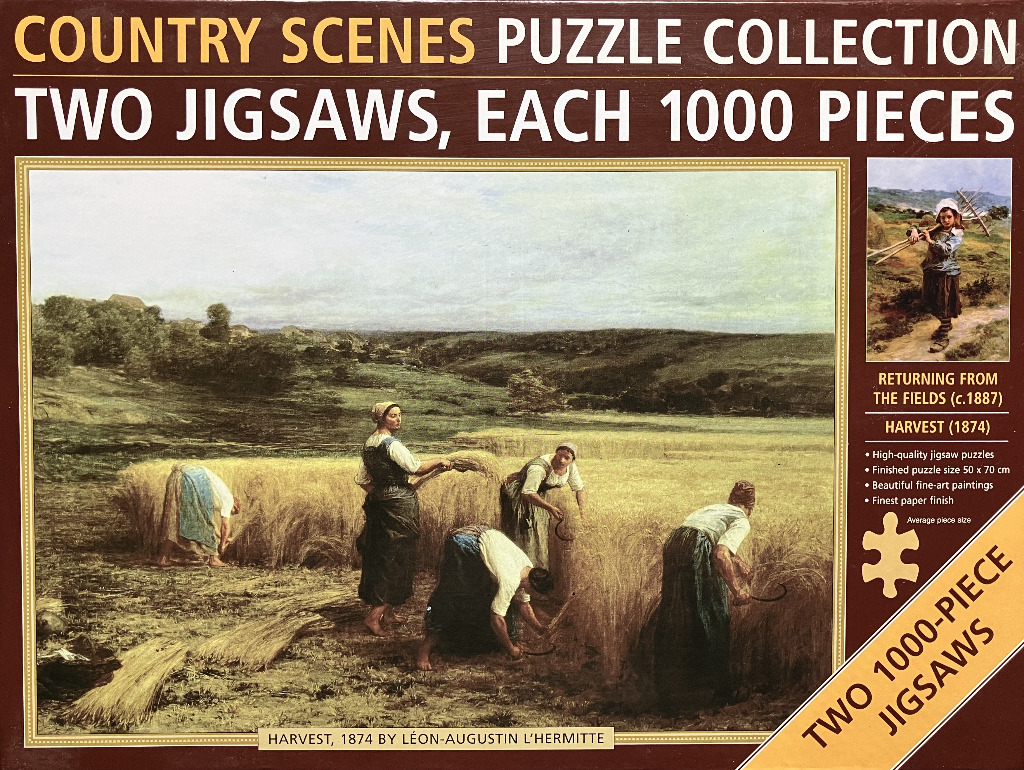
The central artwork is a realist oil painting titled "Harvest" (1874) by Léon-Augustin L'Hermitte. It depicts a wide, rural landscape where five women are diligently harvesting wheat in a large field. The scene captures the essence of 19th-century peasant life, focusing on the rhythmic, labor-intensive nature of the harvest. The composition is grounded by the figures distributed across the foreground, while the expansive, rolling hills and distant trees in the background provide a sense of scale and depth to the countryside setting.
Technically, the painting features a muted, earthy color palette dominated by golden wheat, dark brown soil, and the muted greens of the distant foliage. The lighting is soft and diffused, characteristic of an overcast day, which casts minimal shadows and gives the entire scene a somber yet peaceful atmosphere. Each woman is dressed in traditional working garments, including white blouses, dark skirts, and head coverings. Their postures vary from standing to bending low as they cut the stalks with handheld sickles, demonstrating the collective physical effort involved in the task.
In addition to the main illustration, a smaller inset image on the right displays a separate painting titled "Returning from the Fields" (c. 1887), showing a lone woman walking along a path carrying a wooden rake across her shoulders. The brushwork throughout both images is smooth and detailed, typical of the academic realist style of the era, emphasizing textures in the clothing, the dry wheat, and the textured landscape.
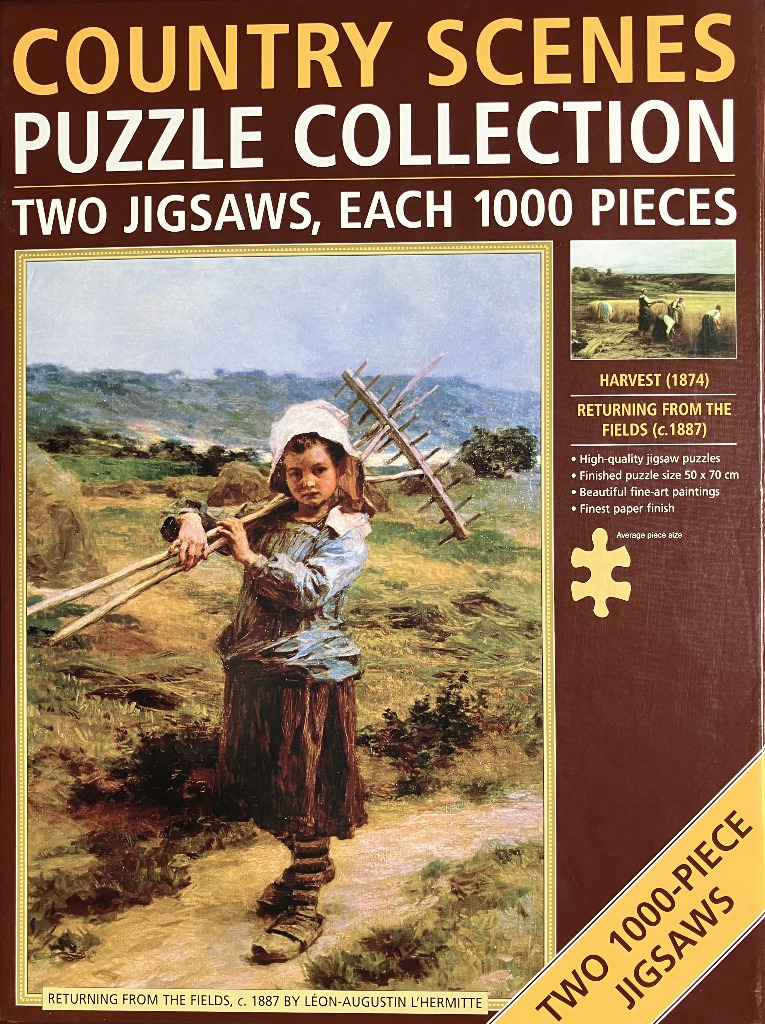
The central focus of the artwork is a young girl walking along a dirt path in a rural, open field. She is positioned in the foreground, facing the viewer with a neutral, contemplative expression. She wears a simple, light-coloured head covering, a blue-toned shirt, and a dark skirt, with rustic, wrapped footwear. Resting across her shoulders is a large, wooden hay rake, which spans diagonally behind her.
The setting is an expansive agricultural landscape, depicted with a soft, impressionistic quality. The background reveals rolling hills under a pale, hazy sky. To the left, there are indications of haystacks or harvested crops, while a small cluster of dark, leafy trees sits on the right. The ground is a mix of earthy browns, tans, and dried grasses, suggesting late summer or early autumn. The composition draws the eye toward the girl, who serves as the anchor point against the sweeping vista behind her.
The painting uses a naturalistic colour palette dominated by muted, earthy tones, interspersed with cool blues in the clothing and sky. The light appears soft and diffuse, typical of a late afternoon. The visible, textured brushstrokes and the realistic yet painterly style identify the work as a late 19th-century European oil painting, specifically "Returning from the Fields" by Léon-Augustin L'hermitte. The overall mood is one of quiet, solitary labour in a timeless pastoral environment.




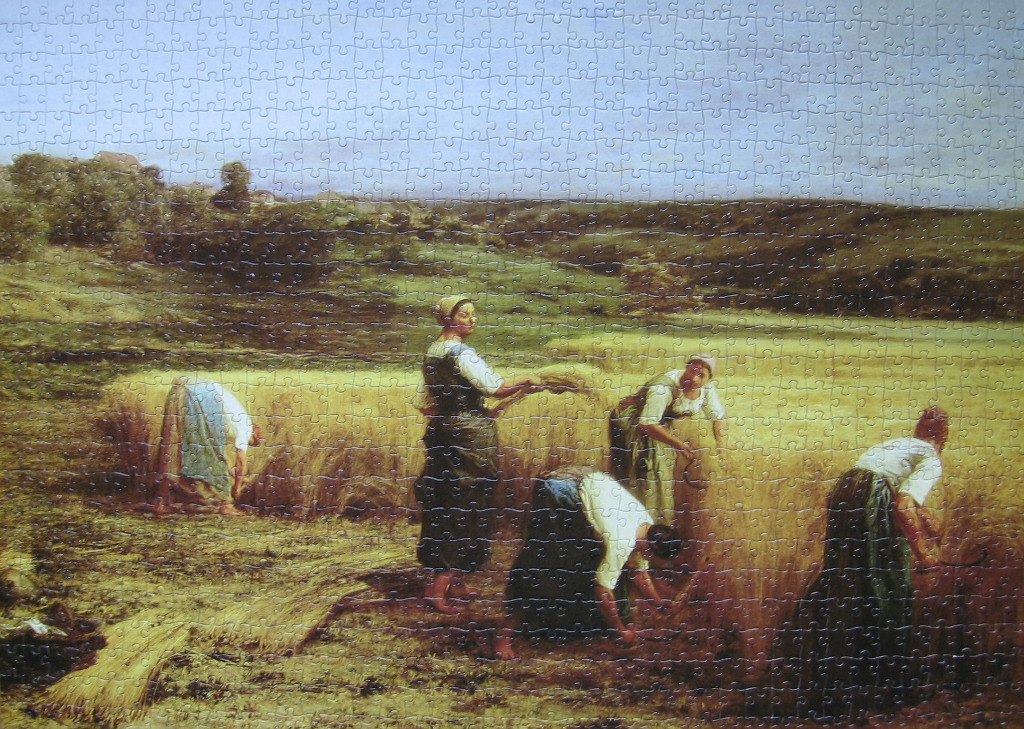
This classical oil painting depicts a serene rural scene of four women laboring in a golden wheat field. The figures are dressed in traditional period clothing, consisting of dark skirts, white blouses, and head coverings. Three of the women are bent low over the stalks, rhythmically harvesting the crop, while one woman stands upright near the center, pausing in her task to look toward the viewer. Their movements are graceful and fluid, suggesting a lifetime of practiced manual labor.
The setting is a vast, rolling countryside under a pale, expansive sky that occupies the upper third of the canvas. In the background, soft hills and patches of distant woodland fade into muted shades of green and brown, creating a sense of quiet isolation. The composition is balanced and atmospheric, focusing on the interplay between the bright, sun-drenched wheat and the earthy, shadowed tones of the foreground soil.
The colour palette is dominated by warm yellows and golds contrasted with deep, earthy olives and browns, reflecting the heat of the harvest season. The lighting is soft and diffuse, likely representing the hazy glow of a late afternoon sun, which casts long, subtle shadows across the uneven ground. The style is realistic and narrative, evoking a sense of historical nostalgia through its detailed portrayal of nineteenth-century agricultural life.
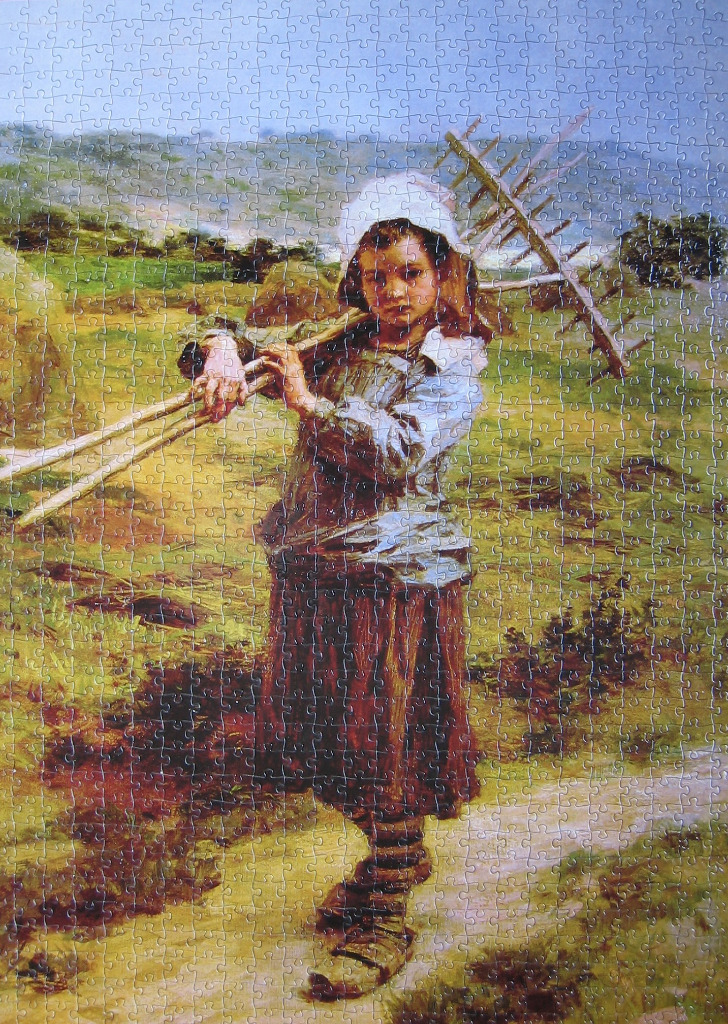
The central subject of this image is a young girl standing in a pastoral field. She is depicted with a serious expression, wearing a white bonnet or cap and a simple, layered brownish dress with a lighter shirt underneath. She carries a long-handled wooden hay rake across her shoulders, holding it firmly with both hands as she looks toward the viewer.
The setting is an open agricultural landscape, likely a hay field or meadow, under a pale, hazy blue sky. The background shows rolling hills in soft, muted tones, suggesting a late summer day. The ground consists of uneven earth, grasses, and patches of darker shrubbery or soil, with a winding, pale path snaking across the bottom right of the frame.
The artwork is rendered in a classic, textured painterly style, reminiscent of 19th-century Realism or Impressionism. The color palette is dominated by warm, earthy tones of ochre, burnt umber, and olive green, contrasted by the bright white of the girl's cap and the cool, soft blue of the sky. The lighting is diffused and even, casting subtle shadows that highlight the textures of her clothing and the grain of the wooden rake. The brushwork is visible throughout, providing a sense of depth and rustic atmosphere to the rural scene.