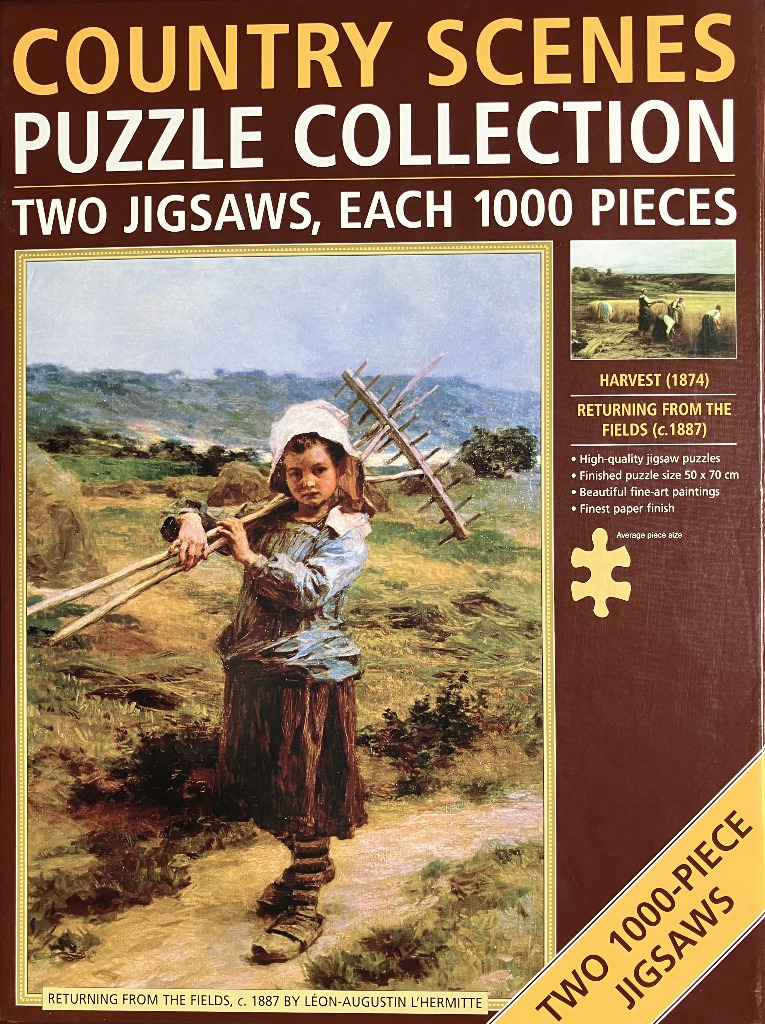
The central focus of the artwork is a young girl walking along a dirt path in a rural, open field. She is positioned in the foreground, facing the viewer with a neutral, contemplative expression. She wears a simple, light-coloured head covering, a blue-toned shirt, and a dark skirt, with rustic, wrapped footwear. Resting across her shoulders is a large, wooden hay rake, which spans diagonally behind her.
The setting is an expansive agricultural landscape, depicted with a soft, impressionistic quality. The background reveals rolling hills under a pale, hazy sky. To the left, there are indications of haystacks or harvested crops, while a small cluster of dark, leafy trees sits on the right. The ground is a mix of earthy browns, tans, and dried grasses, suggesting late summer or early autumn. The composition draws the eye toward the girl, who serves as the anchor point against the sweeping vista behind her.
The painting uses a naturalistic colour palette dominated by muted, earthy tones, interspersed with cool blues in the clothing and sky. The light appears soft and diffuse, typical of a late afternoon. The visible, textured brushstrokes and the realistic yet painterly style identify the work as a late 19th-century European oil painting, specifically "Returning from the Fields" by Léon-Augustin L'hermitte. The overall mood is one of quiet, solitary labour in a timeless pastoral environment.