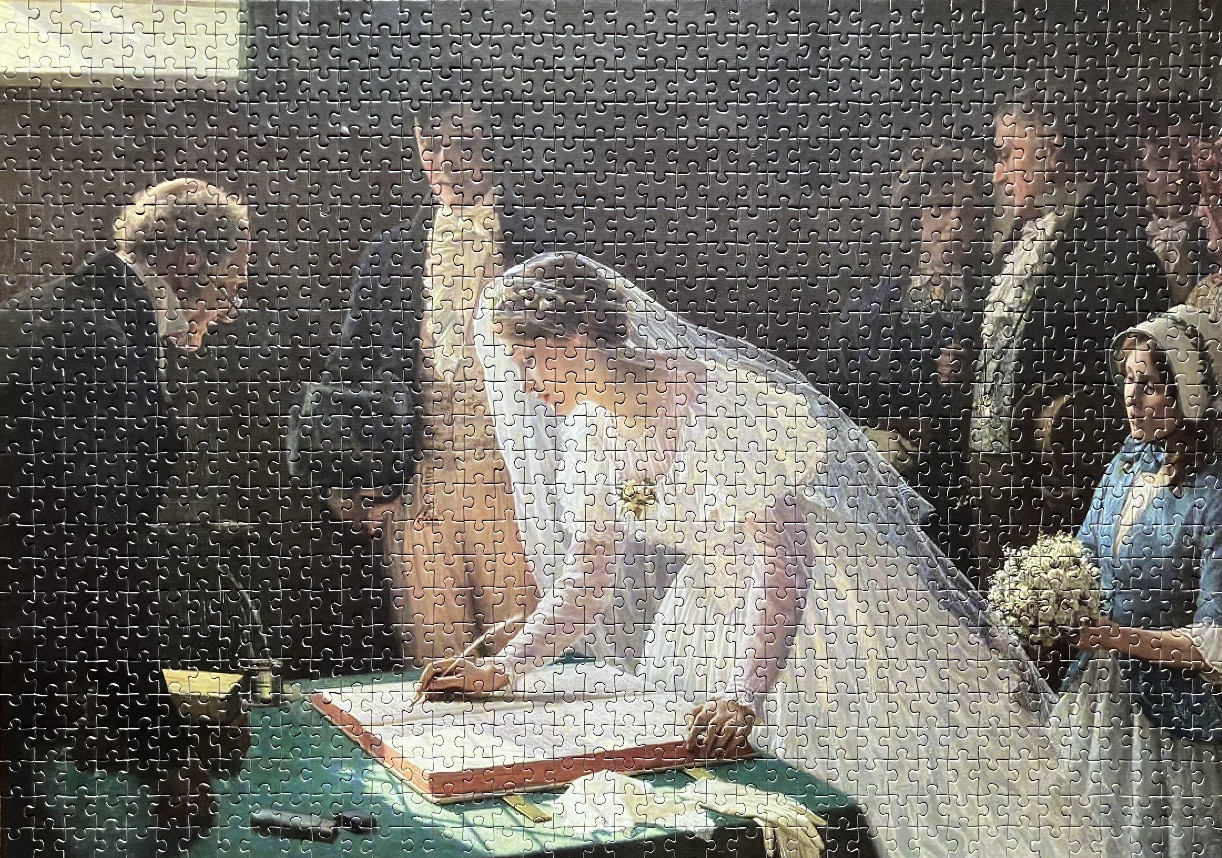
This historical genre painting captures a solemn wedding moment, likely from the 19th century. The central figure is a young bride in a white gown and veil, leaning over a table to sign a large register. Beside her, a young girl in a blue jacket and white skirt holds a small bouquet of flowers. To the left, an older gentleman, presumably the officiant, leans in to watch the process, while several men in formal dark suits and cravats stand as observers in the background, their faces partially obscured by the dim lighting.
The composition is focused on the table, which is covered with a dark green cloth holding the oversized registry book, a quill, and a pair of discarded white gloves. The setting appears to be a dimly lit, wood-paneled room. The lighting is chiaroscuro-inspired, with a primary light source illuminating the bride, the book, and the young girl, while the rest of the figures recede into deep, moody shadows. The painting uses a muted, naturalistic palette of dark earth tones, deep greens, and crisp whites, conveying a sense of historical reverence and quiet formality typical of realist Victorian-era art.