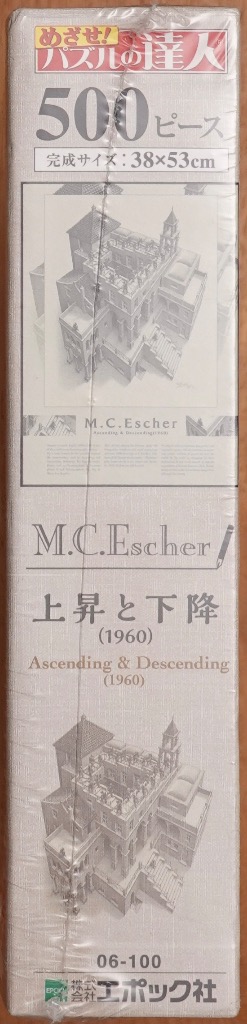
Ascending & Descending (1960)
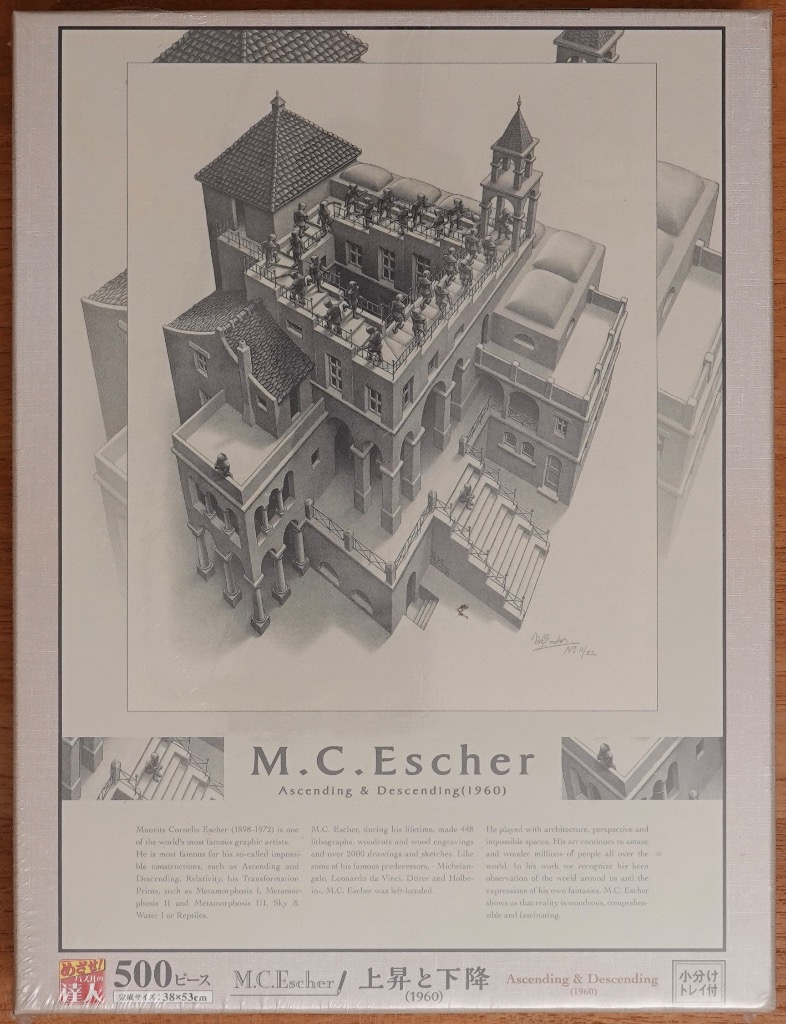
The central artwork depicts a classic impossible structure, a multi-story building featuring a square-shaped roof topped with a never-ending staircase. Small figures are seen walking in a continuous loop up and down the stairs along the top perimeter, a visual paradox where the walkers neither gain nor lose elevation despite their constant movement. The architectural design is heavy and monastic, featuring tile-roofed sections, arched doorways, and stone balustrades.
Rendered in a muted monochromatic palette of graphite greys and off-whites, the illustration employs high-contrast shading and clean, technical lines to establish its surreal perspective. The scene is viewed from an elevated, isometric-like angle, emphasizing the geometric precision of the structure. The stark lighting enhances the three-dimensional illusion, casting soft shadows that ground the impossible building while simultaneously highlighting the absurdity of its cyclical construction.
This iconic lithograph is a definitive example of optical art, showcasing a masterful manipulation of perspective and impossible geometry. Subtle architectural details, such as the bell tower on one corner and the series of arched support columns beneath the main building, provide a sense of realism that contrasts sharply with the logically impossible staircase. The artwork is framed within a simple white border, creating a clean focus on the structural complexity and the rhythmic, repetitive motion of the figures walking along the roofline.