Nr. 4
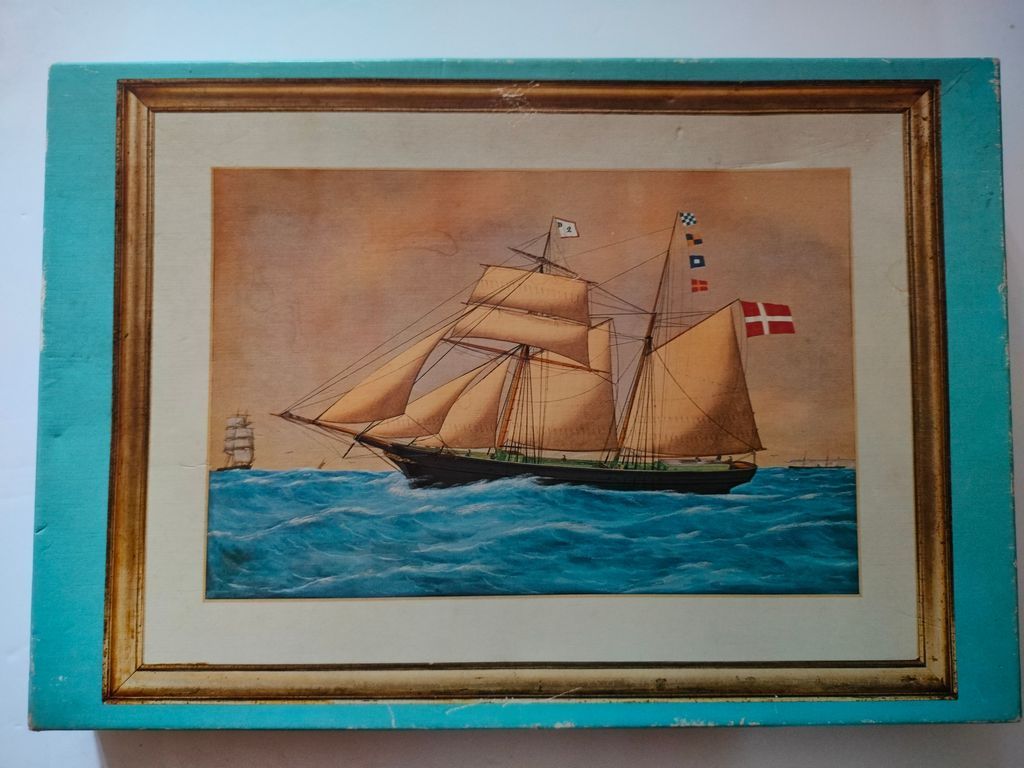
The central focus is a two-masted sailing vessel, depicted in a classic maritime painting style, navigating across choppy, deep blue waves. The ship, which has a dark hull and distinctively tan-colored sails, is shown in profile, angled slightly toward the viewer. Flying from the rear mast is a prominent red flag with a white cross, identifying it as the Danish flag, while a vertical string of smaller, colorful signal flags flutters from the same mast.
The artwork is set against a soft, warm-toned horizon that transitions from a light beige to a gentle amber or pale sunset hue. The sky is largely clear and lacks dramatic clouds, providing a serene backdrop that contrasts with the rhythmic, churning movement of the ocean waves below. The overall composition is balanced and traditional, characteristic of nautical art from the 19th or early 20th century.
In the distance, on the far left, a faint silhouette of another, smaller ship can be seen, adding a sense of depth and scale to the vast sea. The illustration is framed within a double border: an internal, intricate wood-toned frame surrounding the artwork itself, and an outer border of solid, worn teal paint. The style appears to be a vintage watercolor or gouache painting, emphasizing the weathered elegance of maritime historical vessels.
The visual presents a clean, minimalist layout dominated by bold, blue text printed on a solid white surface. The composition is vertically aligned and centered, adhering to a formal, instructional, or documentary style. There are no illustrations, graphics, or photographic elements, as the entire focus remains on the typography and the information provided.
The text begins with two words at the top, "Irma" and "PUSLESPIL," followed by a title in a slightly larger, italicized serif font: "Sejlskibe ...og deres historie." Beneath this, the author's name, "Lars Rostrup Bøyesen," is clearly displayed. The bottom third of the area features a paragraph of descriptive text in a smaller, sans-serif font, providing historical context regarding the challenges of life at sea before the invention of motorized propulsion.
The overall mood is professional, academic, and austere. The stark contrast between the deep blue ink and the plain white background creates a high degree of readability and a sense of classic, understated design. The paper shows slight signs of handling, with subtle creases visible near the edges, adding a tactile, authentic quality to the presentation.
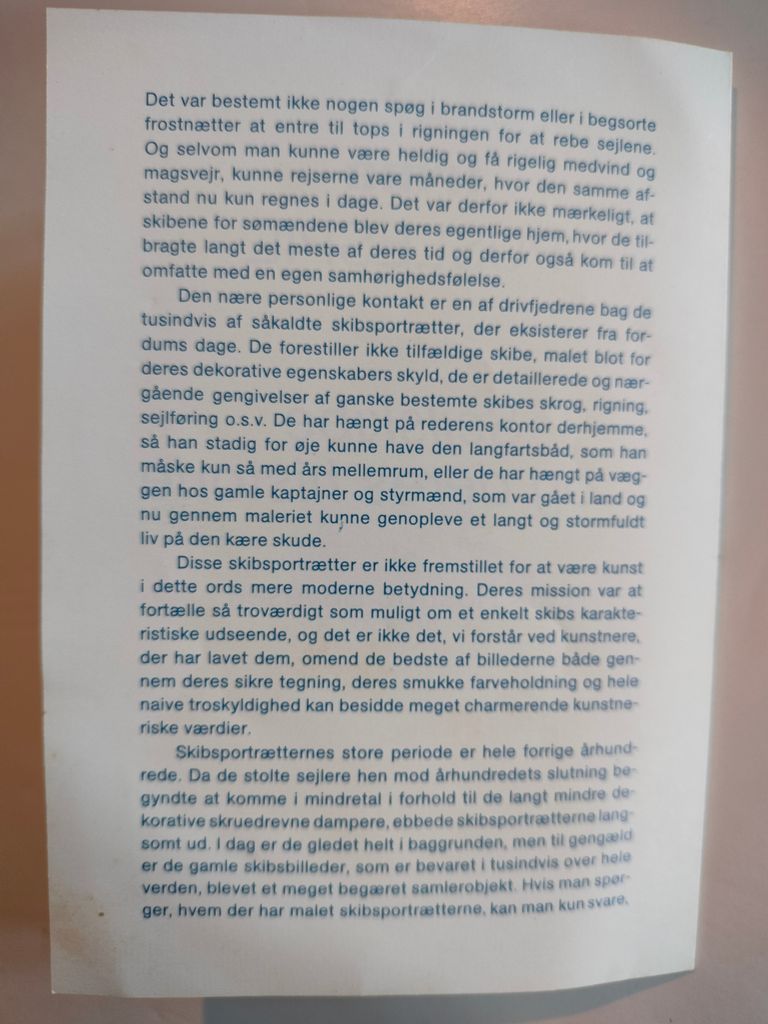
This image displays a vertically oriented piece of paper featuring a block of printed text in Danish. The text consists of four distinct paragraphs, centered on the page with even margins on the left and right sides. The content discusses the historical significance of ship portraits, explaining how these paintings served as sentimental connections for sailors and shipowners to their vessels, often detailing specific rigging and hull designs.
The typography is a clean, dark sans-serif font set against an off-white or light-gray background. The lighting is relatively even, though a subtle gradient shadow appears along the bottom and right edges of the page, suggesting a soft light source from the upper left. The composition is entirely text-based, organized in a traditional block format common for historical notes or exhibition labels.
The text reflects on the transition from sail to steam-powered ships, noting that as traditional sailing vessels declined in the previous century, these portraits evolved from functional records into sought-after collector's items. The tone of the passage is informative and nostalgic, exploring the intersection of maritime history and the artistic preservation of nautical vessels.
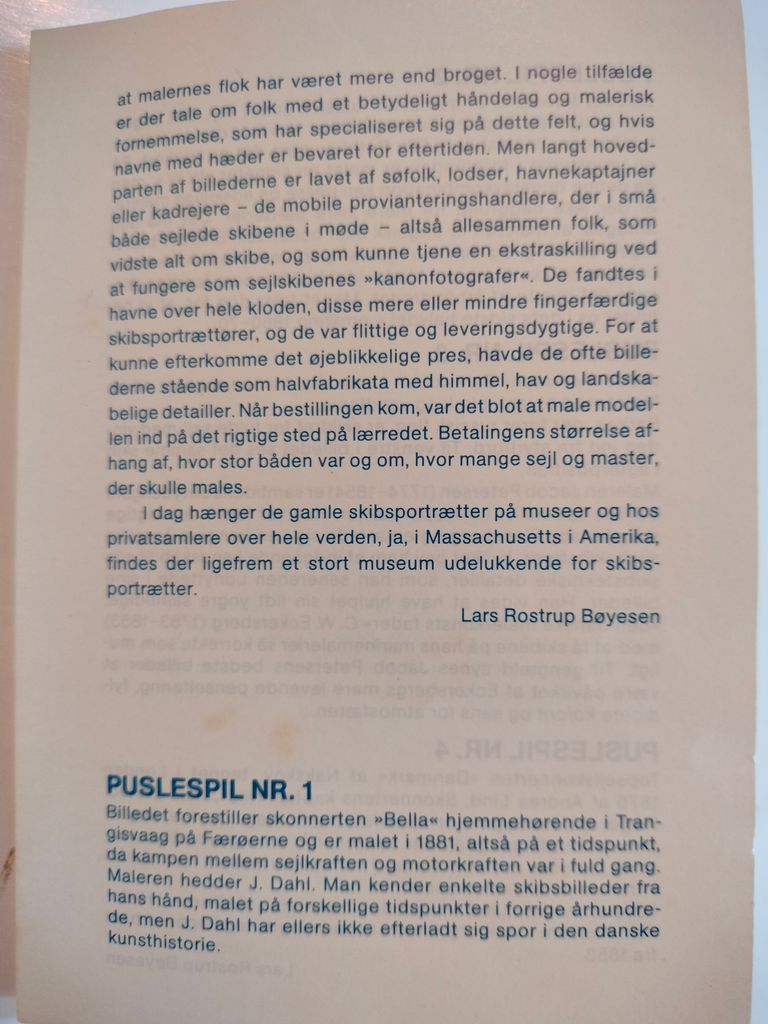
This document contains a block of informational text printed in Danish, set against a plain, off-white background. The composition is straightforward, consisting of several paragraphs of black type that provide historical context regarding maritime art. The text explores the tradition of itinerant artists and sailors who produced ship portraits, explaining their techniques for meeting customer demand and the legacy of these works in modern museums.
The document concludes with a distinct section titled "PUSLESPIL NR. 1." This segment focuses on a specific maritime subject: a schooner named "Bella" from Trangisvaag, Faroe Islands, painted in 1881 by an artist named J. Dahl. The text notes that this painting captures a historical moment during the transition between sail and motor-powered vessels. It briefly mentions that while some of Dahl’s work remains, the artist is not a prominent figure in Danish art history. The overall mood is academic, historical, and descriptive.
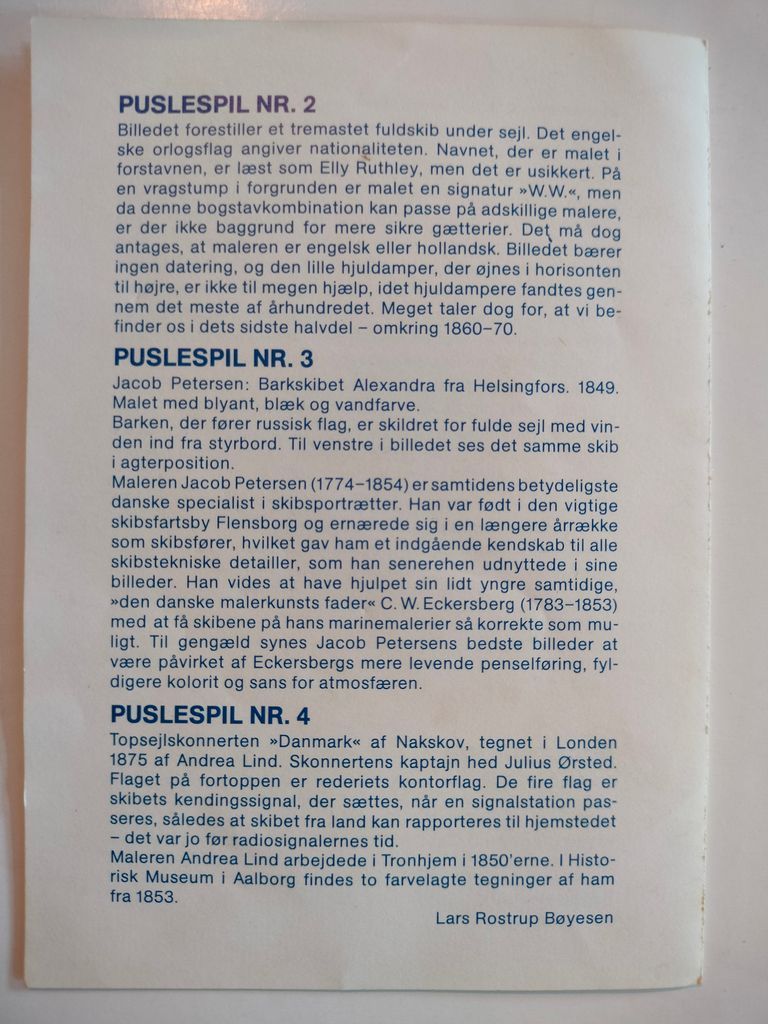
This document contains descriptive text organized into three distinct sections labeled 'PUSLESPIL NR. 2', 'PUSLESPIL NR. 3', and 'PUSLESPIL NR. 4'. The text is presented in Danish and provides historical context, artist attributions, and details about various maritime subjects.
The first section discusses an illustration of a three-masted ship flying an English flag, noting potential uncertainty regarding the ship's name and the artist's identity. The second section focuses on a work by Jacob Petersen depicting a Russian-flagged barque named 'Alexandra', detailing the ship's orientation and mentioning the artist's background as a ship captain and his influence on contemporary marine painting. The final section describes an illustration of a schooner named 'Danmark', detailing its historical signal flags and identifying the artist as Andrea Lind, who worked in Trondheim during the 1850s.
The document is printed in a dark sans-serif font against a light, off-white background. The layout is clean and utilitarian, serving as a catalog or informational sheet to accompany visual works. The overall mood is academic and informative, focusing on the preservation and historical documentation of maritime art.
by Quanjerpuzzles 2024-01-06