Geopoliticus Child Watching the Birth of the New Man
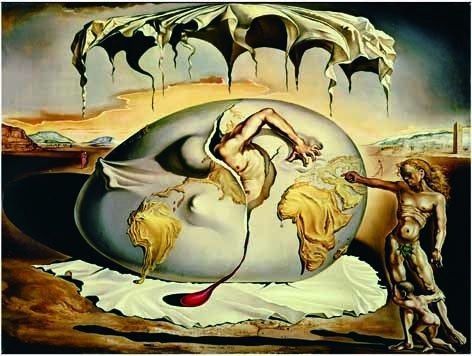
The central focus of this surrealist image is a massive, cracked egg resting on a white cloth in the middle of a desolate landscape. A human torso, characterized by muscular definition and a pained expression, emerges from the jagged opening of the egg. The shell itself is transformed into a map, with golden, raised continents draped across its smooth, pale surface. A single, distinct drop of bright red liquid drips from the crack onto the cloth below.
To the right of the egg, an emaciated, androgynous figure stands pointing toward the globe with an elongated finger, while a small child clings to their leg. Above the entire scene, a heavy, tattered fabric shroud hangs like a canopy, casting deep shadows over the desert environment. The composition is balanced but unsettling, placing the massive egg in the foreground against a vast, hazy horizon that fades into a murky, yellowish sky.
The mood is one of profound isolation and symbolic mystery, characteristic of mid-twentieth-century surrealist art. The color palette relies heavily on earth tones—ochre, tan, and brown—which contrast sharply with the stark white of the cloth and the vibrant, singular splash of red. The lighting is diffused and dreamlike, emphasizing the smooth, organic textures of the figures against the rugged, barren ground. Every element contributes to a sense of birth, fragmentation, and existential questioning.