Reddish Egret
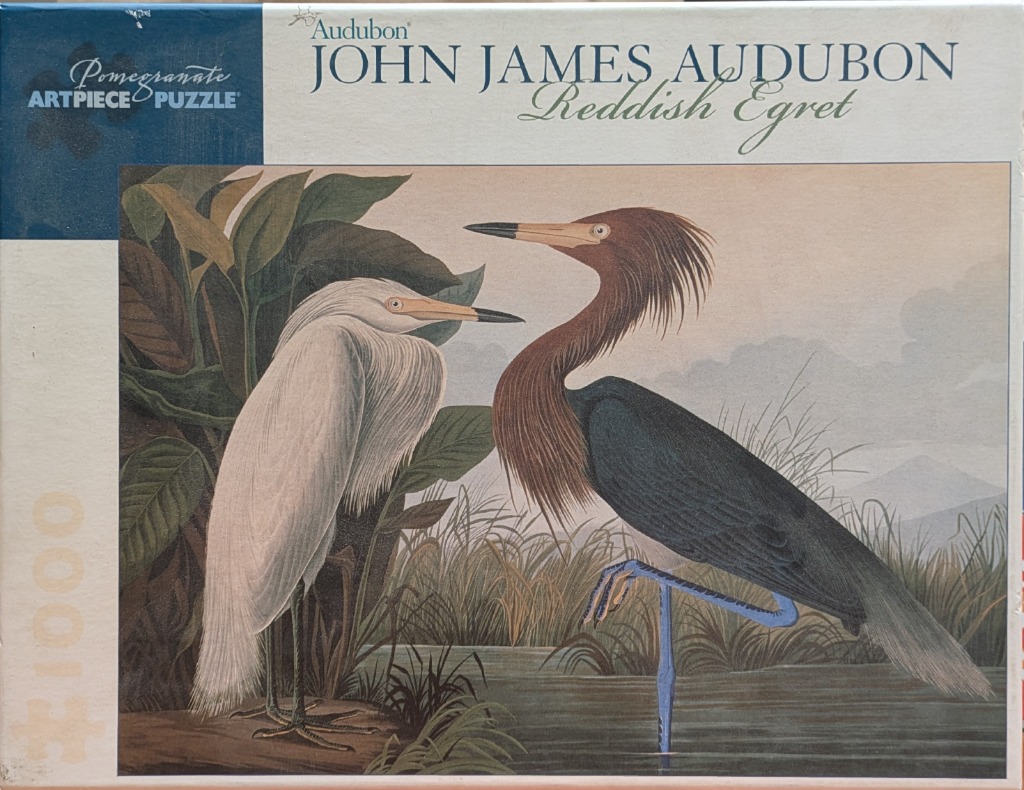
This natural history illustration depicts two egrets in a shallow, marshy wetland setting. On the left stands a white egret with long, flowing plumage and a sharp, yellowish bill, poised on the muddy bank among lush, broad-leafed plants. To its right, a second egret is captured wading in the water, balancing on one leg. This bird features a distinctive, shaggy reddish-brown head and neck, contrasting with a dark, slate-grey body and striking, pale blue legs.
The composition is balanced and scholarly, typical of 19th-century ornithological art. The birds face each other, creating an elegant interaction within the frame. The background is softly rendered, featuring a muted, misty atmosphere with faint silhouettes of distant hills or low dunes under a pale, neutral sky, which draws the focus firmly onto the detailed textures of the birds' feathers.
Rendered in a classic, refined illustrative style, the piece emphasizes scientific precision. The colour palette is dominated by earthy tones, muted greens, and soft beiges, punctuated by the bold, dark plumage of the second egret and its bright, unusual blue legs. The lighting is diffuse and even, suggesting a calm day in the coastal marshes. Every line, from the delicate feathering of the white egret to the crisp details of the reeds in the foreground, is executed with meticulous care.