Train
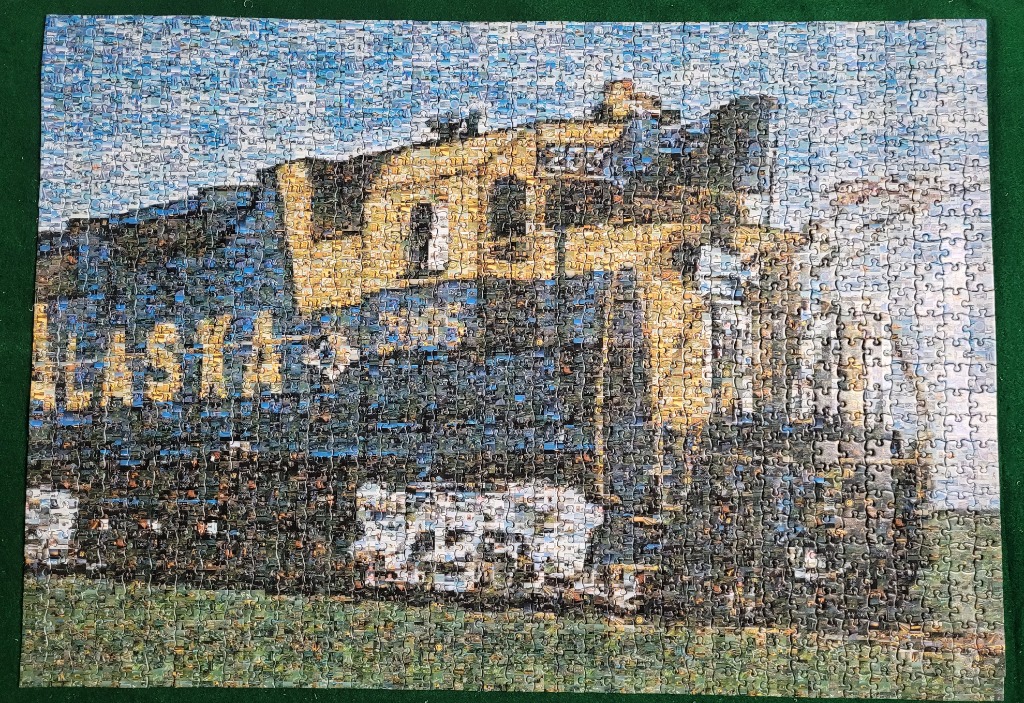
This image depicts a side-profile view of a heavy-duty diesel locomotive belonging to the Alaska Railroad. The train engine is painted in a distinctive color scheme of deep navy blue and vibrant yellow, with the word "ALASKA" clearly visible in bold lettering along the side of the body. The engine sits on a grassy plain under a wide, expansive sky.
The artistic style is highly textured and reminiscent of post-impressionist pointillism or mosaic art. The entire scene is constructed from small, distinct flecks of color that merge to form the shape and shadows of the locomotive. The sky above is a mosaic of varied shades of blue and white, suggesting a bright, breezy day. The grass below is rendered in earthy tones of green and brown.
Lighting and composition focus on the massive front and side body of the train, which dominates the foreground. The interplay of dark blues and bright, sunlight-struck yellows creates a strong sense of mechanical weight and depth. The brushwork, or textural application of color, gives the metallic surfaces of the engine a shimmering, vibrant quality that contrasts with the static, solid nature of the heavy machinery.
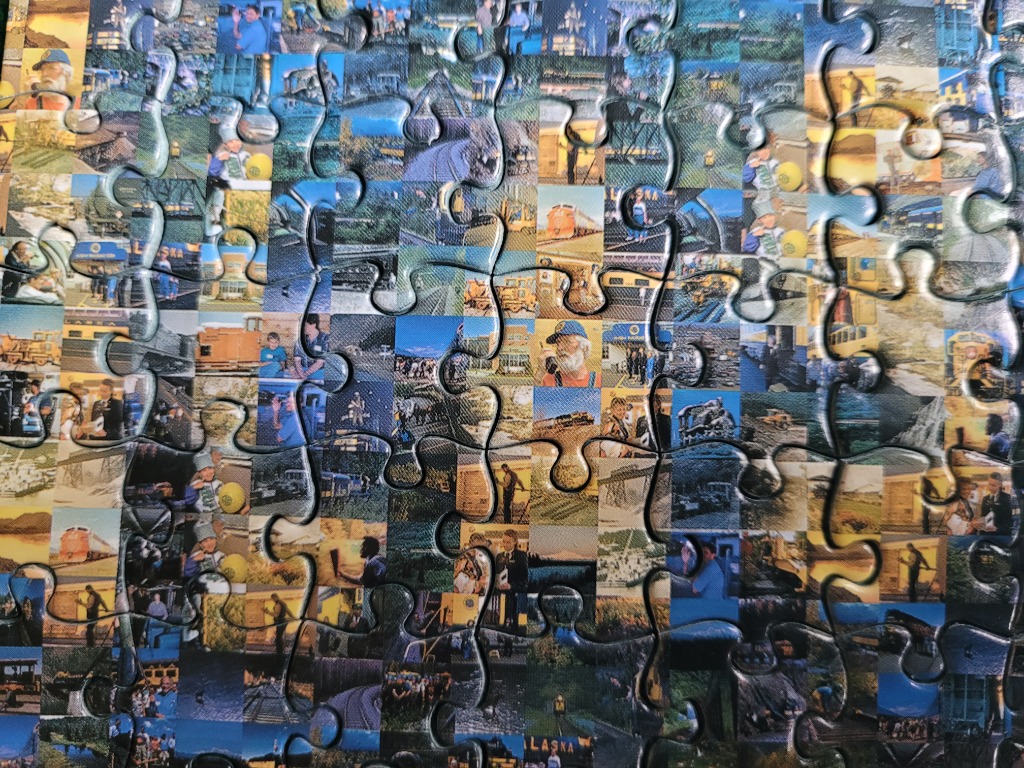
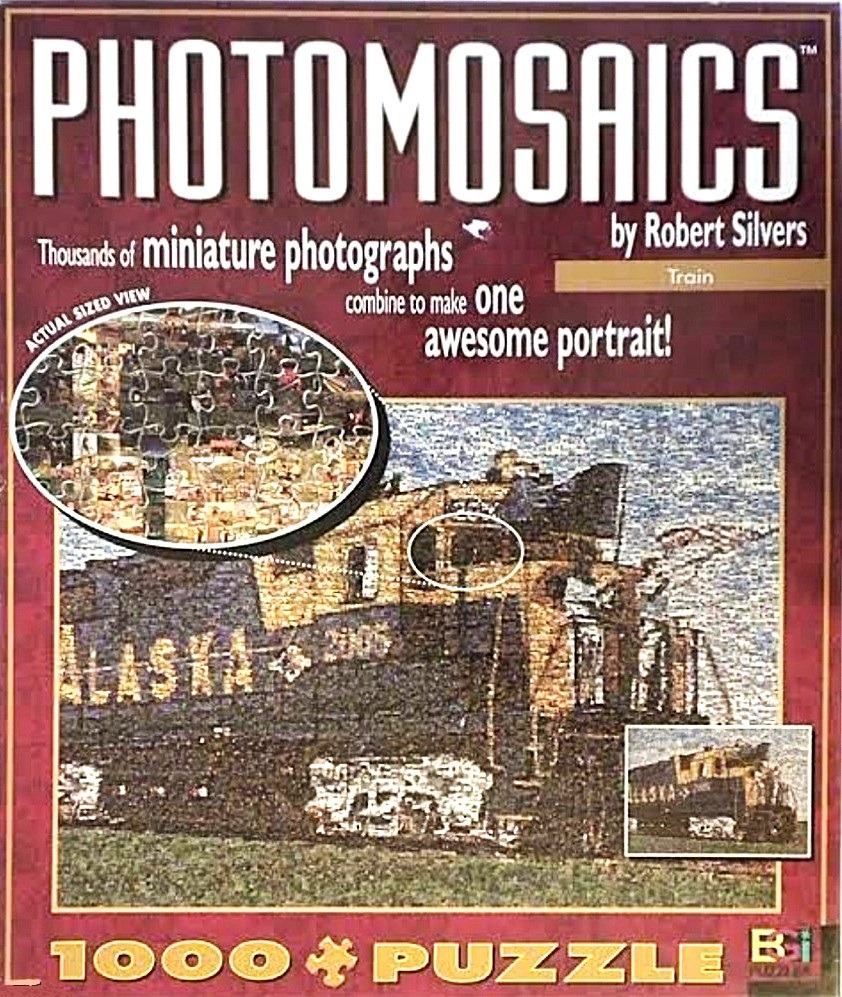
The central artwork is a large-scale photomosaic of an Alaska Railroad locomotive. The image captures the front and side profile of the train engine, which is primarily painted in deep blue and yellow. The texture of the train is not rendered through solid brushstrokes, but is instead composed entirely of thousands of miniature, distinct photographs, creating the illusion of a larger scene when viewed from a distance.
Technically, the piece demonstrates a mosaic style where individual photographic tiles are color-balanced and arranged to mimic the light, shadow, and mechanical details of the train. The yellow areas on the engine are formed by bright, warm-toned small photos, while the dark blue sections are composed of cooler, shadowed images. This creates a compelling interplay between the macro view of the entire train and the micro view of the seemingly random, individual images that make up the whole.
A magnifying glass effect is superimposed on the upper left, showing a cropped, zoomed-in portion of the mosaic where the individual puzzle pieces and the tiny photos themselves are clearly visible. A smaller inset box in the lower right corner displays a standard view of the same locomotive. The overall aesthetic is one of complex digital artistry, blending geometric precision with photographic detail to construct a singular, recognizable subject from a vast collection of smaller, disparate visual elements.