Moon
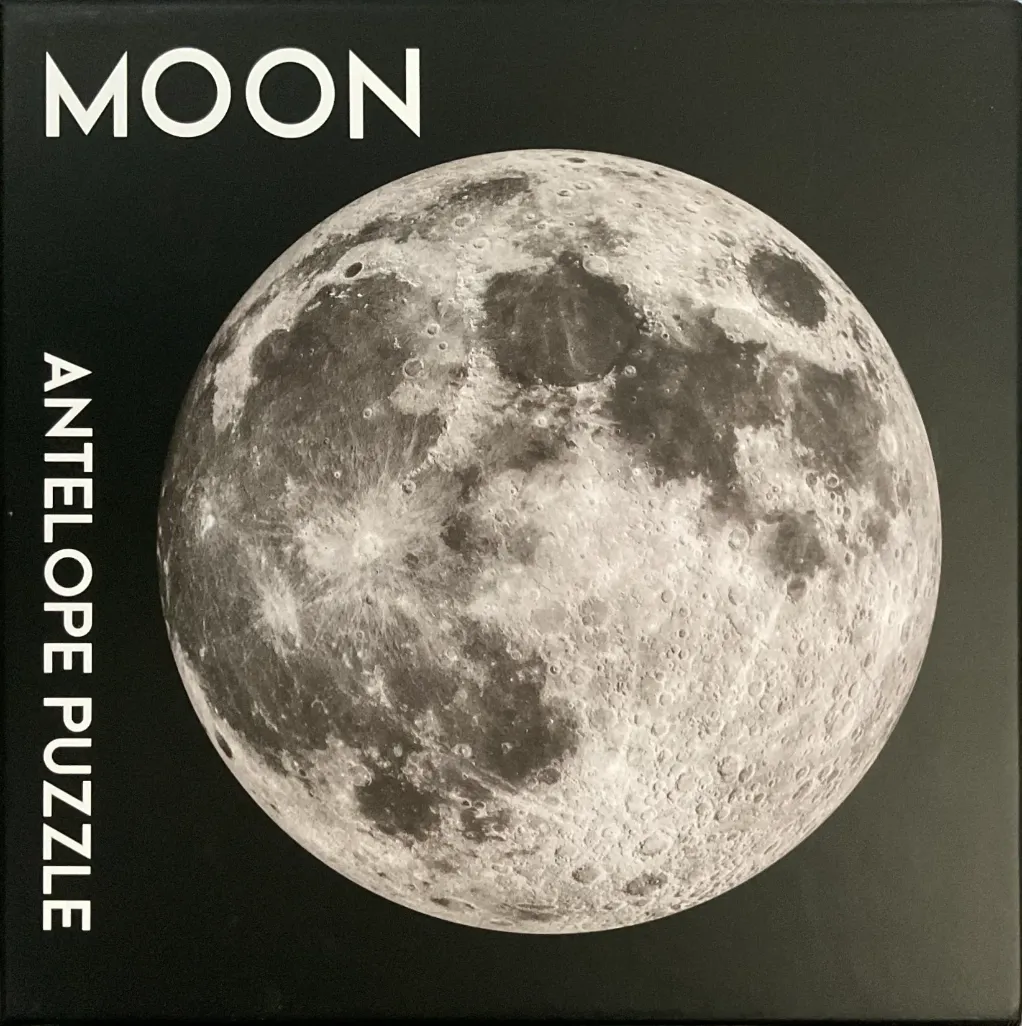
The central focus of this image is a detailed, high-contrast photographic portrait of the moon, rendered in shades of grey, white, and black. The celestial body is presented as a near-perfect sphere, showcasing the intricate topography of its surface. Numerous craters, maria (dark basaltic plains), and ray systems are clearly visible, particularly the prominent Tycho crater with its bright, radiating streaks extending across the southern hemisphere.
Compositionally, the moon occupies the majority of the right side of the frame, set against a stark, solid black background that emphasizes its circular form. This monochromatic palette creates a minimalist and dramatic aesthetic, stripping away all atmospheric interference to focus purely on lunar texture and geometry.
To the left of the sphere, the text "MOON" is printed in a clean, white, sans-serif font at the top, while "ANTELOPE PUZZLE" appears vertically along the left edge. The image is a crisp, high-resolution capture that mimics a professional space photograph, highlighting the contrast between the luminous, textured surface of the moon and the absolute void of the surrounding space.
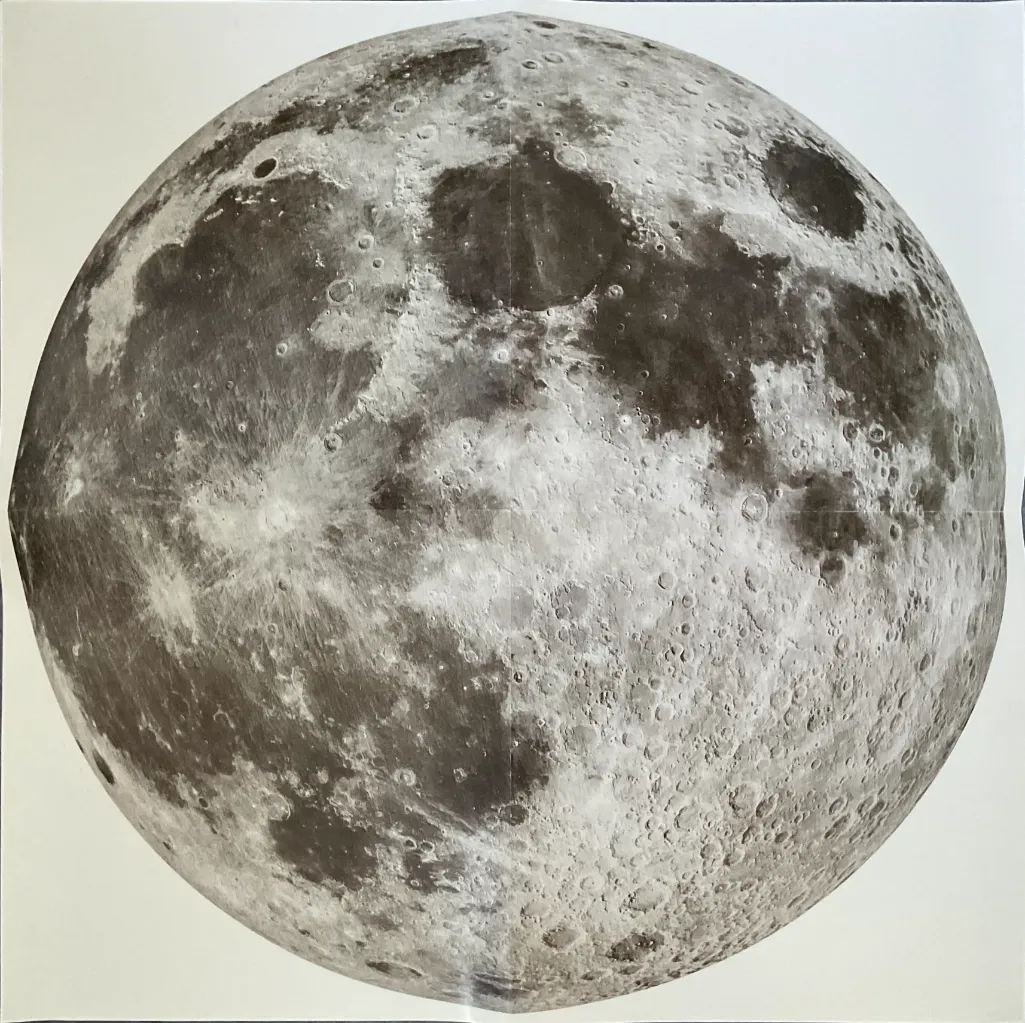
This high-contrast image features a centered, circular view of the full moon. The lunar surface is rendered in intricate detail, showcasing a complex map of the celestial body's geography. Large, dark, low-lying maria dominate the upper and central portions of the sphere, contrasting sharply with the brighter, densely cratered highlands. The interplay of light and shadow highlights the rugged texture of the landscape, revealing a multitude of circular impact craters ranging from vast, prominent basins to tiny, peppered pockmarks.
Compositionally, the moon is isolated against a clean, stark white backdrop, making it the sole focal point. The sphere is presented in a monochromatic palette of greys, whites, and deep blacks, emphasizing the starkness of the lunar environment. A faint, vertical and horizontal cross-section suggests the folding of the underlying surface, adding a physical dimension to the otherwise celestial subject. The overall mood is one of scientific precision and observational wonder, presenting the moon as a vast, textured world frozen in space.
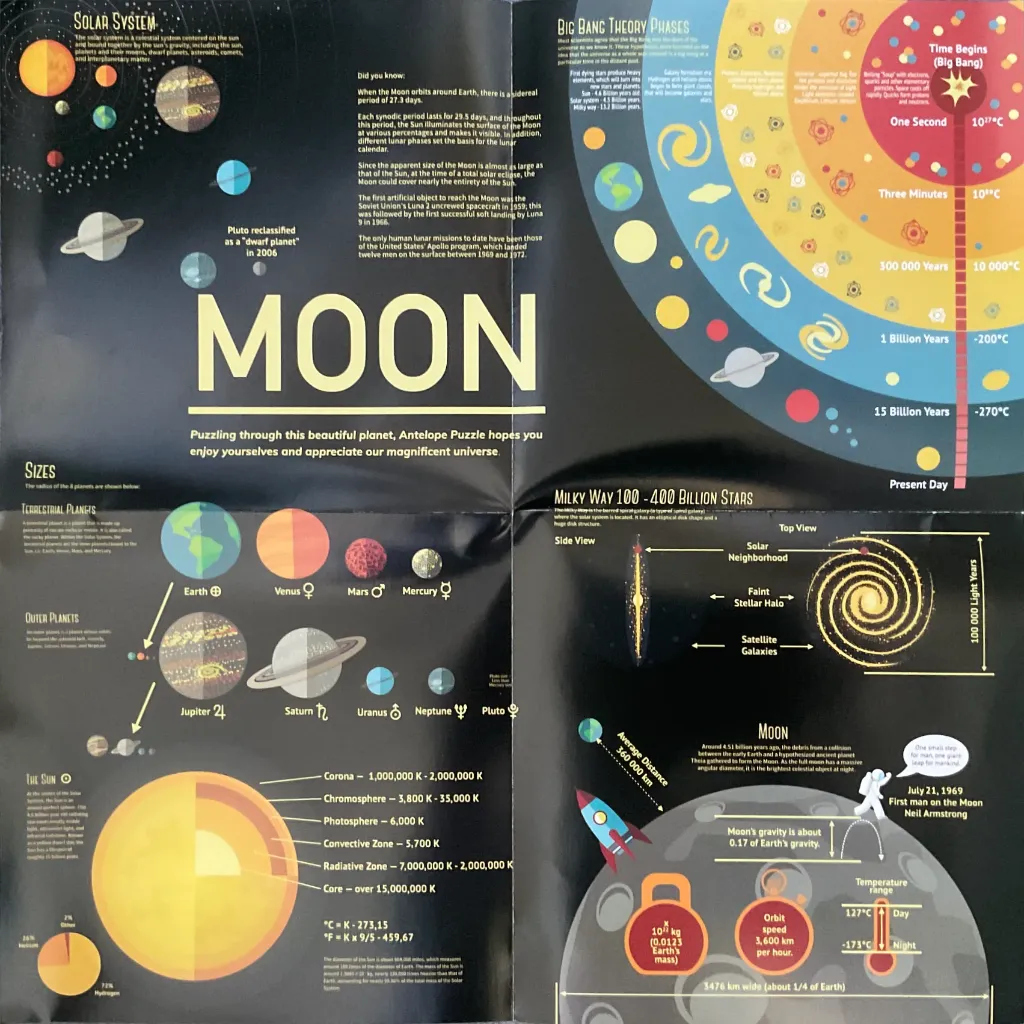
This educational infographic features a dark, space-themed background filled with various charts and diagrams related to astronomy. Centered prominently is the word "MOON" in large, sans-serif yellow letters. The layout is divided into sections, with the top left showing a graphical representation of the solar system, while the top right details the phases of the Big Bang, illustrated with a timeline that marks progress from "Time Begins" to "Present Day" alongside corresponding temperatures.
The bottom section is organized into three primary areas. On the left, it displays comparative diagrams for terrestrial and outer planets, along with a layered cross-section of the Sun and its associated temperature zones. The right side includes a top-down and side-view diagram of the Milky Way galaxy.
The bottom right corner focuses specifically on the Moon. It features a large, grey lunar sphere and includes facts about its distance, gravity, surface temperature, and orbital speed. A small, stylized figure of an astronaut stands on the surface, commemorating the first moon landing. Throughout the entire piece, thin lines and text annotations provide scientific context, figures, and data, using a clean, modern aesthetic with a color palette dominated by black, yellow, white, and muted planetary tones.