Pete's Gambling Hall
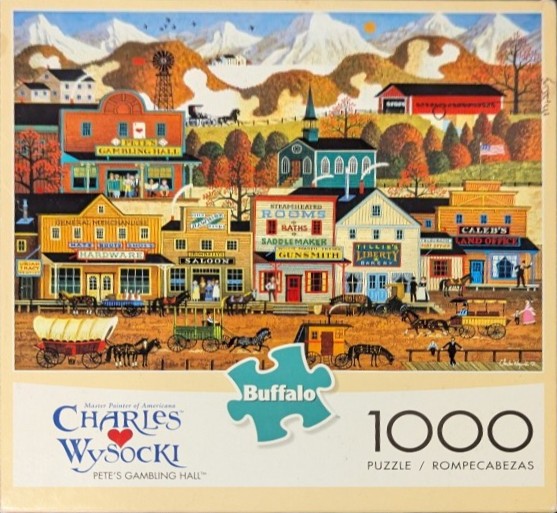
This folk art illustration depicts a lively Old West town nestled at the base of snow-capped mountains. The foreground features a wide dirt road occupied by horse-drawn wagons, stagecoaches, and figures in period attire. The town itself is composed of a series of wooden storefronts, including "Pete's Gambling Hall," a hardware store, a saloon, and a gunsmith, all rendered with distinct architectural details and period signage. A church with a slender steeple stands prominently behind the main street, while a windmill and a rustic red barn are visible on the hillside.
The composition is layered, moving from the busy activity of the town street up to rolling, autumnal hills filled with orange and brown trees. The backdrop is dominated by jagged, snow-dusted mountains under a clear blue sky with a bright sun. The scene uses a warm color palette of earthy browns, golden yellows, and terracotta reds, punctuated by the deep greens of the trees and the white of the mountain peaks.
The style is classic American folk art, characterized by clear, bold outlines and a whimsical, storybook quality. The perspective is slightly flattened, allowing for a comprehensive view of the entire village. The lighting suggests a crisp, clear day, casting soft shadows beneath the wagons and buildings, enhancing the depth and nostalgic, idyllic atmosphere of the scene.
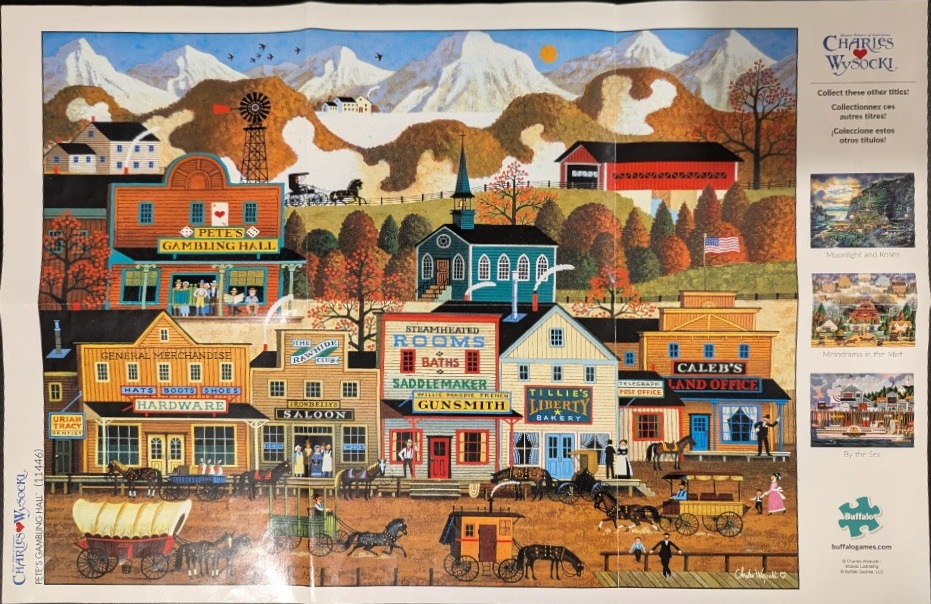
This detailed folk art illustration depicts a quaint 19th-century American frontier town nestled at the base of majestic, snow-capped mountains. The scene is filled with a variety of wooden buildings typical of the Old West, including "Pete's Gambling Hall," a "General Merchandise" store, a "Gunsmith," and "Caleb's Land Office." A dirt road runs through the center of the town, bustling with activity, including horse-drawn carriages, covered wagons, and figures dressed in period-appropriate attire.
The composition is layered, placing the town buildings in the foreground and mid-ground, while the rolling foothills and a bright sun in the sky serve as the backdrop. The architecture is charming and colorful, featuring painted signs, porches, and intricate trim. A church with a steeple stands prominently among the wooden structures, and a red covered bridge is visible in the middle distance. The scene is bathed in a warm, autumnal light, with trees exhibiting fall foliage of oranges, yellows, and deep greens.
The style is highly decorative and narrative, characteristic of American folk art. There is a sense of busy, peaceful community life, with small figures interacting in front of shops and livestock or horses tethered to hitching posts. The overall color palette is rich and earthy, using warm browns, deep blues, and accents of red to unify the scene. The lighting suggests a bright, crisp day, casting soft shadows that enhance the three-dimensional feel of the buildings and carriages.
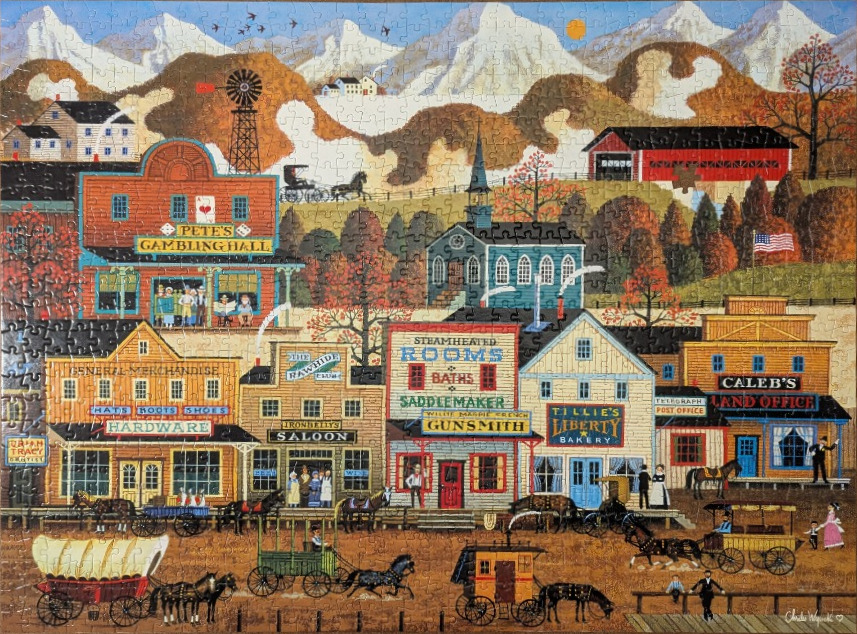
This nostalgic illustration depicts a vibrant American Old West town nestled at the base of dramatic, snow-capped mountains. The foreground features a dusty main street lined with classic wooden storefronts, including a general merchandise store, a gunsmith, a saloon, and a land office. Several horse-drawn carriages and wagons traverse the street, while residents in period attire stand on boardwalks or walk along the road.
The composition is layered, moving from the busy storefronts of the town center up to a slight incline where a church and a red covered bridge sit amidst autumn-hued trees. In the distance, the landscape is defined by rolling, golden-brown hills that lead the eye toward the towering, craggy peaks under a clear sky. A lone, bright sun hangs in the corner of the sky, casting a warm glow over the entire scene.
The artwork uses a rich, autumnal colour palette dominated by warm oranges, deep reds, golden browns, and earthy tones, which contrast beautifully with the cool whites and greys of the distant mountains. The style is detailed and folk-art inspired, with clear outlines and a whimsical, storybook quality that emphasizes the charm of frontier life. Small details like signage for "Pete's Gambling Hall" and "Tillie's Liberty Bakery" add character and depth to this idealized historical setting.
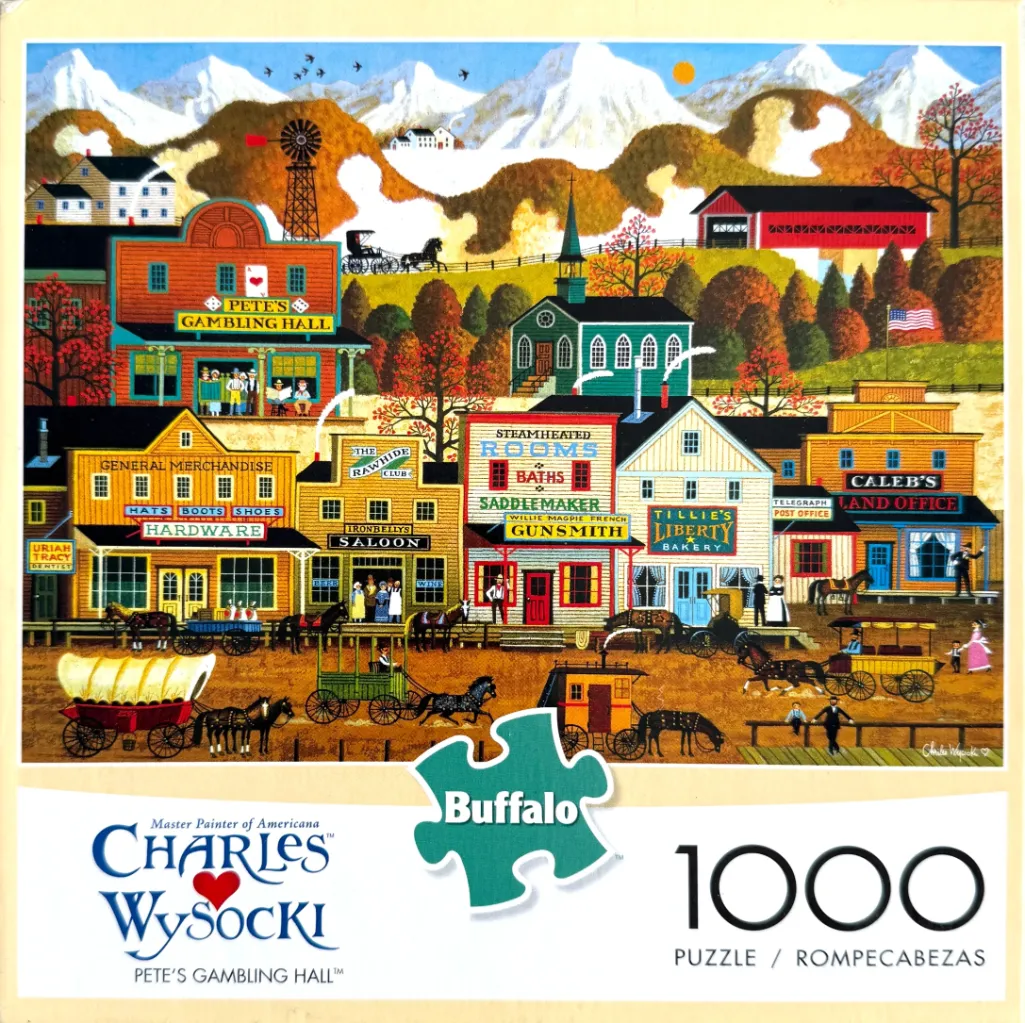
This folk-art illustration depicts a charming, bustling Western town set against a backdrop of majestic, snow-capped mountains. The composition features a horizontal row of colorful, distinct buildings typical of the American frontier, including Pete's Gambling Hall, a gunsmith, a bakery, and a land office. In the foreground, a dusty dirt street is populated with various horse-drawn carriages, wagons, and townspeople dressed in period clothing. A windmill stands near the gambling hall, while a church spire rises gracefully in the middle distance.
Beyond the town, a rolling landscape transition from autumn-colored trees to the grand, craggy peaks under a clear blue sky. A single sun is visible near the top right, and birds are scattered across the upper portion of the sky. To the far right, a large red barn sits prominently on a hillside, adding to the rural, pastoral feel of the scene.
The style is quintessentially American folk art, characterized by clean lines, flat perspective, and a vibrant, warm color palette. Earthy tones of ochre, burnt orange, and deep brown dominate the ground and structures, contrasted by the sharp white of the distant mountains and the clear blue sky. The overall mood is nostalgic and whimsical, capturing a snapshot of historic small-town life with intricate detail and a cheerful, storybook quality.

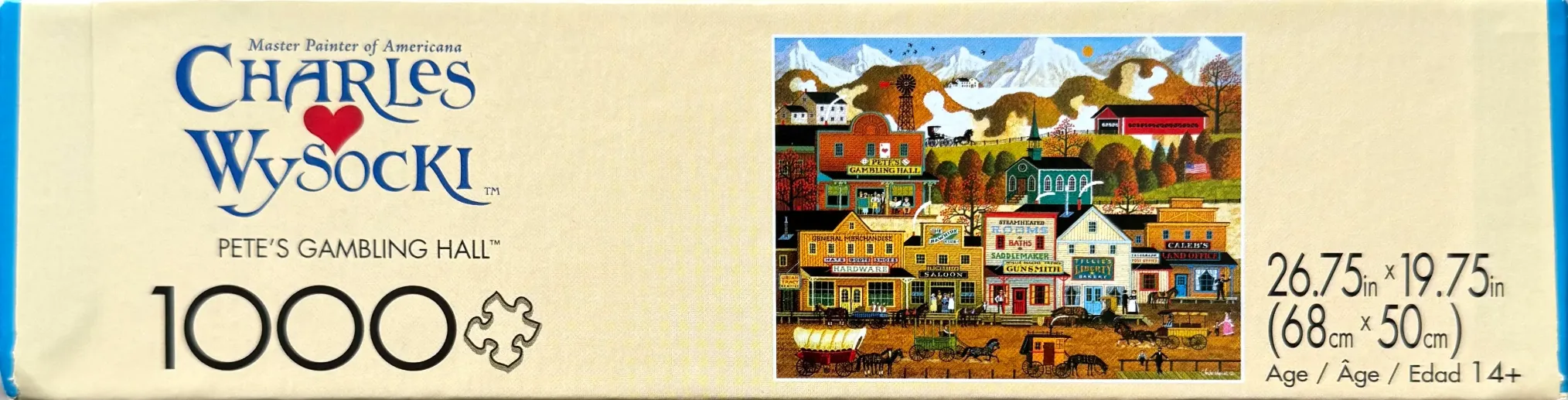
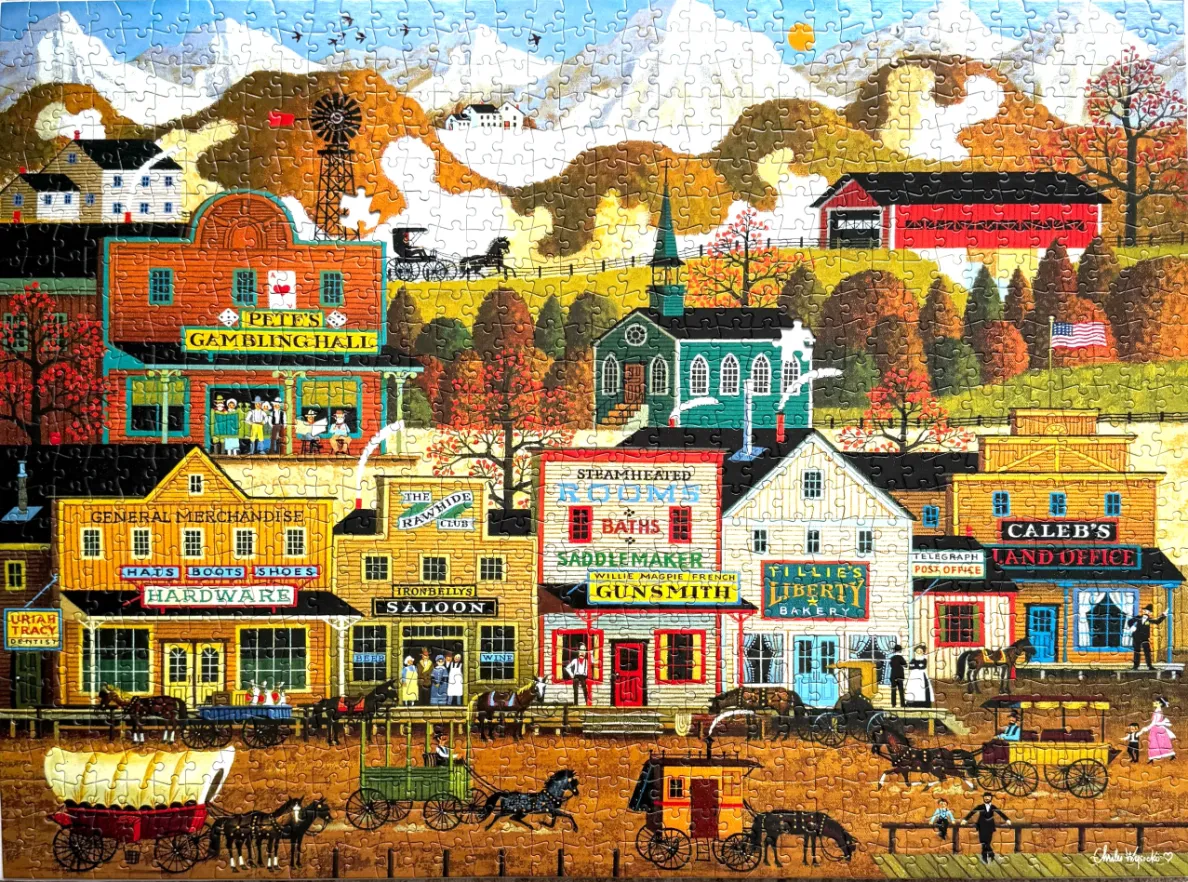
This illustration depicts a quaint 19th-century American frontier town set against a backdrop of rolling, golden-brown autumn hills and snow-capped mountains. The foreground is alive with activity, featuring a row of wooden buildings lining a dusty street. Notable storefronts include "Pete’s Gambling Hall," a general merchandise store, "Ironbelly’s Saloon," a gunsmith, and a liberty bakery. People dressed in period-appropriate attire walk the wooden sidewalks, while horse-drawn carriages and stagecoaches traverse the foreground.
Compositionally, the town is anchored by a teal-coloured church in the middle ground, adding vertical interest to the scene. To the far left stands a tall windmill, and to the right, a large red covered bridge spans a gentle hill. The architectural style is rustic and varied, with vibrant colours like yellow, red, and blue distinguishing the individual shop fronts from one another.
The colour palette is warm and saturated, dominated by the rich oranges, yellows, and deep greens of an autumn landscape, contrasted by the cool blue of the sky and the church. The lighting suggests a bright, crisp day, with a small sun hanging in the upper sky. The artistic style is reminiscent of folk art, characterized by clear outlines, charmingly stylized figures, and a focus on nostalgic storytelling. The overall mood is peaceful and industrious, capturing the lively spirit of a bygone era in a charming, idyllic setting.
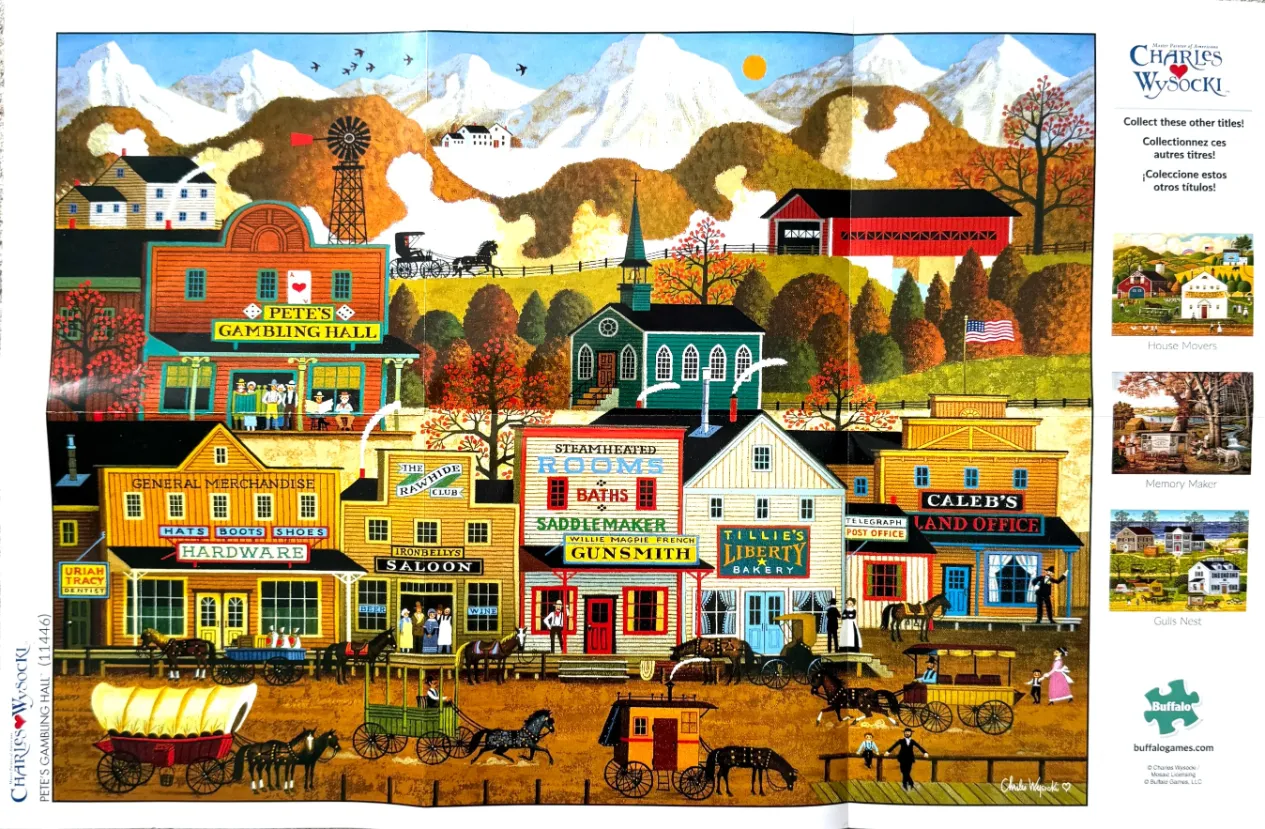
This vibrant folk-art scene depicts a bustling main street in a 19th-century American town, framed by rolling golden hills and distant, snow-capped mountains under a clear blue sky. The composition is anchored by a row of diverse wooden storefronts, each painted in distinct colors and adorned with bold, hand-painted signage. Notable businesses include Pete’s Gambling Hall, a Hardware store, a Gunsmith, and Caleb’s Land Office. A church with a steeple rises behind the storefronts, and a covered bridge sits nestled among the autumn-colored trees in the background.
The foreground street is busy with activity, featuring horse-drawn carriages, a covered wagon, and local residents dressed in period clothing going about their daily business. The warm, inviting color palette emphasizes an autumn season, with rich browns, ochres, and hints of fiery red foliage contrasting against the cool white of the mountains. A tall windmill stands to the left, adding to the rural, period-specific aesthetic.
The artwork uses a flattened, stylized perspective typical of folk art, focusing on decorative detail and narrative charm rather than strict realism. The lighting is soft and even, suggesting a bright, clear day, while the presence of small details like smoke rising from chimneys and various horses tied to hitching posts creates a lively, lived-in atmosphere. The overall mood is one of nostalgic Americana and historical storytelling.
Many similar buildings put this in the midrange of time to complete for a Wysocki puzzle. No quality issues.
by LakeBird 2026-03-29