THE MOON
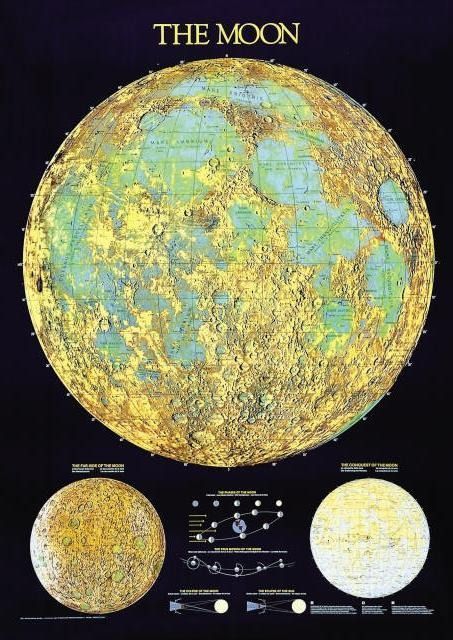
The central focal point of this image is a large, detailed cartographic representation of the Moon against a deep black background. The main lunar sphere is rendered in shades of textured, golden-tan highlands and smooth, light-blue plains, creating a distinct topographical contrast. The entire surface is crisscrossed by a faint grid of longitudinal and latitudinal lines, labeling various craters and maria in a classic scientific style. The title "THE MOON" is prominently displayed in bold, serif capital letters at the very top of the composition.
Beneath the main globe, the space is organized with secondary astronomical data. To the left is a circular view of the Moon's far side, rendered in muted golden hues. To the right sits a smaller, lighter-toned circular map of the lunar surface. Centrally located between these two smaller circles are several diagrams illustrating the phases of the Moon, the far side's orbital path relative to Earth, and a breakdown of lunar and solar eclipses.
The overall aesthetic is that of a vintage educational celestial chart. The high-contrast color palette, featuring bright yellows and blues against the void of space, emphasizes the physical features of the lunar body. Small, precise text and technical diagrams are neatly integrated into the lower third of the layout, giving the image a scholarly, encyclopedic quality.