Ringling Brothers Menagerie
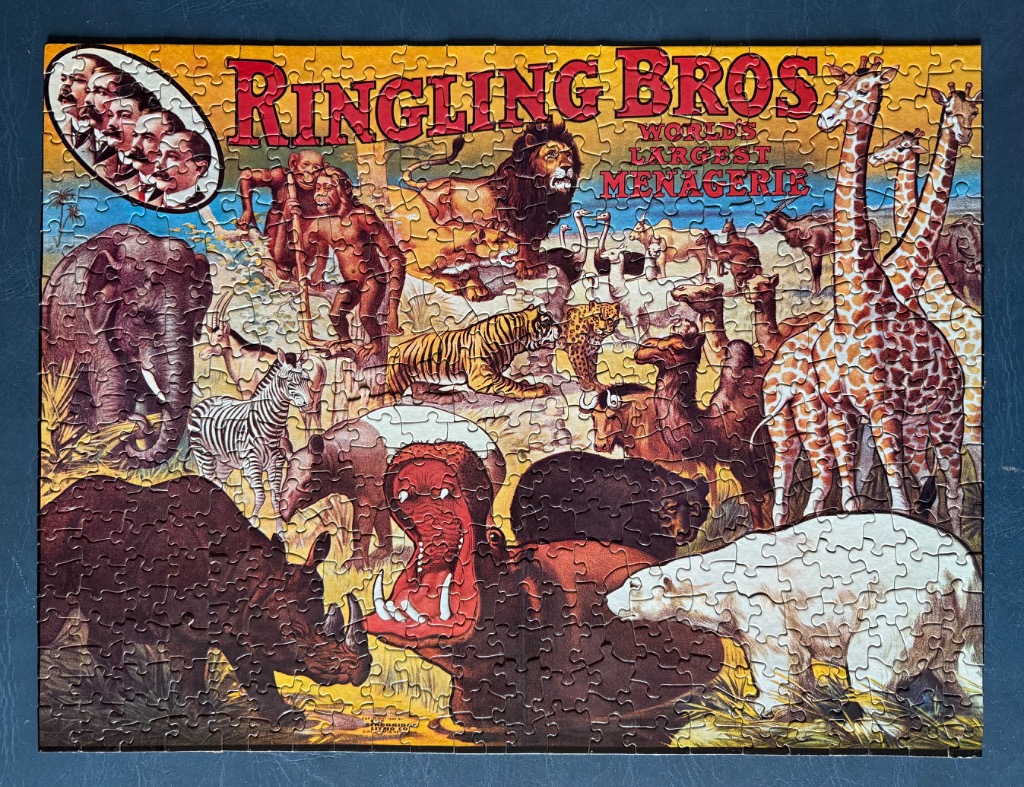
This vintage-style illustration depicts a bustling menagerie of wild animals, presented in the artistic aesthetic of a classic circus advertisement. Large, bold red text across the top reads "RINGLING BROS" and "WORLD'S LARGEST MENAGERIE." In the upper left corner, a circular inset displays the overlapping profile portraits of the five Ringling brothers, set against a creamy, aged-paper background.
The central scene is crowded with a wide variety of animals, including a standing elephant, chimpanzees, a majestic lion, a tiger, a cheetah, a zebra, and a rhinoceros. Towards the bottom center, a large hippopotamus is depicted with its mouth wide open, revealing bright white teeth, while a polar bear stands on the lower right. Two tall giraffes dominate the right side of the frame, their long necks stretching toward the upper edge, complemented by other smaller figures like camels and ostriches integrated into the background.
The colour palette is earthy and warm, utilizing golden yellows, deep browns, and muted natural tones that evoke a sense of nostalgia. The lighting is flat and illustrative, typical of early 20th-century lithography or poster art. The overall composition is dense and tightly packed, creating an energetic and overwhelming display of exotic wildlife designed to capture attention.
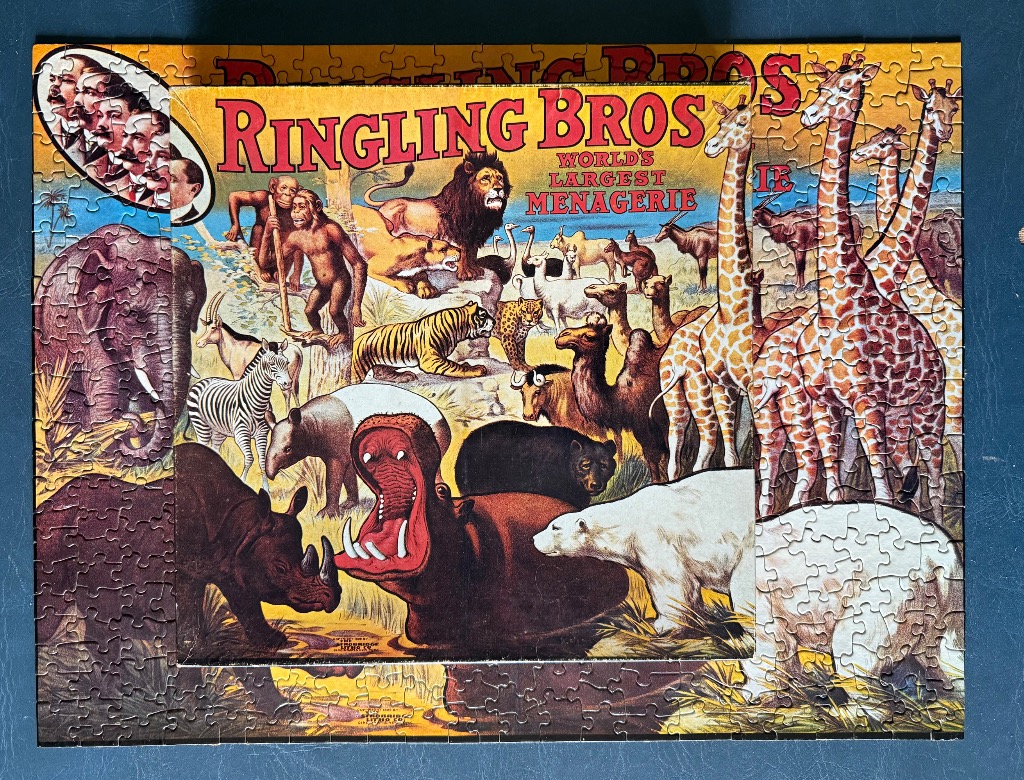
This vintage-style illustration depicts a vast menagerie of wild animals gathered in a stylized, sun-drenched savanna landscape. The composition is densely packed, with creatures arranged in foreground, midground, and background layers to create a sense of scale and variety. At the top of the scene, a majestic lion stands prominently on a rock formation, while a tall giraffe dominates the right side of the frame. In the lower foreground, a rhinoceros and a hippopotamus with its mouth agape command attention, flanked by a polar bear walking toward the edge.
Intermediate layers are filled with a diverse array of species, including apes perched in trees, a pacing tiger, a leopard, a zebra, and several species of antelope, camels, and llamas. The background features a simple, pale horizon line against a soft yellow sky, giving the appearance of an early 20th-century advertisement poster. Text in large, decorative lettering across the top reads "RINGLING BROS" and "WORLD'S LARGEST MENAGERIE," echoing the style of classic traveling show lithographs.
The artwork utilizes a warm, saturated color palette dominated by golden yellows, earthy browns, and deep forest greens, which contrast with the stark white of the zebra, the white tapir patch, and the polar bear. The style is classic commercial illustration, characterized by clear outlines, traditional shading, and a dramatic, theatrical arrangement of the animals that emphasizes their exotic nature and power.

This vertical image displays a black panel featuring white, bold, sans-serif typography set against a stark, solid background. The primary text reads "RINGLING BROTHERS MENAGERIE," arranged vertically from top to bottom in large, capitalized letters. The aesthetic is clean, minimalist, and starkly monochromatic.
Additional informational text is printed in smaller white type along the edges. Toward the top left, the text reads "MORE THAN 500 PIECES/PUZZLE SIZE 18 1/8" x 24 1/8"." Further down, credited to "photo / Joseph Martin / Scala," the design emphasizes the archival nature of the image content. At the bottom, further fine print provides copyright and manufacturing details, including "AN EATON JIGSAW PUZZLE FROM THE TREASURE COLLECTION" and location information. The overall composition is functional and structured, designed for easy identification of the item on a shelf.
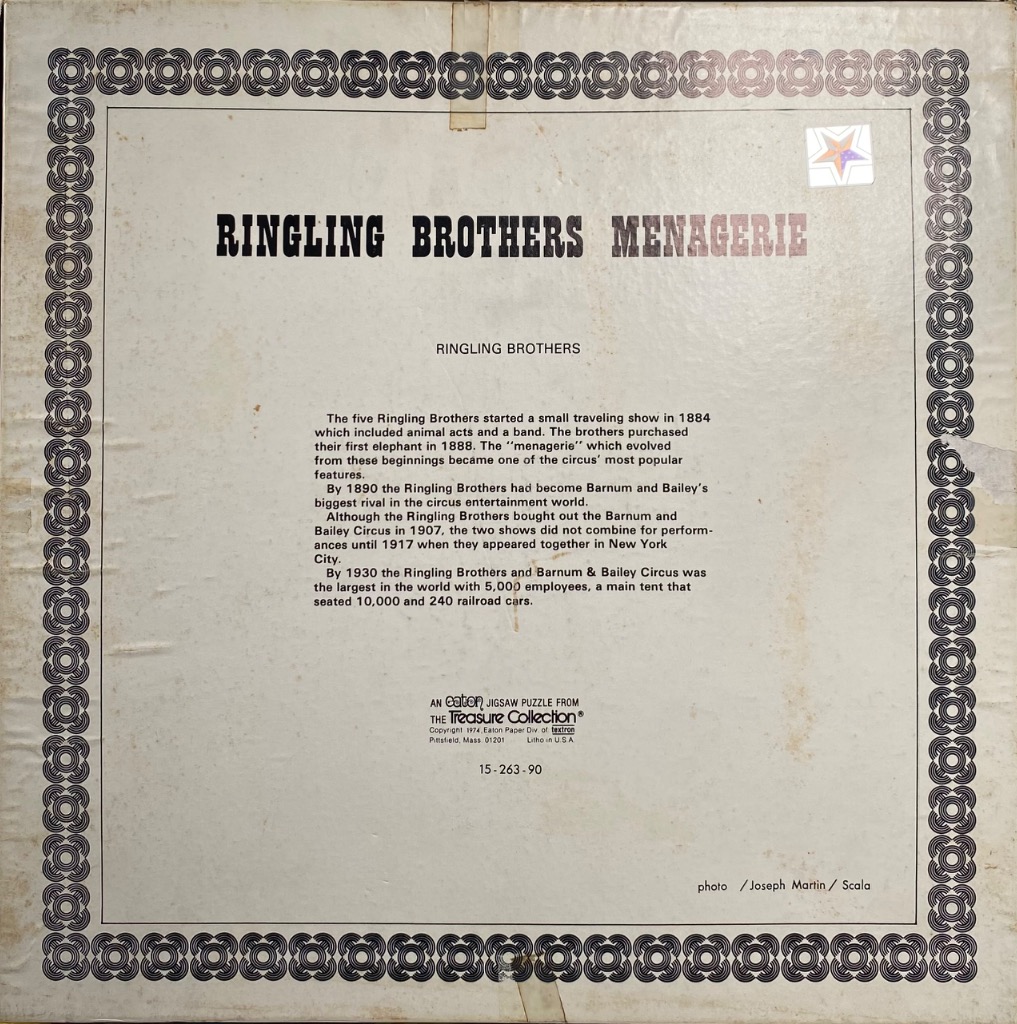
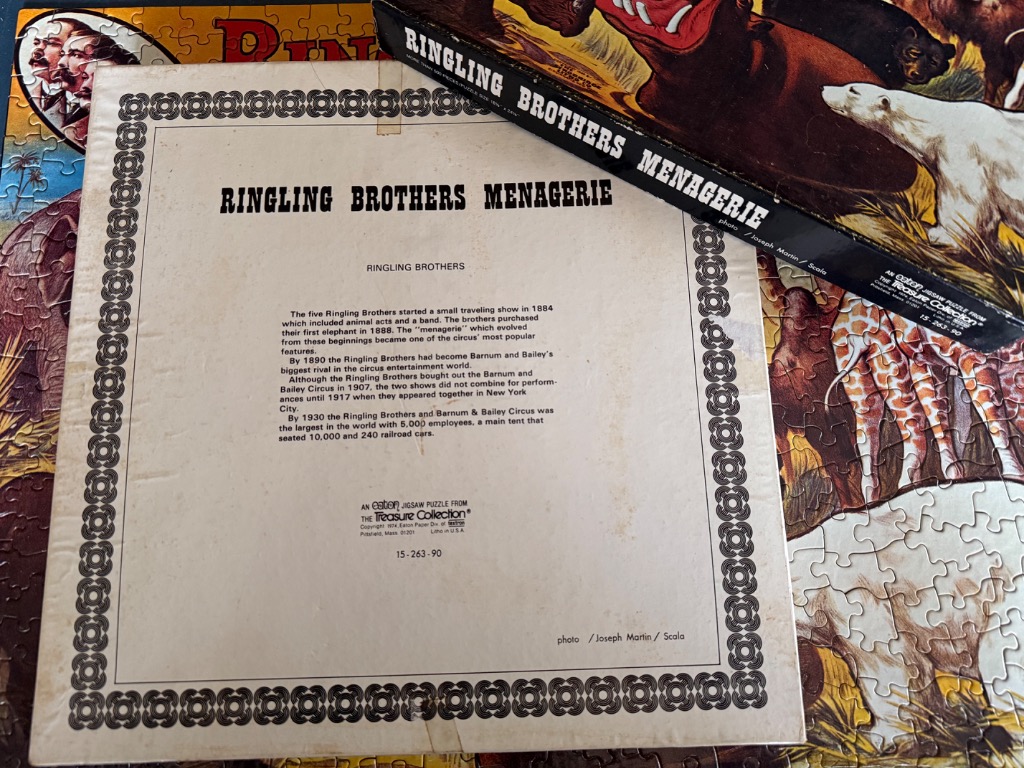
The image features a minimalist, document-style graphic set against a cream-colored background. A bold, decorative black border composed of repeating geometric clover-like floral patterns frames the entire composition. The text is centered and laid out in clear, black block typography. The main heading reads "RINGLING BROTHERS MENAGERIE," with the sub-heading "RINGLING BROTHERS" positioned immediately below.
Following the titles, a central block of text provides a brief historical narrative of the circus troupe. It details the origins of the five brothers, their 1884 traveling show, the acquisition of their first elephant in 1888, and their eventual growth into one of the most significant entertainment operations in history. The paragraph concludes by noting the scale of the circus by 1930, mentioning its 5,000 employees and massive capacity.
The overall aesthetic is that of a vintage printed document or archival record. In the top right corner sits a small, stylized multi-colored star icon. At the bottom, standard publication details, a copyright date of 1974, and the credit "photo / Joseph Martin / Scala" appear in a smaller, professional typeface, reinforcing the impression of a historical informational piece.