The Last Three
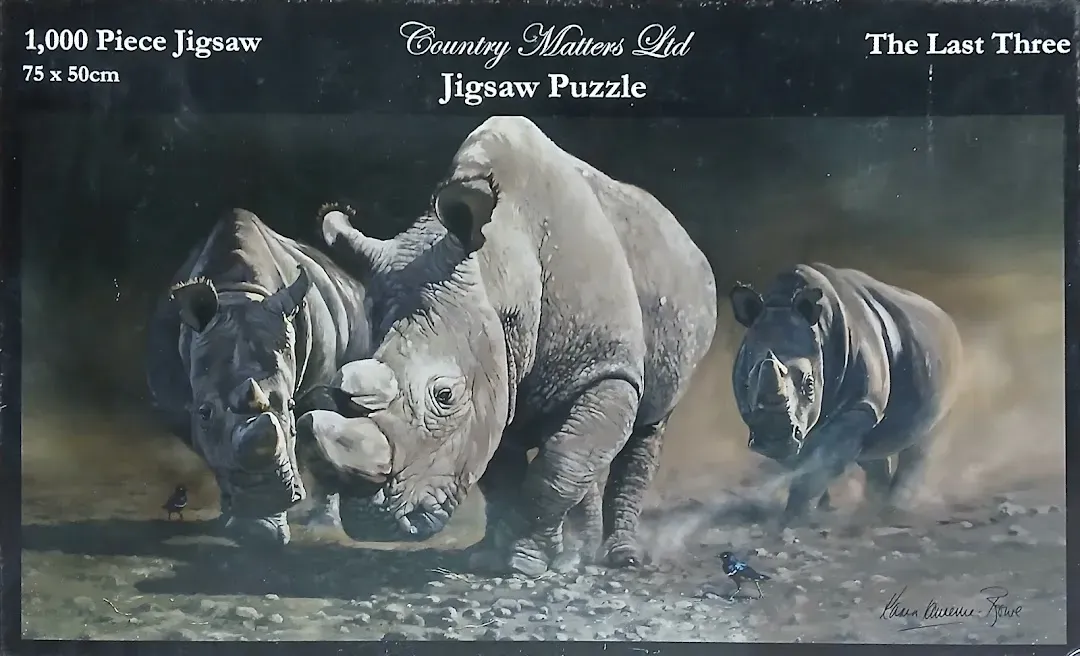
The central focus of this realistic painting is a trio of rhinoceroses moving forward through a dusty, parched landscape. The animals are depicted in high detail, showcasing the rugged texture of their gray, armored skin, the heavy folds of their bodies, and the sharp points of their horns. The lead rhino on the left and the large center rhino dominate the foreground, their heads lowered as they navigate the terrain, while a third rhino follows slightly behind on the right.
The setting appears to be a desolate, arid plain during the late day. A soft, hazy light illuminates the scene, casting long shadows and creating a sense of quiet movement. Dust swirls around the feet of the rhinos, obscuring the ground and adding depth to the composition. Two small, dark birds are perched on the gravelly surface near the rhinos, providing a sense of scale and a touch of color contrast against the muted, earthy tones of the ground.
The overall mood is solemn and evocative, with the painting style emphasizing the heavy, sculptural forms of the animals. The color palette is restricted to shades of charcoal, slate gray, and dusty brown, which highlights the harsh reality of their environment. The background is cast into a deep, shadowy gloom, which forces the viewer to focus entirely on the rhinos. The artist's signature is visible in the lower right corner, marking the work as a fine art illustration.

The central artwork depicts three rhinoceroses moving toward the viewer across a dry, earthy landscape. The largest rhino in the foreground is rendered in great detail, with its thick, textured grey hide and prominent horn catching the light. To its left, a second rhino follows closely, while a third slightly smaller rhino trails behind on the right, creating a sense of forward motion and family grouping.
The setting appears to be an open savannah or plain during dusk or twilight, as the background fades into a deep, moody shadow. The ground is dusty and uneven, with small tufts of vegetation visible. A light haze or dust cloud kicks up around their feet, suggesting their steady movement through the arid terrain. The composition emphasizes the grandeur and solitary nature of these animals.
The artwork uses a muted, naturalistic colour palette dominated by shades of charcoal, slate, and earthy browns, which contrast sharply against the dark background. The lighting is dramatic, highlighting the muscular forms of the rhinoceroses while casting the rest of the scene into deep obscurity. The style is that of a realistic wildlife painting, with careful attention paid to the anatomy and skin texture of the animals, resulting in a solemn and contemplative mood.