Singerly's Call to Alarm 1892
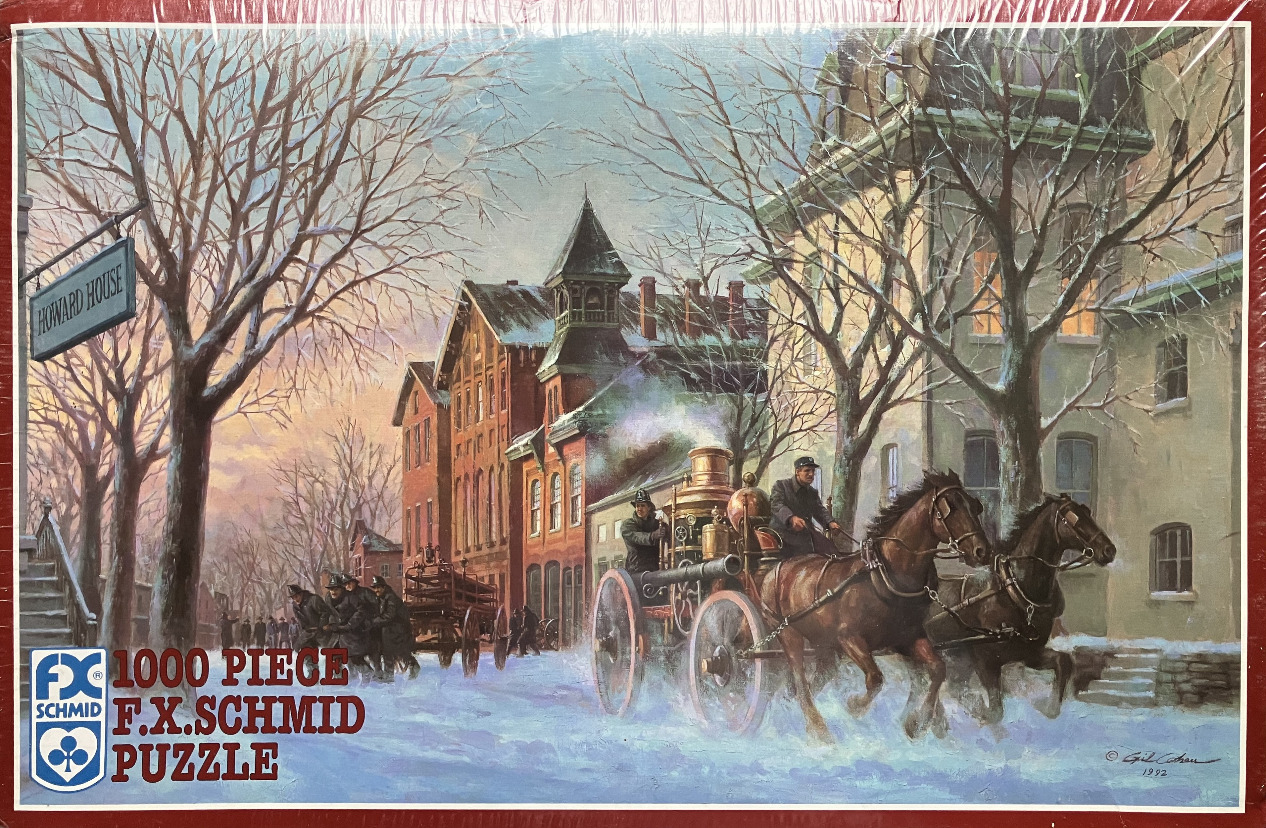
This oil painting depicts a historic 19th-century town street blanketed in deep snow. The focal point is a team of two dark horses pulling a brass-trimmed steam fire engine at a brisk pace. Two firemen are stationed on the engine, while another group of firefighters is visible in the background, walking along the side of the road near a building labeled "Howard House."
The composition centers on the mid-ground, with the fire engine moving from right to left against the backdrop of brick and stone architecture. The town buildings feature steep roofs and towers, suggestive of late Victorian-era design. Leafless, snow-dusted trees frame the scene on both sides, creating a sense of depth and enclosure.
The color palette is dominated by cool blues, whites, and greys of the winter atmosphere, contrasted by the warm, earthy browns of the horses and the muted red-orange brick of the buildings. A soft, golden glow at the horizon suggests a late afternoon sun struggling through a winter sky. The overall mood is one of urgent, cold activity, captured with a realistic, painterly style that emphasizes the texture of the snow and the steam rising from the fire engine.

This historical illustration depicts a dramatic winter scene from 1892, featuring a horse-drawn fire carriage racing down a snow-covered town street. The central focus is a team of dark horses pulling an ornate, brass-accented fire engine, moving rapidly toward the foreground. The street is lined with traditional brick and clapboard buildings, their roofs dusted with white snow, creating a sense of a cold, crisp late nineteenth-century setting.
The composition is anchored by the movement of the fire apparatus, which cuts across the frame from right to left. Bare, winter-stricken trees frame the scene on the left, their intricate branches reaching against a pale, overcast sky. In the background, smaller figures and additional carriage traffic can be seen in the distance, suggesting a bustling scene of activity during an emergency response.
The colour palette is dominated by cool blues, whites, and greys, reflecting the snowy landscape and wintry atmosphere. The warm, metallic bronze tones of the fire engine provide a stark, high-contrast focal point against the chilly background. The artwork appears to be a detailed, realistic painting, capturing the texture of the snow, the musculature of the horses, and the period-accurate architectural details of the historic townscape.

This historical oil painting depicts an active fire department scene set in late 19th-century America. In the foreground, two dark horses pull a vintage steam-powered fire engine at a brisk pace along a snow-covered street. Firefighters in period gear are positioned on the equipment, with one appearing to steer or manage the team. The horses' musculature and the billowing steam from the engine convey a sense of urgent movement.
Behind the fire engine, the scene shows a quaint, wintry town street lined with multi-story red brick buildings that feature architectural details like arched windows and ornate cornices. Bare, skeletal trees stretch upward against a pale, early morning or late afternoon sky. The ground is blanketed in a layer of pristine white snow, with subtle tracks visible where the heavy wheels of the fire apparatus have broken through the surface.
The overall color palette is dominated by muted, wintry tones of cool blues, soft grays, and the deep, earthy reds of the brick architecture. The lighting is soft and diffuse, suggesting an overcast day, which casts gentle shadows on the snow and highlights the brass and dark metal details of the fire engine. The style is realistic and narrative, evoking the feeling of a historical documentary illustration commissioned to commemorate a 100th anniversary of the Singerly Volunteer Fire Company.

This illustration depicts a historical scene titled "Singerly's Call to Alarm 1892," featuring a horse-drawn fire carriage racing through a snow-covered town street. The central focus is a team of two dark horses pulling a brass-accented fire apparatus, with figures of firefighters visible on board. They are moving rapidly across a white, wintery landscape, leaving tracks in the fresh snow.
The setting is an early 19th-century town, characterized by multi-story brick buildings lining the street. The composition is structured to lead the eye along the thoroughfare, past the carriage and toward the background, where leafless trees stand against a soft, cool-toned sky. The lighting suggests the low, muted glow of a winter dawn or dusk, casting gentle shadows across the snowy ground.
The colour palette is dominated by cool whites, icy blues, and greys, which contrast with the warmer, earthy tones of the horses and the red-brown of the buildings. The painting style is representational and detailed, capturing the texture of the snow, the movement of the horses' manes, and the mechanical elements of the vintage fire equipment. The atmosphere is one of urgency and historical nostalgia, capturing a moment of civic action in a bygone era.
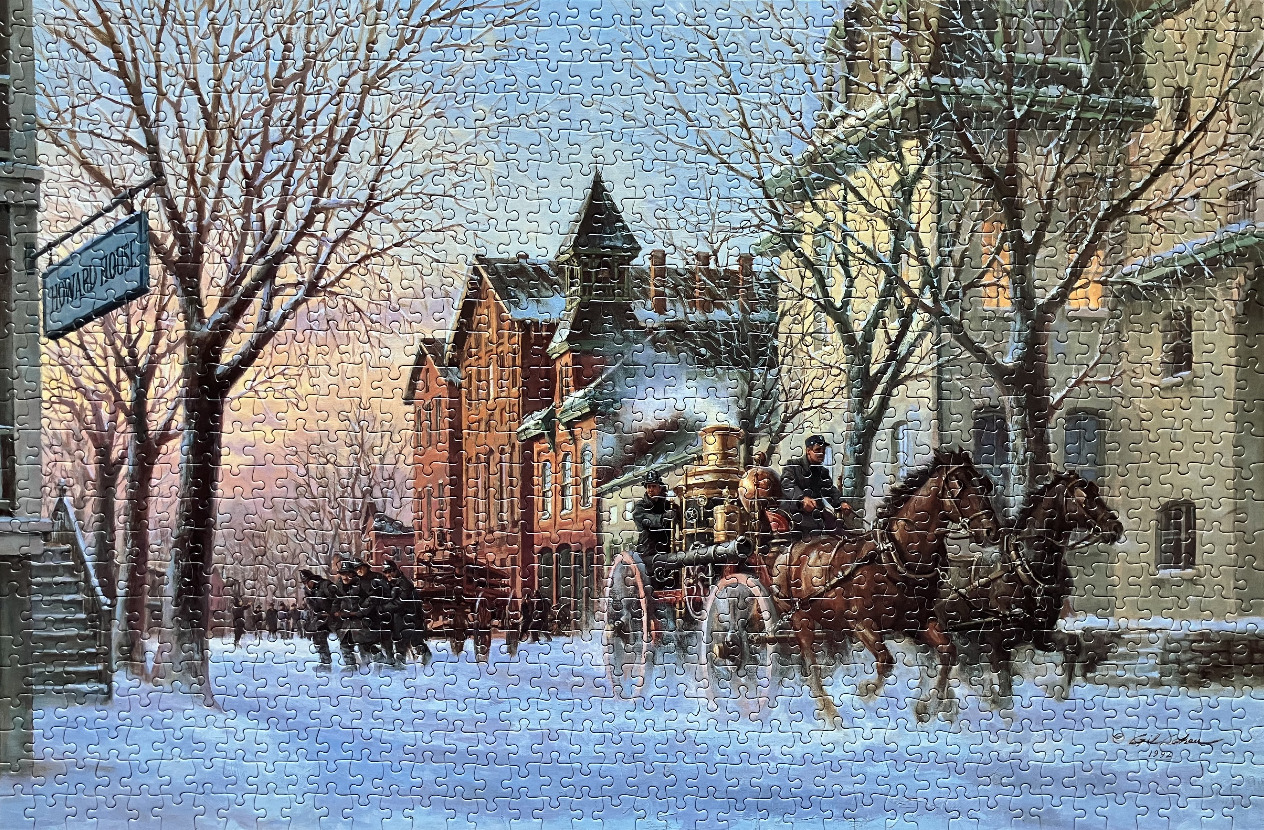
This illustration depicts a historical scene on a snowy town street during the twilight hours. The focal point is a horse-drawn steam-powered fire engine, operated by two men, moving toward the right side of the frame. The team of horses is captured in motion, pulling the heavy metallic apparatus through the deep snow. In the background, a group of firemen in dark uniforms marches along the side of the street, heading toward a large, multi-story brick building that appears to be the Howard Hotel, indicated by a prominent hanging sign on the left.
The composition is framed by bare, wintry trees that stretch their branches across the pale sky. The architecture of the buildings is characterized by traditional brickwork, peaked roofs, and narrow windows, suggesting a 19th-century setting. Steam billows from the engine, adding a sense of action and urgency to the quiet, frozen atmosphere. The ground is covered in a thick blanket of snow, with subtle textures indicating wheel tracks and footprints.
The colour palette is dominated by cool, wintry tones of white, grey, and soft blue, contrasted by the warm, earthy browns of the horses and the deep reds of the brick structures. The light is diffused, typical of late afternoon or early evening, casting a tranquil yet busy mood over the scene. The overall style is reminiscent of a detailed, nostalgic historical painting, capturing a slice of life from a bygone era.