Nighthawks
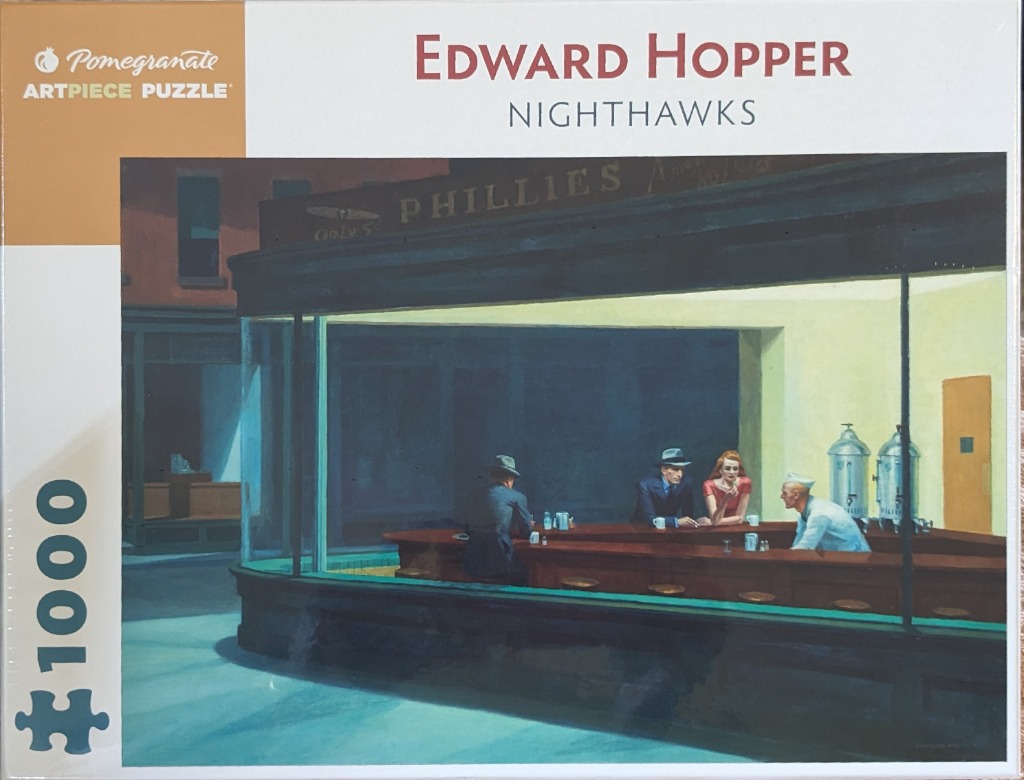
The scene depicts a late-night view of an urban diner, showing four individuals inside a glass-enclosed space. A man and a woman sit together at the counter, a solitary man sits with his back to the viewer, and a white-clad counter attendant faces the couple. The figures appear isolated and pensive, typical of early 20th-century realism.
The diner forms a sharp, angular focal point that cuts across the bottom-right of the composition. A curved glass window separates the brightly lit interior from the dark, silent city street outside. The perspective emphasizes the diner’s prominence, while the surrounding brick storefronts are cloaked in deep shadows, suggesting a quiet, empty urban neighborhood.
The colour palette relies on high contrast between the warm, sickly yellow light emanating from within the diner and the deep, murky blues and greens of the exterior night. The interior is sparse, featuring a long, cherry-wood counter and two large silver coffee urns against the back wall. The lighting is artificial and clinical, casting sharp, distinct shadows on the sidewalk.
This iconic work is an oil painting characterized by smooth, clean brushwork and a lack of intricate texture, focusing instead on geometric forms and the dramatic interplay of light and shadow. The composition captures a sense of urban alienation, with the diner appearing as an illuminated island amidst a dark and empty city.