A London Cab Stand
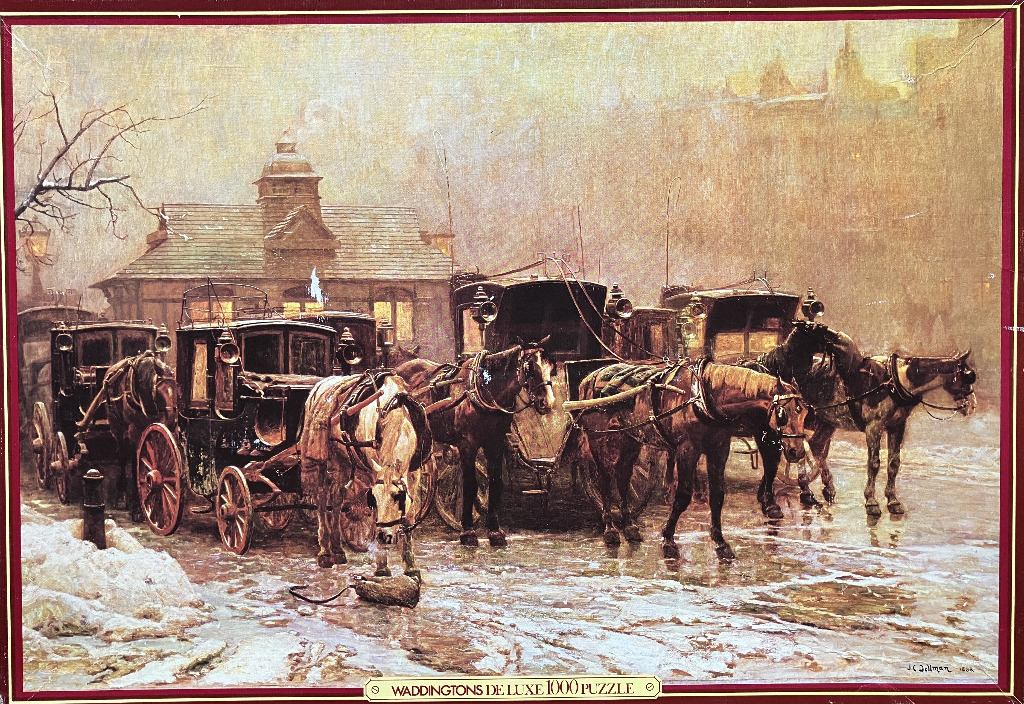
The scene depicts several dark, vintage horse-drawn carriages huddled together in a quiet city square during a winter twilight. A group of horses, harnessed to these cabs, stand patiently on a slushy, wet street covered in patches of melting snow. The atmosphere is thick with a hazy, yellowish fog that obscures the background, suggesting a cold, damp evening. To the left, a traditional street lantern glows softly, casting a warm light against the chill of the surroundings.
In the background, a low-slung, architectural structure with a cupola and rectangular windows provides a sense of place. The composition is balanced horizontally, with the row of carriages creating a strong foreground anchor. The color palette is dominated by muted earthy tones—ochre, browns, grays, and whites—that emphasize the somber, historic quality of the setting. The lighting is diffused and ethereal, softening the outlines of the carriages and the horses while highlighting the reflective, icy puddles on the ground.
The artwork appears to be a 19th-century style oil painting characterized by loose, textured brushwork that captures the mist and the granular quality of the snow. The overall mood is one of stillness, isolation, and quiet industry, reminiscent of life in a Victorian-era urban center.

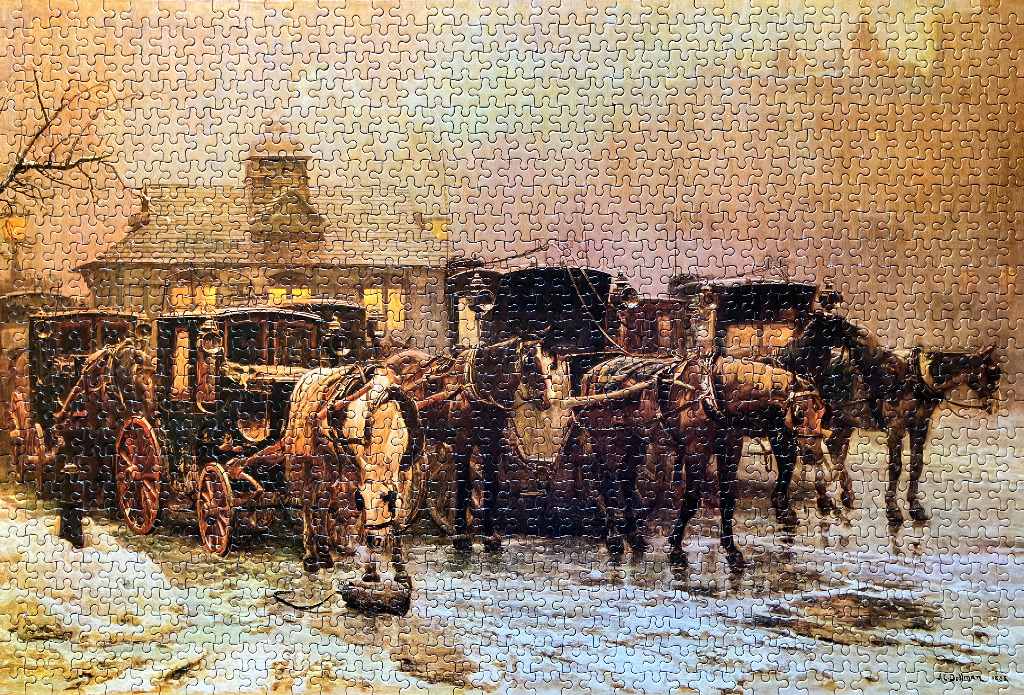
This atmospheric painting captures a snowy evening scene dominated by a line of dark horse-drawn carriages waiting outside a stone building. In the foreground, several horses are harnessed to these vintage carriages, their forms rendered in deep shades of brown and black. The wet, slushy ground reflects the dim light, creating a sense of cold, wintry conditions characteristic of a late Victorian era street.
In the background, a large building with a prominent chimney and glowing windows suggests a bustling coach house or inn. The light spilling from these windows provides a warm, golden contrast to the cool, muted tones of the snowy street. The overall composition is horizontal, emphasizing the stationary line of vehicles and the stillness of the quiet, winter night.
The colour palette is largely dominated by earthy browns, charcoal blacks, and icy, pale blues of the snowy ground, punctuated by the soft amber glow emanating from the building. The style of the painting is realistic and narrative, focusing on capturing the texture of the horses' coats, the intricate wheels of the carriages, and the hazy, soft-focus quality of the air. The artist's signature, "J.C. Dollman 1888," is visible in the lower right corner, placing the scene firmly in the nineteenth century.