Biodiversity
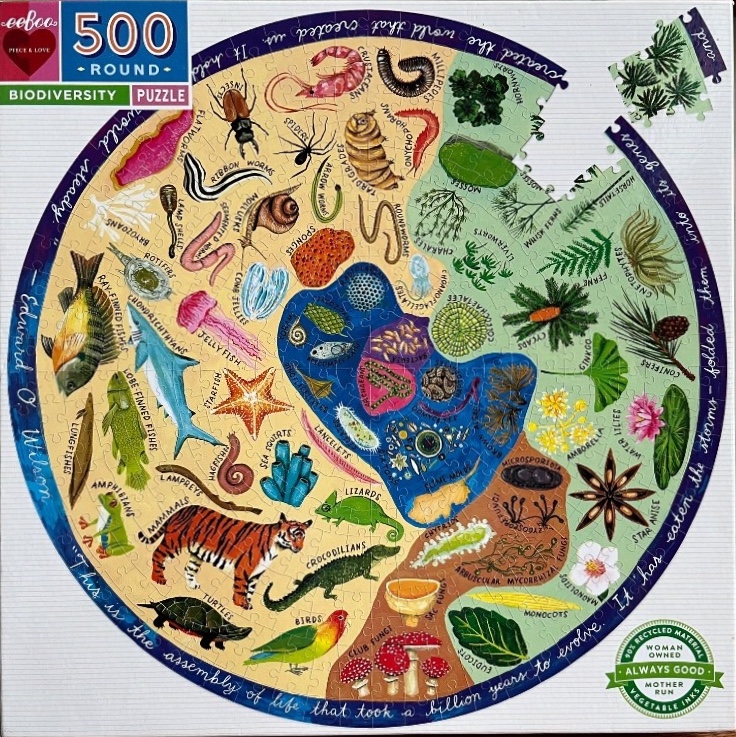
This circular illustration serves as a visual representation of biological diversity, featuring a central cluster of microscopic organisms surrounded by radiating branches of life. At the center, deep blue and purple sections highlight single-celled entities, bacteria, and archaea. From this core, the image expands outward into larger organisms, with different species arranged in a fan-like distribution that mimics an evolutionary tree.
The artwork is divided into distinct zones based on the type of life form. The left side is dominated by fauna, featuring a range of creatures including a tiger, turtle, lizard, fish, jellyfish, and insects, all meticulously rendered. The right side focuses on flora and fungi, showcasing detailed depictions of mosses, ferns, ginkgo, conifers, mushrooms, and various flowering plants. Thin, branching lines connect the different groups, accompanied by small, neatly printed labels in black text identifying each scientific category.
The composition is anchored by a deep blue center that transitions into lighter tan and green background tones, creating a sense of growth and progression. The edge of the circle is bordered by a dark navy-blue band featuring flowing white cursive script that reads, "This is the assembly of life that took a billion years to evolve. It has eaten the storms - folded them into its genes. It holds the world that created us." The overall style is a clean, educational, and vibrant scientific illustration set against a clean white background.
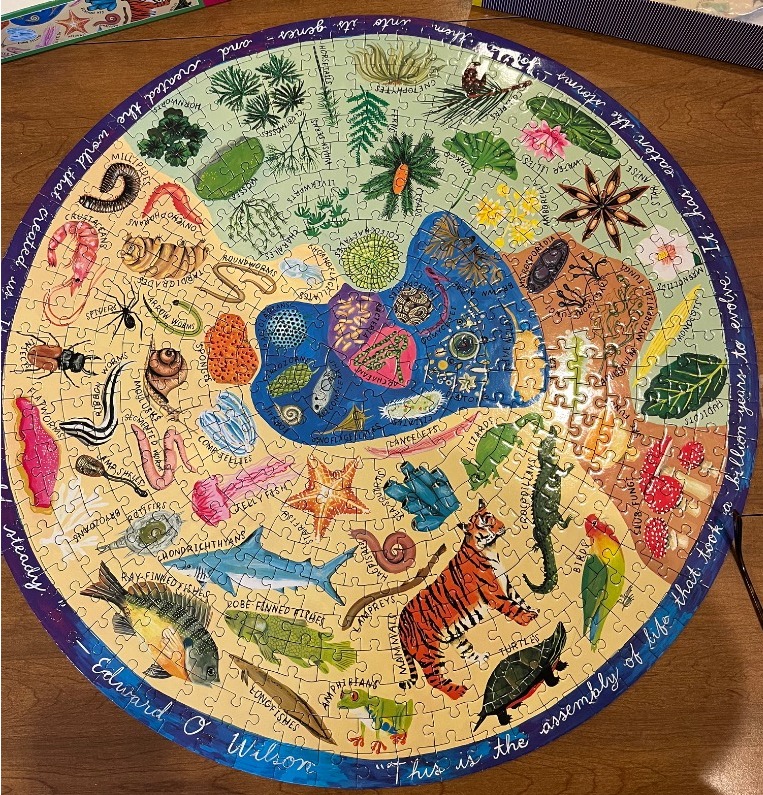
This circular illustration acts as an educational diagram depicting the tree of life. At the center, a deep blue circular core contains microscopic organisms like bacteria and archaea, branching out into increasingly complex life forms. Surrounding this core are distinct sections representing different biological classes, including various fish, reptiles, mammals like a tiger, birds, amphibians, insects, mollusks, and diverse plant species, all meticulously labeled in handwritten text.
The composition is organized like a color wheel, moving from vibrant blues and teals in the center to soft yellows, oranges, and greens as the evolutionary timeline expands outward toward the perimeter. Each organism is illustrated in a detailed, scientific style reminiscent of a naturalist's field guide, showcasing the biodiversity of life on Earth. The art style is clean and informative, using soft washes of color to differentiate the various taxonomic groups.
A dark blue border frames the entire circular design, containing a lengthy quotation written in elegant white cursive script that traces the circumference. This text provides context for the image, discussing evolution and the long span of time required for life to reach its current diversity, while also crediting the author Edward O. Wilson. The overall mood is one of scientific wonder and organized, scholarly discovery.