Libra
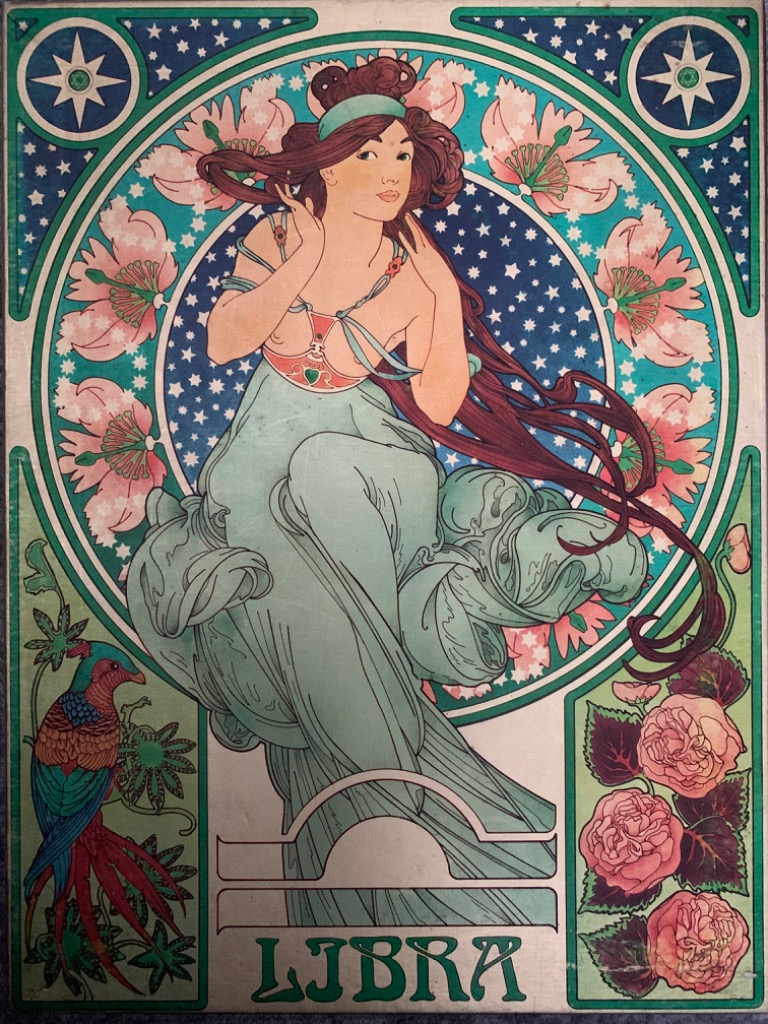
This Art Nouveau style illustration features a woman as the personification of the zodiac sign Libra. She is positioned centrally, seated within a circular frame against a deep blue background filled with white stars. The woman has long, flowing auburn hair adorned with a teal headband and wears a flowing, pale teal gown that gathers at her waist. Her expression is serene as she adjusts her hair, her posture elegant and relaxed.
The artwork is framed by a decorative border of stylized pink blossoms and green leaves. Below the central circular composition, the word "LIBRA" is printed in bold, stylized lettering above the balance scale symbol. The lower corners contain intricate details: on the left, a vibrantly colored bird with green, blue, and red plumage perches among foliage, while on the right, a cluster of lush, detailed pink roses blooms against dark, textured leaves.
The color palette is dominated by cool teal and soft pinks, contrasted against the dark, starry backdrop. The style is defined by thick, dark outlines characteristic of the movement, lending a clean, graphic quality to the design. Decorative geometric stars are positioned in the top corners, completing the balanced, ornamental layout that draws focus to the central figure.
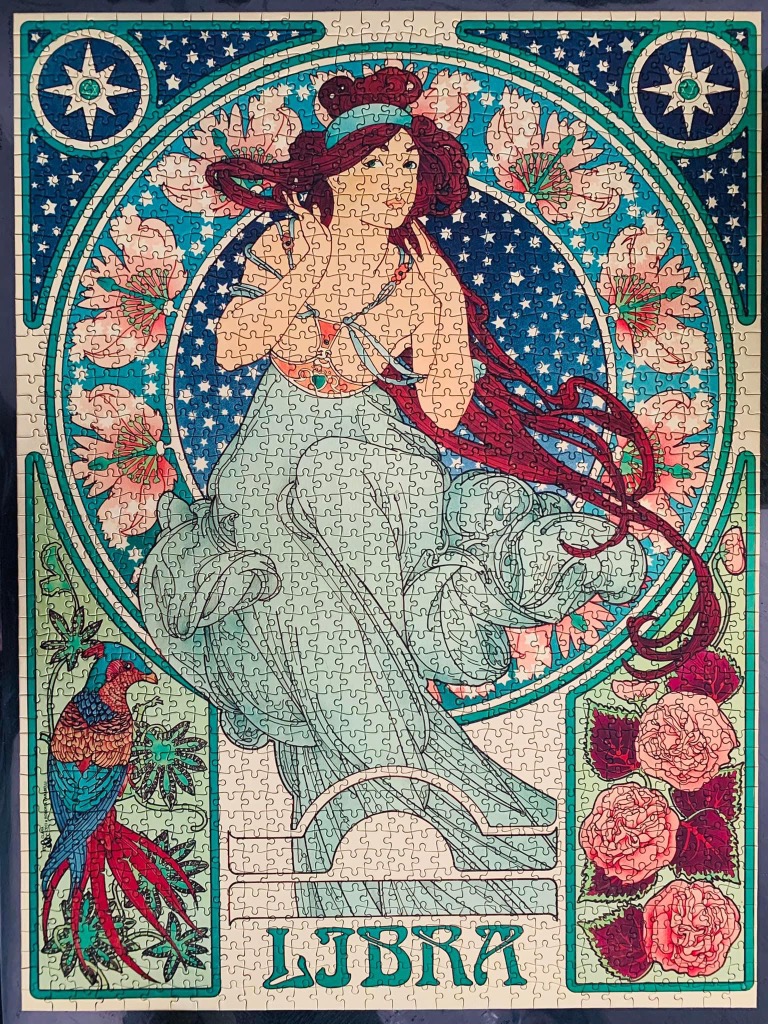
This Art Nouveau-style illustration depicts the zodiac sign of Libra, centered around a graceful woman with long, flowing reddish-brown hair. She is framed by a large, circular backdrop filled with a deep blue night sky sprinkled with white stars. Soft pink blossoms are arranged symmetrically around her within this circle, adding a delicate, organic touch to the composition. She wears a flowing, light blue gown and sits regally within the frame.
Below the central figure, the word LIBRA is written in a stylized, bold typeface. The bottom corners of the rectangular frame feature decorative elements: a brightly colored, exotic-looking bird with vibrant plumage on the left, and a cluster of lush, detailed pink roses nestled among dark foliage on the right. Two circular medallions containing star shapes anchor the top corners of the scene, reinforcing the celestial theme.
The entire piece uses a palette of soft teals, vibrant blues, rich pinks, and deep greens, consistent with the decorative aesthetic of the turn-of-the-century period. The use of heavy, dark outlines for the figures and flora, paired with intricate floral patterns and sweeping, curvilinear lines, creates a highly stylized, ornamental look reminiscent of stained glass or vintage posters. The lighting is flat and uniform, emphasizing the graphic qualities of the illustration.