The Night Watch, 1642

The central artwork depicts Rembrandt's famous masterpiece, The Night Watch. The scene is a dramatic group portrait of a 17th-century city militia stepping out from a dark, arched gateway. The composition is anchored by two central figures: a captain dressed in black with a bright red sash, and his lieutenant, who is illuminated and wearing a vibrant yellow outfit. Around them, a bustling group of musketeers, spear-bearers, and figures in shadow create a sense of movement and impending activity.
Deep, murky shadows dominate the background and edges, emphasizing the central figures through chiaroscuro. The light source appears to come from the upper left, highlighting specific faces, metallic armor, and the intricate lace collars of the men. A mysterious, small, golden-gowned girl stands near the center of the crowd, serving as a focal point of brightness amidst the darker tones of brown, ochre, and deep crimson.
The medium is a classic oil painting with rich, textured brushwork and a solemn, historical mood. Various weapons, including long pikes and muskets, are held at different angles, breaking up the horizontal flow of the figures and adding vertical lines to the composition. The entire scene captures a moment of organized chaos, characteristic of the Dutch Golden Age.
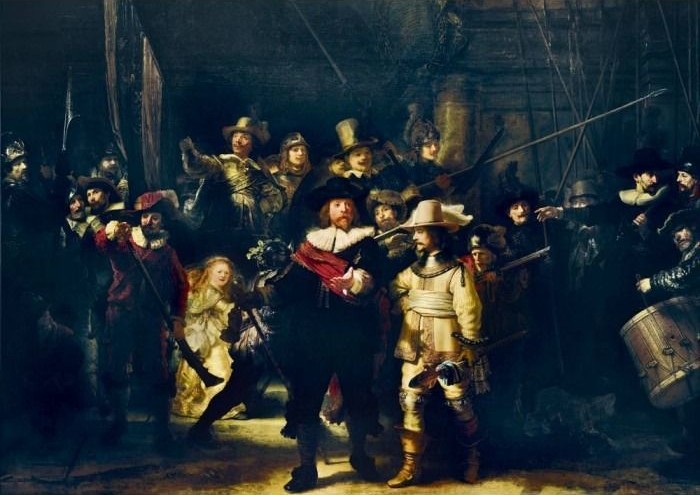
This iconic group portrait captures a company of armed men in motion, appearing to emerge from a dark, shadowed architectural space. At the center, two figures lead the group: a man dressed in black with a red sash and a white ruffled collar, accompanied by a man in a pale yellow doublet. They are surrounded by a diverse crowd of soldiers, some carrying pikes and muskets, others wearing ornate hats and period clothing. A young girl, glowing in a luminous golden dress, is partially obscured near the center, adding a mysterious, almost spectral quality to the composition.
The scene is defined by a masterfully executed chiaroscuro technique, where intense spotlights highlight the faces and gestures of the primary subjects while the surroundings dissolve into deep, murky shadows. This contrast creates a sense of profound depth and theatrical urgency, as if the company has just been summoned to action. The movement is captured in a flurry of gestures: a pointing hand, a drum being struck, and varied expressions of determination and camaraderie.
The painting emphasizes realism and texture, from the metallic glint of armor and the intricate folds of velvet and lace to the weathered features of the men. The color palette is restricted, dominated by deep blacks, ochres, and muted earthy tones, which serve to emphasize the brilliance of the illuminated figures. The work possesses a timeless, moody atmosphere, conveying both the grandeur of civic pride and the gritty reality of seventeenth-century military life.