Solar System
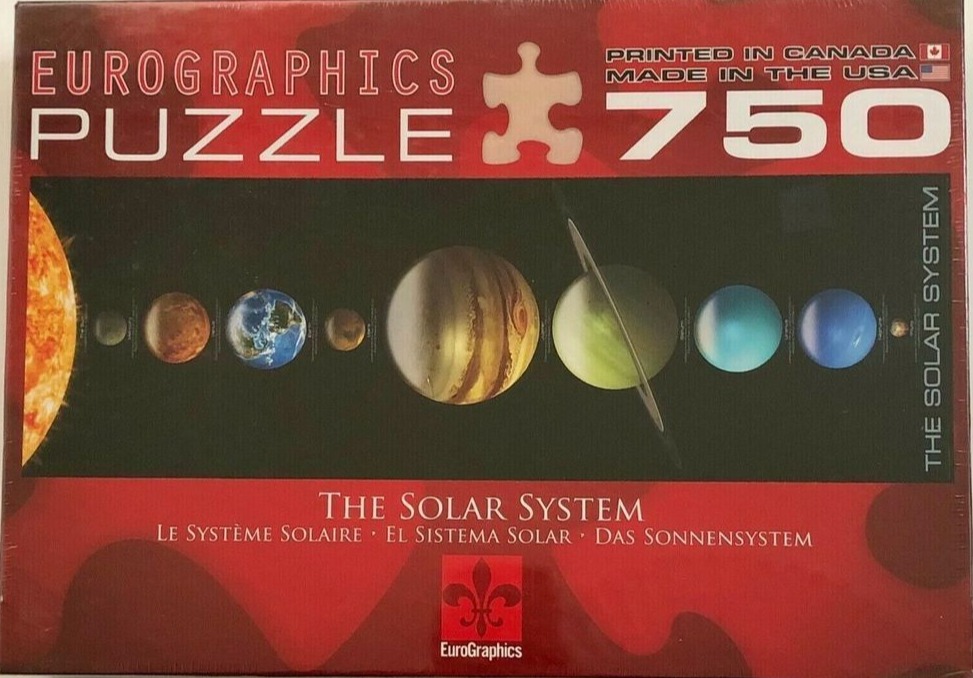
This illustration depicts the Solar System, organized horizontally across a deep black void. On the far left, a large, textured portion of the Sun glows with fiery yellows, oranges, and deep reds. Stretching toward the right, the eight major planets are arrayed in their correct order: Mercury, Venus, Earth, Mars, Jupiter, Saturn, Uranus, and Neptune. Each planet is rendered with realistic surface details and colouring, contrasting sharply against the surrounding darkness.
The planets vary in size and visual character. Jupiter is the largest, appearing as a massive sphere with prominent cloud bands, while Saturn is distinguished by its iconic, thin ring structure. The inner rocky planets appear smaller and more muted in colour, while the outer gas giants are characterized by shades of teal, blue, and deep tan. Each celestial body is accompanied by a small, subtle label denoting its name.
The overall aesthetic is that of an educational scientific chart, favouring clarity and anatomical accuracy over artistic interpretation. The composition is clean and minimalist, allowing the vibrant, spherical shapes of the planets to serve as the focal points. The lighting is uniform, highlighting the surface textures of the gaseous and rocky spheres against the backdrop of empty space.