Celestial
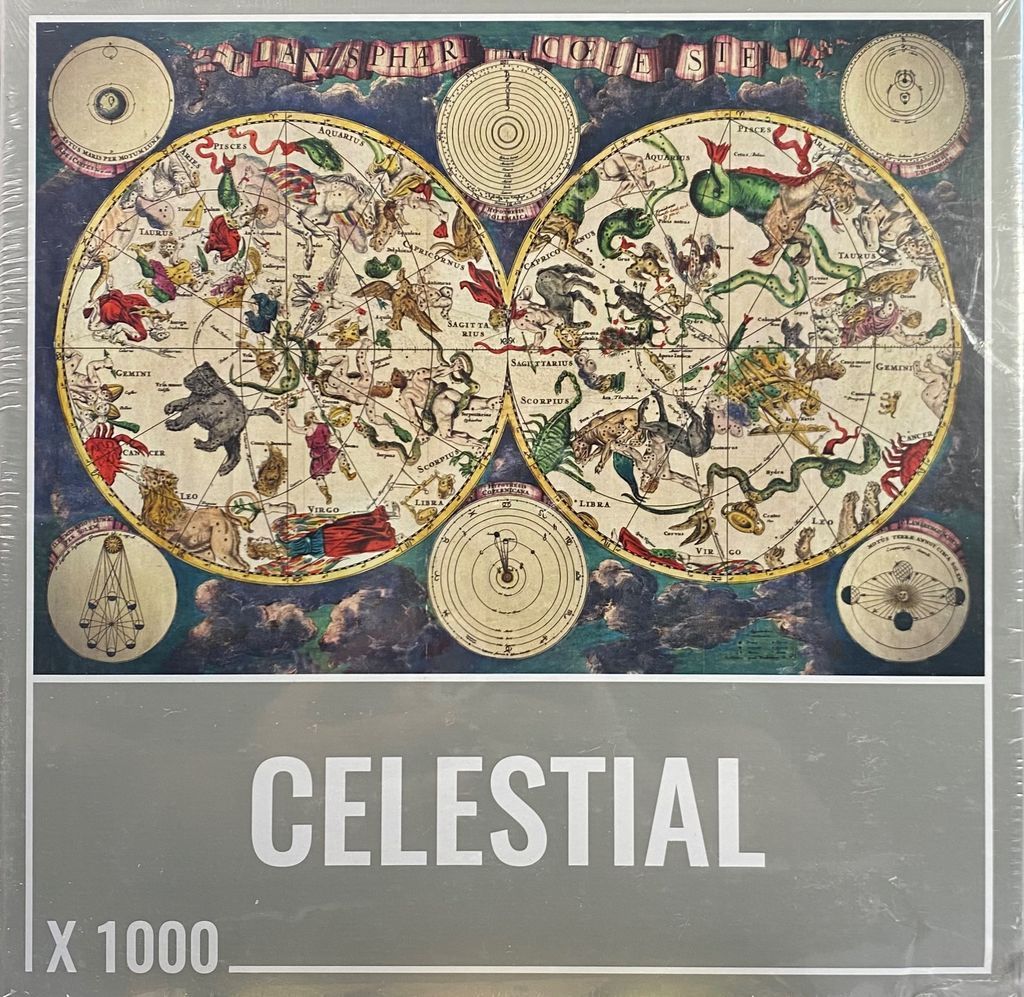
This artwork features an antique-style celestial planisphere presented as two large, circular hemisphere maps set against a dark, cloudy sky. The maps are detailed with intricately drawn constellations representing various animals and mythical figures such as a lion, a crab, and a ram. The celestial spheres are interwoven with fine grid lines, and the labels for various zodiac signs, including Pisces, Aquarius, and Sagittarius, are clearly marked throughout the charts in elegant, classical typography.
Surrounding the two primary hemispheres are four smaller circular diagrams positioned at the corners, each depicting geometric orbital movements and planetary cycles. A decorative ribbon banner at the top centre features the text "PLANISPHAERIUM COELESTE," tying the composition together with a sense of historical authority. The entire scene is framed by a rich, deep navy background populated with heavy, textured clouds that give the impression of looking into the night sky from a bygone era.
The colour palette is dominated by muted earthy tones, including parchment yellows, faded terracotta, and sage greens, which contrast against the deep blue and near-black backdrop of the cosmos. The style is that of an 18th-century copperplate engraving or hand-coloured map. The fine lines of the star charts and the slightly weathered appearance of the paper texture evoke a classic scientific and artistic aesthetic, reflecting the historical study of astronomy and astrology.
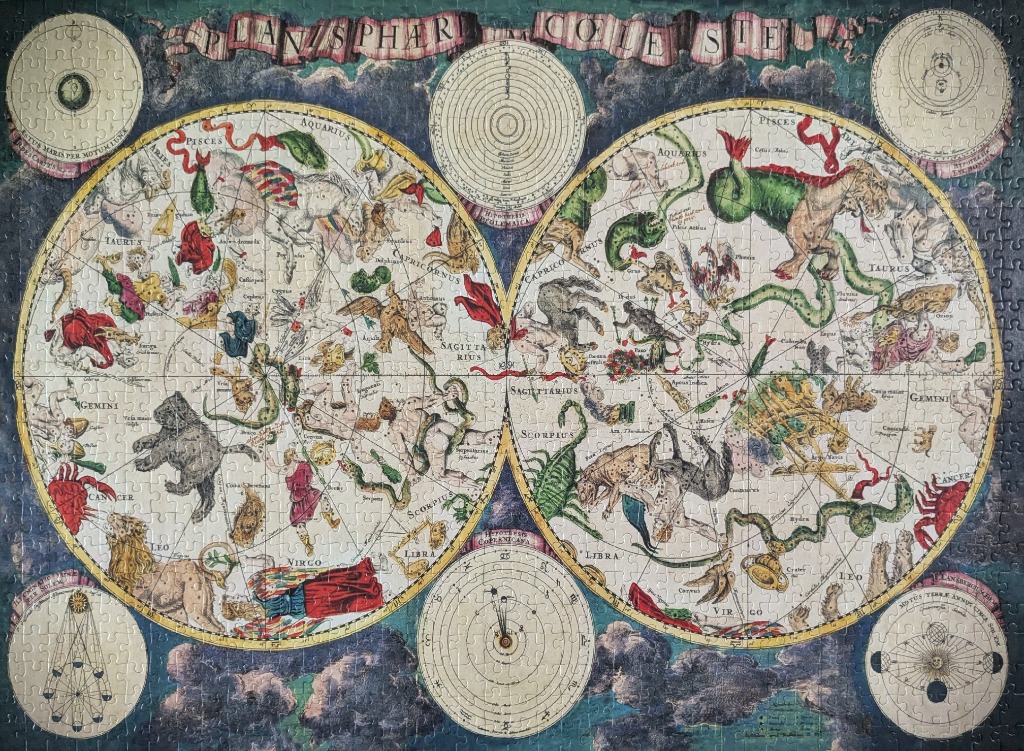
This antique-style celestial map depicts the night sky divided into two circular hemispheres. The central focus is on a variety of zodiac constellations, represented by detailed, hand-drawn mythological figures, animals, and classical imagery, all set against a cream-colored grid. The hemispheres are surrounded by a deep, dark atmospheric backdrop filled with textured, dramatic clouds that frame the astronomical illustrations.
Interspersed between the two large circular maps are several smaller, circular orbital diagrams showing planetary paths and solar systems. The title of the work, "PLANISPHAERIUM COELESTE," is prominently displayed in a flowing, ribbon-like banner at the top of the composition. The entire image is presented with the aesthetic of a historical scientific engraving, featuring delicate linework and a muted, earthy color palette dominated by creams, soft greens, deep reds, and dark slate blues.
The overall mood is scholarly and reminiscent of Enlightenment-era scientific cartography. Each hemisphere is labeled with astrological signs such as Aquarius, Taurus, Gemini, and Scorpio, written in elegant, classic typography. The composition is highly symmetrical, balancing the central dual-sphere design with the perimeter planetary diagrams, creating a harmonious and educational visual arrangement typical of early celestial atlases.