Concave and Convex
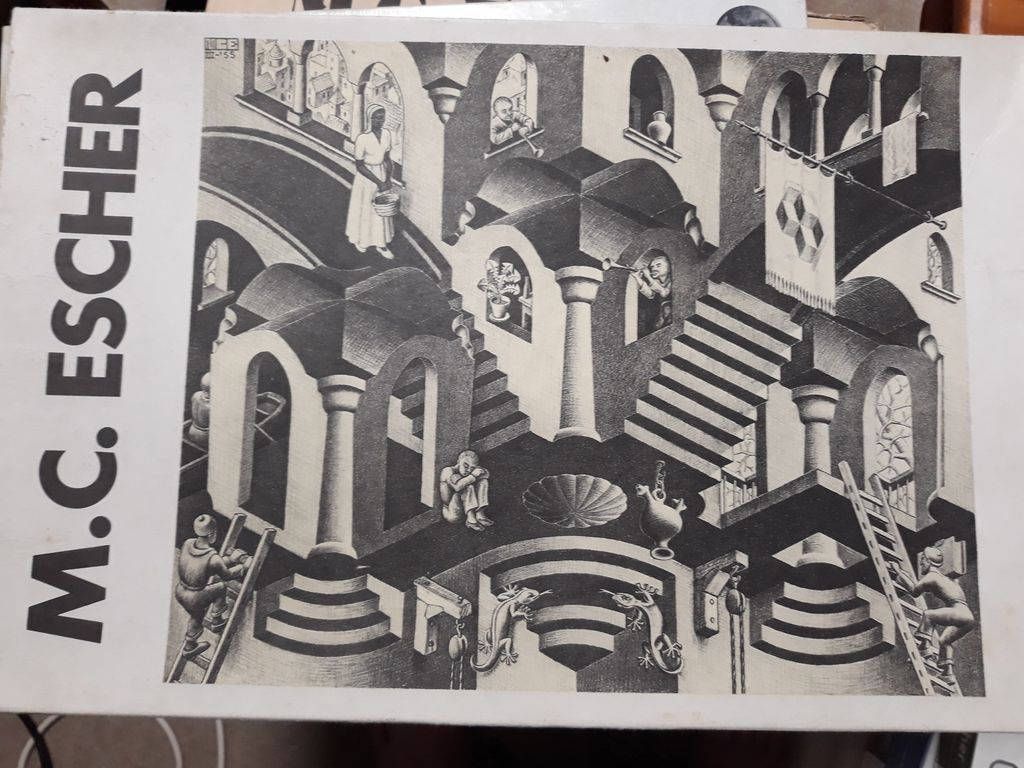
The central image is a complex, impossible architectural scene rendered in a stark black and white lithographic style. It depicts a multi-level structure defined by intersecting staircases, vaulted archways, and cylindrical pillars. The perspective is intentionally paradoxical, where stairways seem to lead both up and down simultaneously, and the space appears to fold in on itself, creating a disorienting, gravity-defying environment.
Several small human figures are scattered throughout the composition, integrated into the architecture. Some individuals are seen climbing ladders or peering out of window-like openings, while one figure sits introspectively on a landing. A unique feature includes two lizard-like creatures positioned prominently in the lower section, near a central bowl-shaped indentation. A hanging banner with a geometric pattern decorates an upper balcony, adding to the surreal atmosphere.
The artwork uses dramatic high-contrast shading and cross-hatching to define depth and form, giving the stone-like surfaces a tangible, textured quality. The overall composition is a masterful study in visual illusion, relying on clean lines and precise geometric forms to challenge the viewer's perception of physical reality. The entire scene is framed by a minimalist white border, with the artist's name, M.C. Escher, prominently printed vertically along the left side.

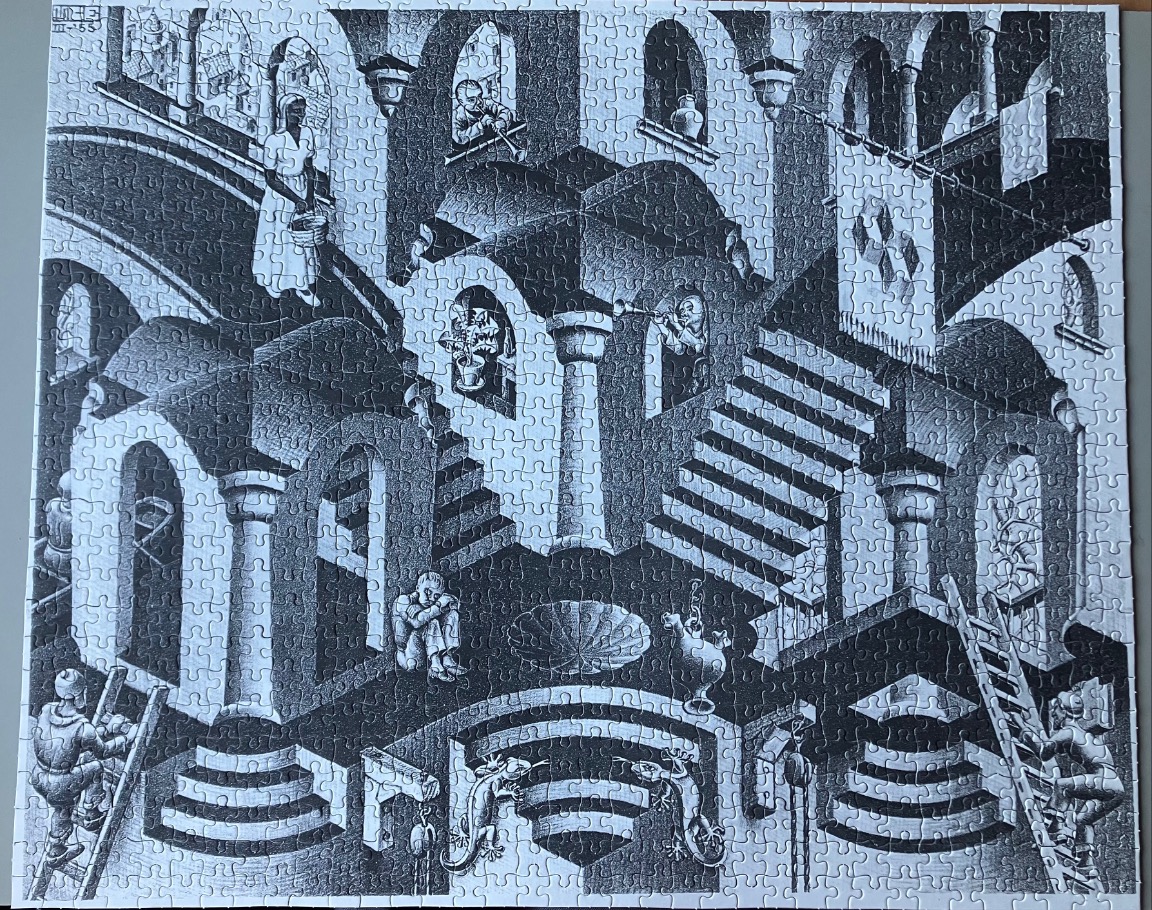
This intricate black and white lithograph depicts a surreal, impossible architectural space filled with winding staircases, arched doorways, and interconnected platforms. The composition relies on gravity-defying geometry where the same set of stairs serves different levels depending on the perspective of the viewer. Small figures are scattered throughout the scene; some descend stairs, one sits pensively on a ledge, and another plays an instrument from a high window, creating a sense of quiet, rhythmic activity within this labyrinthine environment.
The artwork uses high-contrast ink work to define the space, with deep shadows providing depth to the archways and undersides of the stone structures. The light source appears diffuse, highlighting the textures of the masonry and the varied architectural elements like pillars and circular pedestals. Small details, such as a potted plant in a window and patterned tapestries, add layers of visual interest to the stark, monochromatic surroundings.
The overall style is precise and illustrative, leaning into a mathematical approach to visual illusion. The perspective is intentionally disorienting, inviting the eye to follow paths that wrap around themselves in a continuous, non-Euclidean loop. The atmosphere is solemn and contemplative, characteristic of mid-20th-century graphic art that explores themes of infinity and spatial paradox.
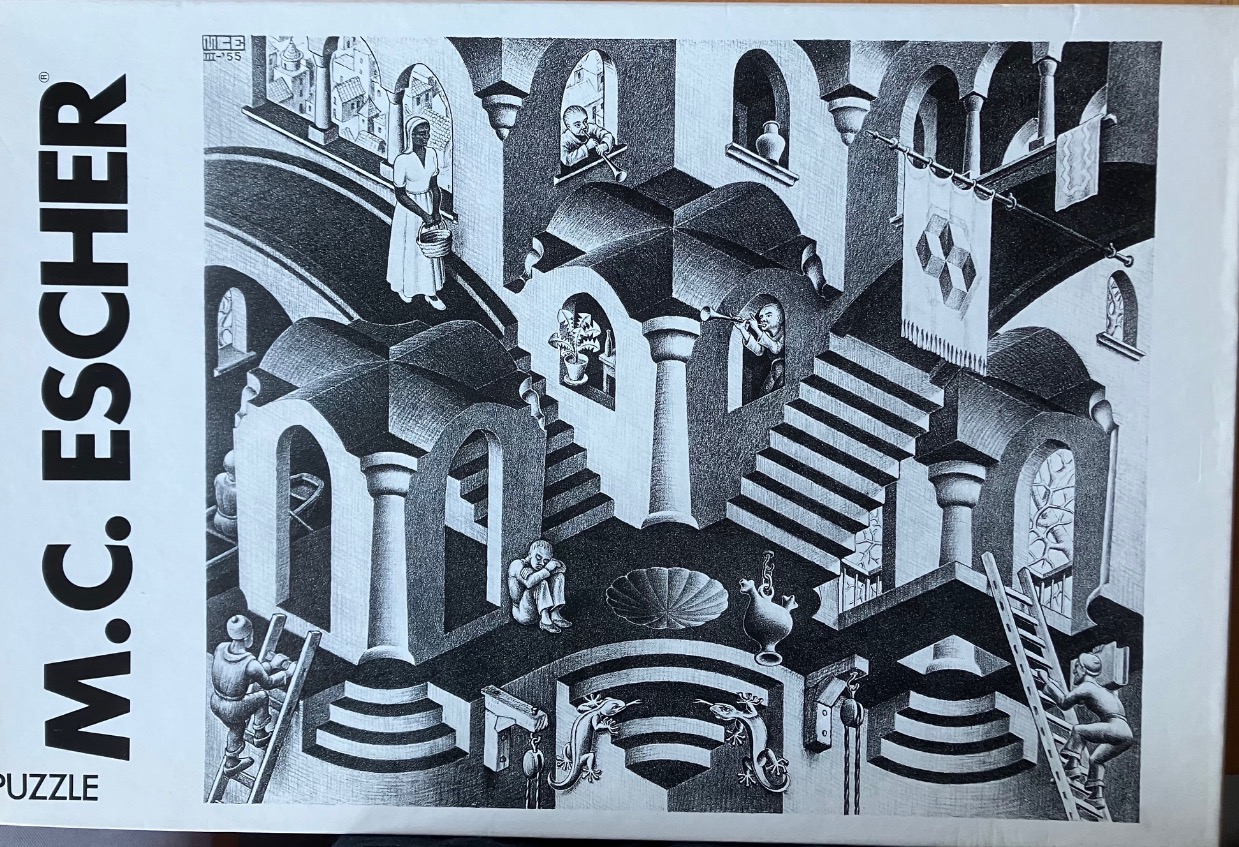
This black and white lithographic illustration depicts a complex, impossible architectural structure defined by repeating arches, stairways, and levels. The scene defies traditional perspective, creating a maze-like environment where staircases lead simultaneously up and down. A variety of figures occupy the space, including a woman standing on a landing, individuals peering out of arched windows, and figures climbing ladders. One person sits on the floor near the center, while two lizard-like creatures are positioned prominently on a ledge in the foreground.
The composition is densely packed and balanced, utilizing a high-contrast style that emphasizes the geometry of the vaulted ceilings and supporting pillars. The light and shadow are rendered through intricate cross-hatching, which gives the stone surfaces a textured, three-dimensional quality despite the illogical spatial layout. The overall mood is quiet and surreal, characteristic of an impossible construction that challenges the viewer's spatial reasoning.
In addition to the human and reptilian figures, various small details are scattered throughout the image, such as a potted plant, a hanging banner with a geometric pattern, and a basin-like bowl. The drawing, titled "Convex and Concave," utilizes a stark monochromatic palette to pull the viewer's eye across the multiple planes of the structure. The interplay of light and dark creates depth, guiding the viewer through the intricate, looping corridors that define the piece.

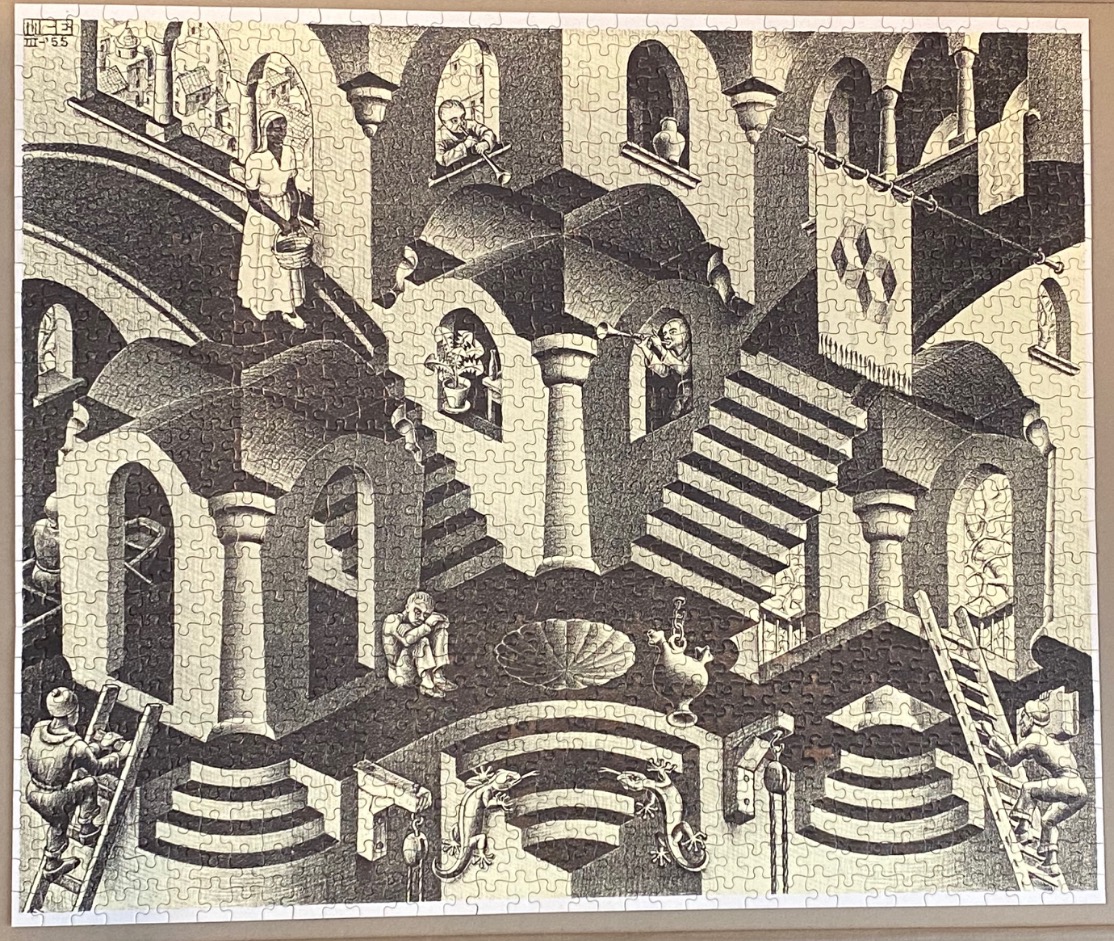
This intricate black and white lithograph, titled 'Convex and Concave' by M.C. Escher, features a paradoxical architectural scene that defies the laws of gravity and perspective. The composition is filled with curved archways, multiple staircases that lead in contradictory directions, and various rooms integrated into the complex structure. The perspective shifts constantly, making it unclear whether certain surfaces are concave or convex, creating a disorienting yet captivating visual experience.
Several human figures populate the structure, each engaged in mundane activities such as walking, sitting, or using tools like ladders and trumpets. Their presence amidst the impossible geometry adds a layer of surrealism to the scene. The architecture includes columns, vaulted ceilings, and decorative elements like hanging tapestries and patterned floor details. Lizards are also integrated into the lower portions of the structure, further blending organic forms with the rigid, repeating patterns of the stonework.
The entire work is rendered in high-contrast ink or graphite, utilizing meticulous stippling and cross-hatching to create depth, shadow, and texture. The lighting is uniform, highlighting the complex geometry rather than emphasizing a specific light source. The mood is intellectually stimulating and slightly uncanny, typical of surrealist art that challenges the viewer's perception of physical reality through meticulous line work and impossible spatial arrangements.