Royal Denmark
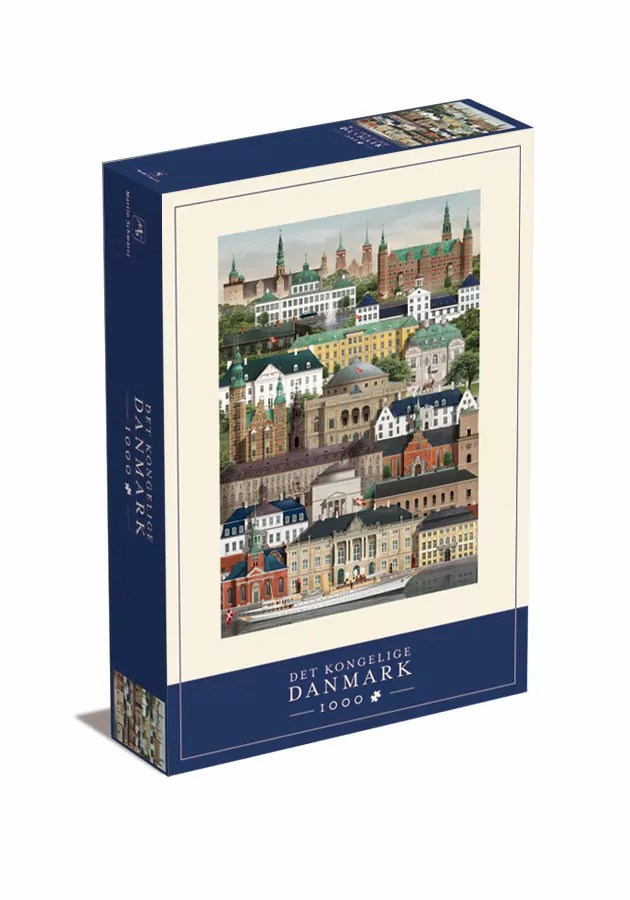
This illustration depicts a vertical collage of iconic Danish royal buildings, layered from the foreground to the distant background. The composition features a dense collection of historic architectural landmarks, including grand palaces, manors, and castles. In the foreground, a prominent royal vessel is docked alongside a classically designed building with a pale facade. As the view moves upward through the layers, the structures become increasingly intricate, showcasing various rooftops, copper-green spires, and brick chimneys characteristic of traditional Scandinavian design.
Elements are arranged in a stacked, tapestry-like layout that creates a sense of depth without traditional linear perspective. The scene is presented in a clean, illustrative style with soft, even lighting that emphasizes the architectural details rather than dramatic shadows. The buildings are interspersed with patches of greenery, suggesting park-like surroundings integrated into the urban royal landscape. Small Danish flags are placed strategically throughout, adding pops of red and white to the composition.
The colour palette is sophisticated, favoring earthy tones of brick red, warm beige, and muted gray, punctuated by the signature weathered green of oxidized copper roofs and spires. The illustration has a crisp, polished quality, with fine lines and solid color blocks that give it a contemporary graphic look. The entire scene is framed by a solid cream-colored border, which isolates the detailed artwork from the surrounding dark blue edges.
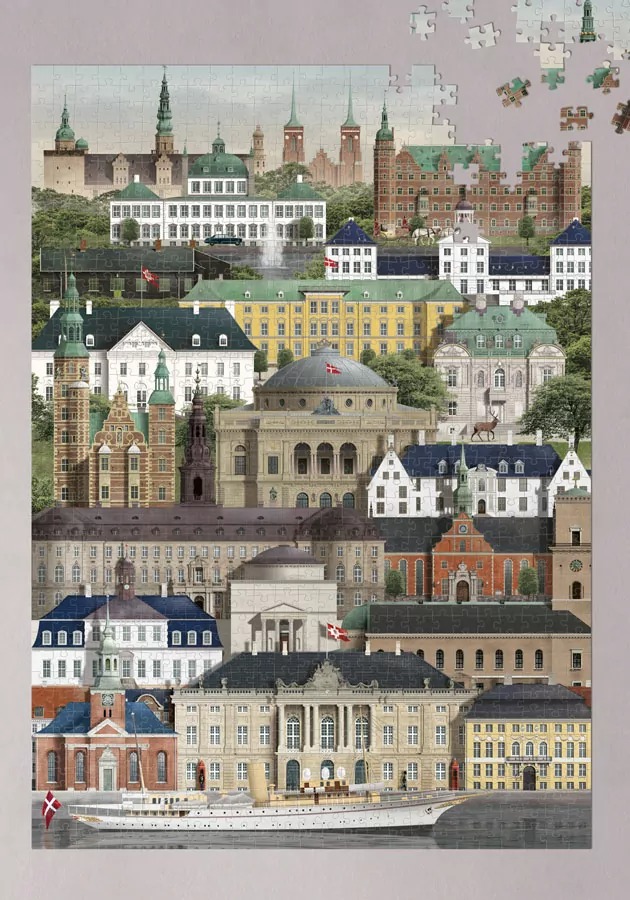
This illustration features a dense, layered montage of iconic Danish historical architecture. The composition is structured vertically, with numerous grand castles, royal palaces, and neoclassical government buildings stacked upon one another as if viewed in a stylized, non-linear perspective. In the foreground, a large white royal yacht sits on the water, flying a small Danish flag.
Each structure is rendered in clear, detailed strokes, showcasing diverse architectural styles ranging from red-brick medieval fortifications with copper spires to pristine white-stucco mansions and yellow-walled estates. Foliage and trees are interspersed between the buildings, softening the lines of the dense urban assembly. A few notable elements include a large circular dome building, various steep-roofed structures, and several smaller Danish flags waving atop the roofs.
The colour palette is varied and naturalistic, dominated by the earthy tones of brick red, warm yellow, and cool grey stone, contrasted against the bright white of the palaces and the deep green of the roofs and surrounding trees. The lighting appears soft and even, typical of a bright overcast day, which allows the intricate details of the facade work and windows to remain highly visible. The medium is an artistic digital illustration that aims for a representational, architectural look rather than a photographic one, creating a cohesive, postcard-like homage to Danish royal heritage.
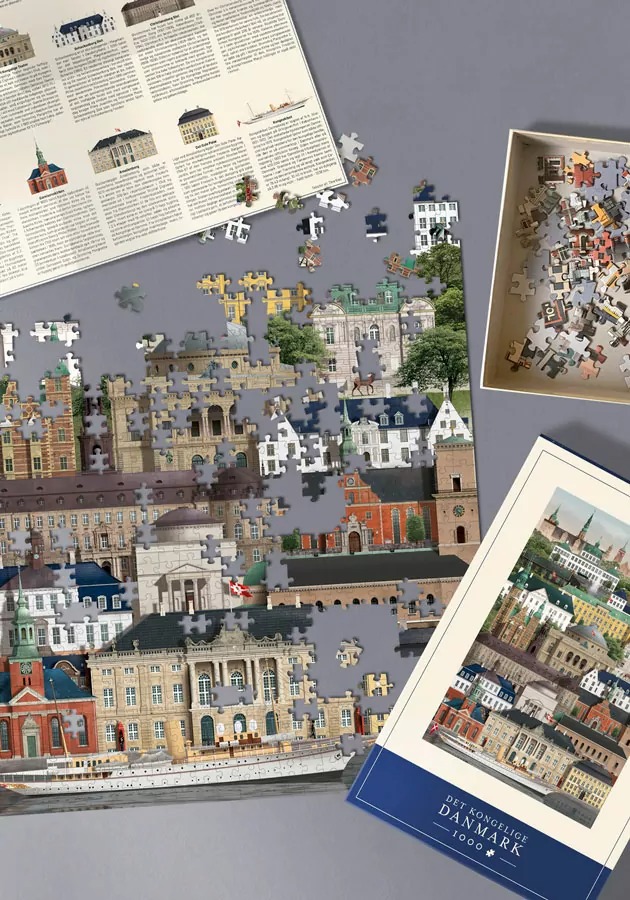
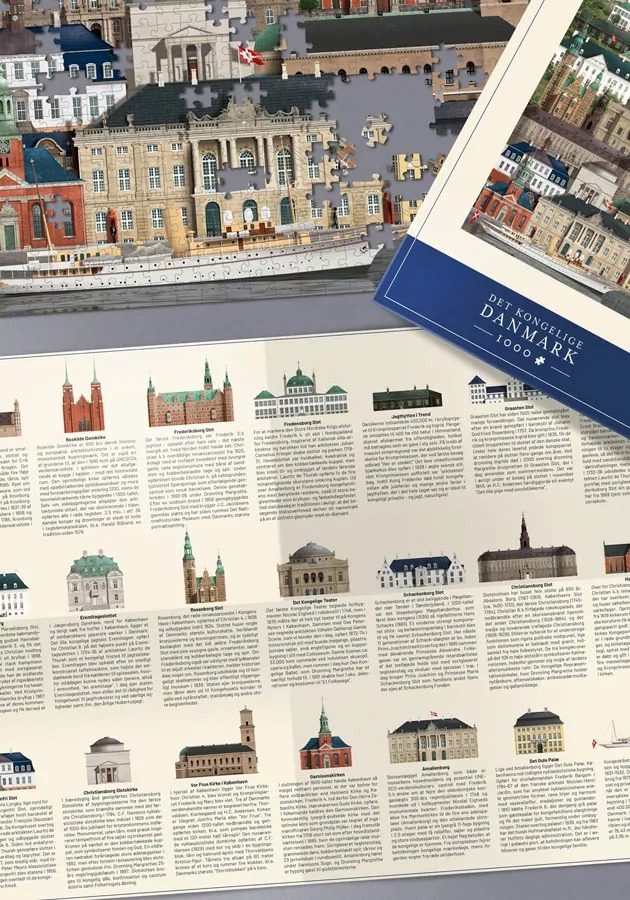
The image features a split-level composition. The upper portion displays a detailed, intricate illustration of a grand royal palace, rendered in a realistic, painterly style with shades of soft brick, grey stone, and teal-roofed turrets. This focal structure is depicted along a harbor or waterway, with the architectural precision of its windows, decorative facades, and flag-topped towers clearly visible. The lower portion transitions into a clean, graphic design featuring a grid of small, illustrated icons representing various famous landmarks across Denmark.
These smaller icons are presented in a minimalist, flat aesthetic, neatly arranged in rows against a light cream-colored background. Each icon is paired with several lines of informative, small-print text in Danish, providing historical context and naming sites such as the Roskilde Cathedral, Rosenborg Castle, and the Royal Theatre. The overall aesthetic is organized and educational, blending a rich, textured perspective of a specific palace with a systematic, chart-like display of Danish national heritage. The lighting is balanced and clear throughout, suggesting a high-quality print production intended for historical appreciation and visual reference.