Yorkshire Pullman
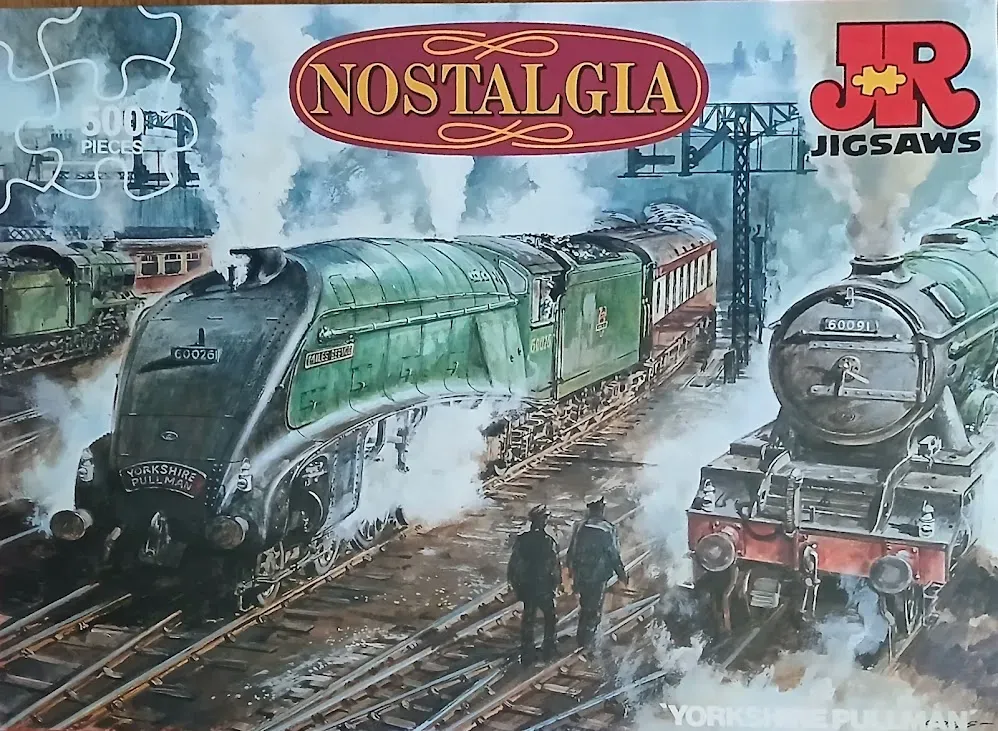
This illustration depicts a busy railway scene featuring two prominent steam locomotives. In the center, a sleek, dark green streamlined train marked "60026" pulls passenger carriages, while a second, more conventional green locomotive labeled "60091" sits on an adjacent track. A third, partially obscured train is visible in the background to the left. Two figures dressed in dark, period-appropriate work coats stand between the tracks in the foreground, facing toward the trains.
The composition captures a sense of industrial motion, with thick, white clouds of steam billowing from the engines and rising into the misty atmosphere. The scene is set in a rail yard or station, with overhead gantry structures and signal masts providing a sense of scale and depth. The ground is a complex network of steel tracks and gravel, rendered in earthy brown tones that contrast with the mechanical coldness of the trains.
The artwork is rendered in a painterly, illustrative style with a muted color palette dominated by deep forest greens, charcoal greys, and hazy whites. The lighting suggests an overcast, industrial day, enhancing the atmosphere of nostalgia. The focus is on the heavy machinery and the classic design of the mid-20th-century locomotives, with fine details highlighting the rivets, buffers, and signage on the engines.

The main artwork depicts two large, vintage steam locomotives in a bustling, historical railway station. On the left, a vibrant green locomotive is depicted moving through the tracks, emitting thick, white plumes of steam that billow into the air and obscure the background. To the right, a darker locomotive sits idling on a parallel track, completing the busy industrial scene.
The composition captures a dynamic moment in railway history, with the trains positioned at a slight angle to give a sense of depth and movement. In the foreground, the tracks stretch across the lower portion of the frame, where small, indistinct figures of railway workers or passengers can be seen standing near the engines. The overall setting feels like a classic, active terminal, crowded with the atmosphere of early twentieth-century rail travel.
The style of the image is a traditional representational painting, likely executed in gouache or oil. The colour palette is somewhat muted, dominated by the rich green of the primary locomotive, the dark metallic tones of the secondary engine, and the cloudy, grey-white tones of the atmospheric smoke. The light is diffused, suggesting an overcast day, which enhances the gritty, industrious mood of the railway environment.

The image displays a flat, rectangular graphic design against a vibrant red background. On the left side, the large white number 500 is prominently displayed, followed by the word "PIECES" and its translations in Dutch, German, and French: "STUKJES," "TEILE," and "MORCEAUX."
To the right of these labels is a horizontal, golden-yellow rectangular box with rounded corners. Inside this yellow field, the words "STEAM ENGINES" are written in a bold, dark serif font. The entire composition is contained within a thin, yellow border that matches the outline of the central yellow text box.
On the far right side of the image, there is a white rectangular area containing a standard black barcode with the numerical string "5 015796 001068" printed beneath it. The overall style is clean, utilitarian, and graphic, using a high-contrast palette of red, yellow, and white to emphasize the textual information.