29 Cube Maze
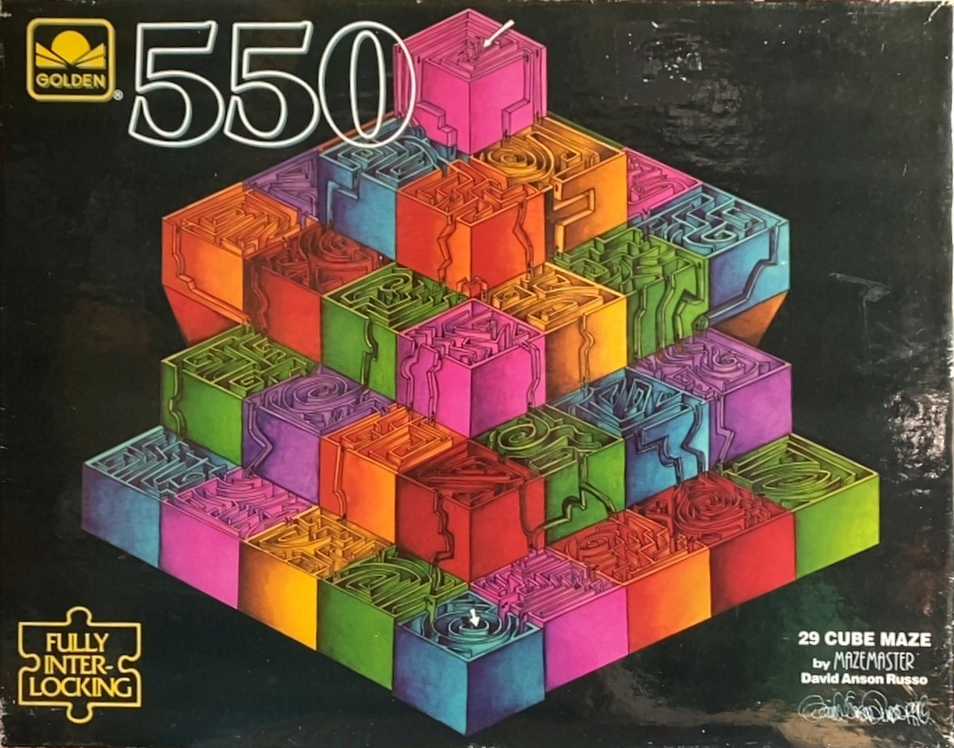
The central artwork depicts a pyramid-like structure built from 29 individual cubes arranged in an isometric perspective. Each cube face is intricately carved with a different maze pattern, creating an overall effect of depth and geometric complexity. The structure is set against a stark, solid black background, which makes the vibrant colors of the cubes pop. A small white arrow points toward the top-most cube, perhaps indicating the starting point of the puzzle, and another arrow points toward a spiral maze pattern at the very front-bottom cube.
The colour palette is intense and saturated, utilizing a spectrum of neon-inspired hues including magenta, bright orange, lime green, deep purple, and sky blue. Each cube face displays a gradient or flat block of color that contrasts with its neighbors. The lighting is stylized to emphasize the 3D form, with deeper shadows on the side faces of the cubes and brighter highlights on the top surfaces, reinforcing the architectural structure of the pyramid.
The artwork is a highly detailed, sharp illustration with crisp edges and precise line work. The style is reminiscent of 1980s graphic design, characterized by bold, geometric abstraction and a playful use of color to define form. While the overall shape is a clear pyramid made of stacked cubes, the internal maze details add a layer of chaotic, tangled lines that juxtapose the rigid outer frame of the structure.

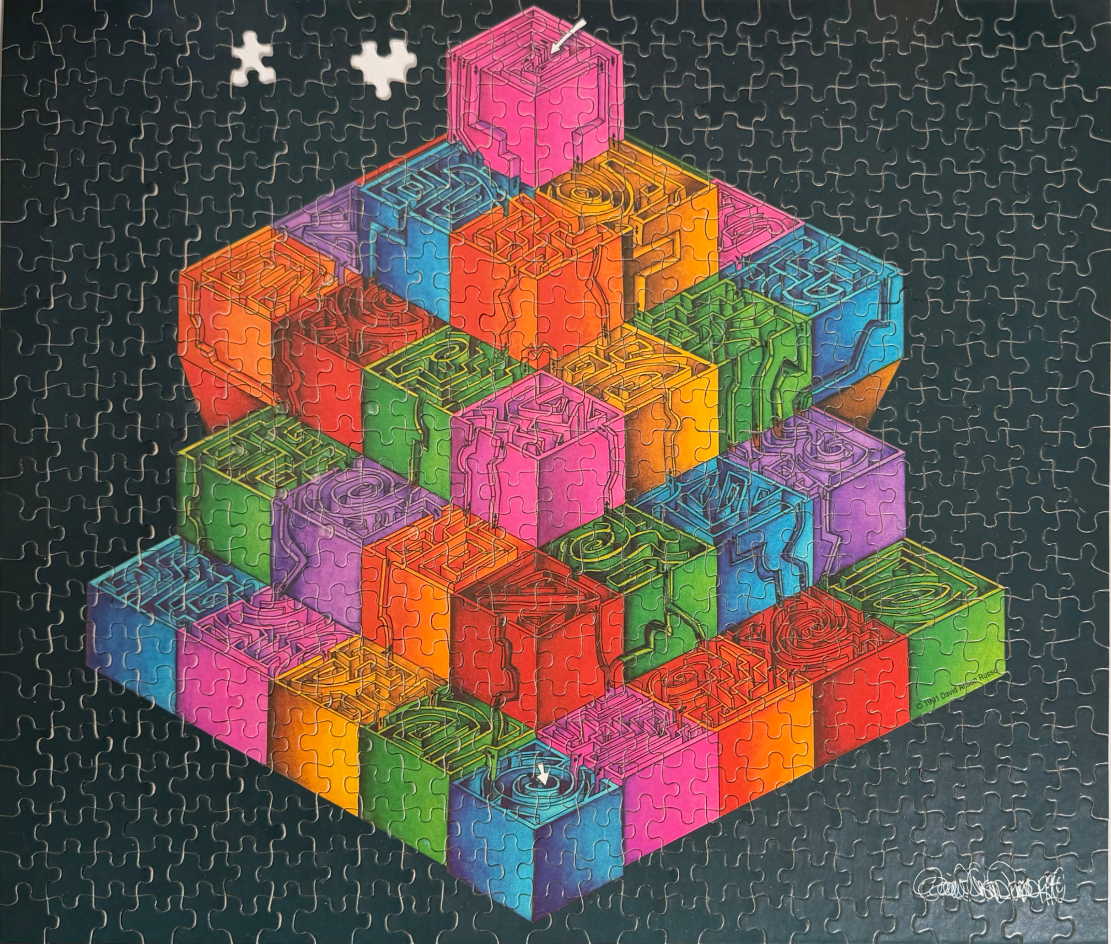
This image features a large, pyramidal structure composed of multiple smaller cubes stacked against a solid black background. Each cube face displays a unique, intricate maze pattern, with pathways etched into the surfaces. The arrangement creates an isometric, three-dimensional effect, suggesting a complex, interconnected labyrinth that climbs toward a single point at the summit.
The entire composition is rendered in vibrant, neon-like colors, including shades of magenta, orange, lime green, deep purple, and bright blue. The saturation of these colors creates a glowing, luminescent quality that contrasts sharply with the deep, void-like black backdrop. The lighting is stylized, giving each cube a slight sense of volume and depth through subtle shading along the edges.
In terms of style, this is a clear illustration or artistic graphic design rather than a photograph. Two small, white arrows are visible, one pointing toward the maze on the top-most cube and another at the base, highlighting specific entry points within the intricate paths. The work is signed by the artist in the bottom right corner, accompanied by a small copyright date, adding to the structured, mathematical aesthetic of the piece.