Spring
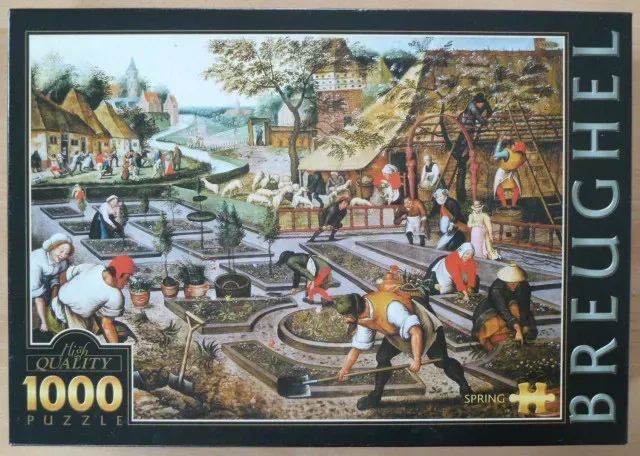
This detailed Renaissance-style painting captures a busy spring day in a rural community. The foreground is dominated by a formal garden with geometrically shaped planting beds where several figures are actively gardening, digging, and tending to small plants. In the mid-ground, a group of people works near a thatched-roof structure, with some climbing ladders, while a flock of sheep rests near a fence. The background reveals a quaint village with a winding path leading toward distant stone buildings and a church tower.
The composition is dense and layered, typical of late 16th-century Flemish art. The perspective is slightly elevated, allowing the viewer to take in the entire scope of the industrious village life. The layout balances the systematic rows of the garden against the more organic, sprawling movement of the people in the village and the natural flow of the nearby path.
The colour palette features earthy tones, dominated by shades of brown, green, and muted ochre, reflective of early spring soil and vegetation. Small splashes of red and bright clothing on the figures provide visual focal points throughout the scene. The lighting is soft and even, typical of the period's style, casting subtle shadows that define the figures and the topography of the garden beds.
This artwork is a reproduction of a painting, likely from the school of Pieter Bruegel, characterized by fine brushwork and a narrative focus on common folk. Every corner of the image is filled with activity, emphasizing the connection between the changing seasons and the
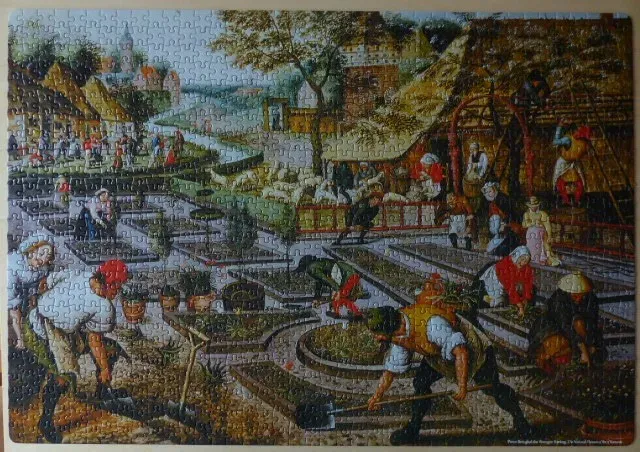
This detailed Renaissance-style painting depicts a sprawling, vibrant garden filled with numerous figures engaged in agricultural labor. In the foreground, individuals in period clothing are busy digging in the soil, planting, and tending to structured garden beds arranged in geometric patterns. The figures are captured in various poses, some bending over their work while others stand and walk between rows of plants, showcasing the busy rhythm of rural life.
Beyond the primary garden area, the scene extends into a pastoral landscape. A stream winds through the background, separating the cultivation area from a small village with thatched-roof houses and a church tower visible in the distance. To the right, a large structure with a timber frame and roof serves as a workspace, where people are occupied with additional chores, including climbing ladders and managing livestock. A flock of sheep rests near a wooden fence, adding to the bustling, communal atmosphere of the countryside.
The color palette is rich and earthy, dominated by shades of deep green, golden browns, and terracotta, reflecting the textures of soil, vegetation, and traditional building materials. The light appears soft and diffuse, highlighting the intricate details of the clothing, the garden beds, and the surrounding scenery. The composition is dense and layered, typical of late medieval or Northern Renaissance art, creating a narrative-filled view of seasonal labor and village life.