American Military Posters
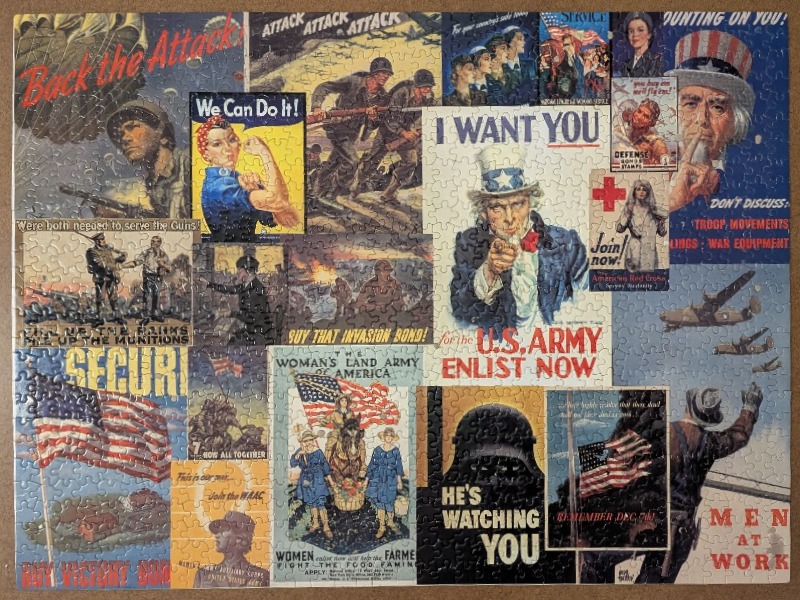
This image is a detailed collage of classic World War II-era American recruitment and propaganda posters. The composition features various iconic illustrations, including the famous "I Want You" Uncle Sam poster which acts as a central focal point, and the "We Can Do It!" Rosie the Riveter figure. Other prominent imagery includes soldiers marching in formation, scenes of factory workers, and depictions of the Woman's Land Army, all arranged in an overlapping, layered layout.
The artwork showcases the distinct graphic style of mid-20th-century American propaganda, using bold typography and patriotic themes. The colours are largely muted and earthy, dominated by deep blues, rustic reds, and parchment-like creams, reflecting the aged look of historical prints. Bright white and yellow accents are used strategically to draw the eye to key slogans and messaging.
The content highlights various aspects of the wartime effort, ranging from direct military enlistment calls to civilian industrial support and home-front contributions. Several posters incorporate American flags, military hardware like aircraft, and stylized silhouettes of soldiers. The collection effectively captures the aesthetic of wartime mobilisation, using a mix of illustrative styles that range from dramatic realism to sharp, iconic graphic design.
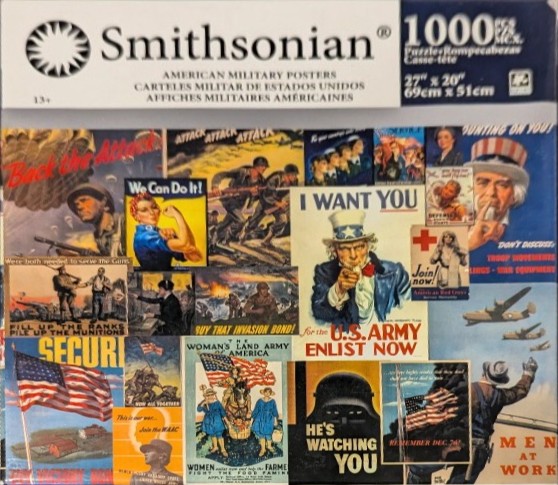
This collection of historical graphic art features a dense montage of American military recruitment and propaganda posters, primarily from the World War I and World War II eras. The composition is a rich tapestry of iconic imagery, including soldiers in battle, nurses, and symbolic figures such as Uncle Sam and Rosie the Riveter. The posters are layered over one another in a mosaic pattern, creating a busy and visually engaging display of patriotic history.
Prominent figures stand out throughout the arrangement. A large representation of Uncle Sam pointing his finger with the text "I WANT YOU" anchors the center-right, while another smaller, somber Uncle Sam looks on from the upper-right corner. Rosie the Riveter is clearly visible on the left with her iconic flexed-arm pose. Various scenes depict soldiers charging into combat, artillery units, and air force bombers flying across the sky. Several posters incorporate symbols of national identity, such as the American flag, which appears in multiple designs.
The colour palette is dominated by bold, patriotic hues of red, white, and blue, contrasted with earthy tones of khaki, olive drab, and deep blacks used to depict military equipment and war-torn landscapes. The artistic style varies across the collage, reflecting the diverse graphic design trends of the mid-20th century, ranging from dramatic, painterly illustrations of battle scenes to clean, bold, text-heavy advertisements. The overall mood is one of historical gravitas, urgency, and nationalistic pride.