Vintage Fashion
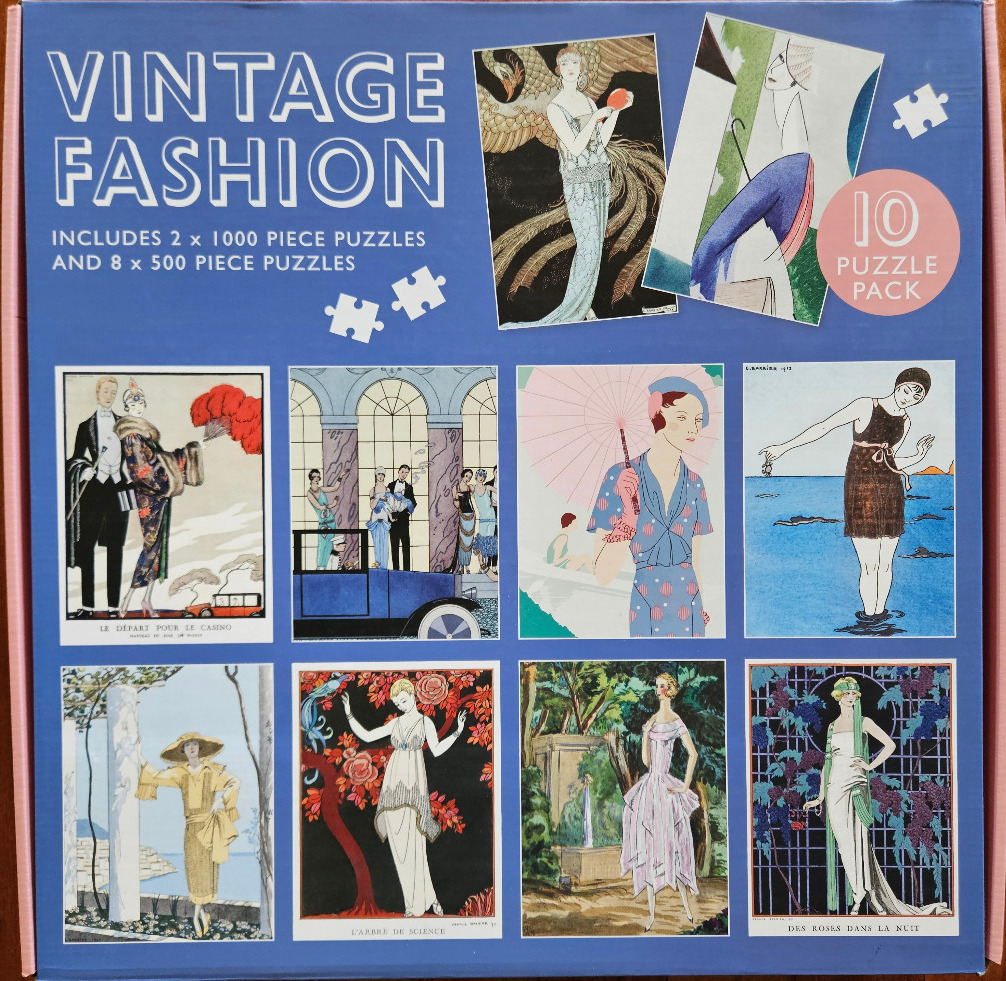
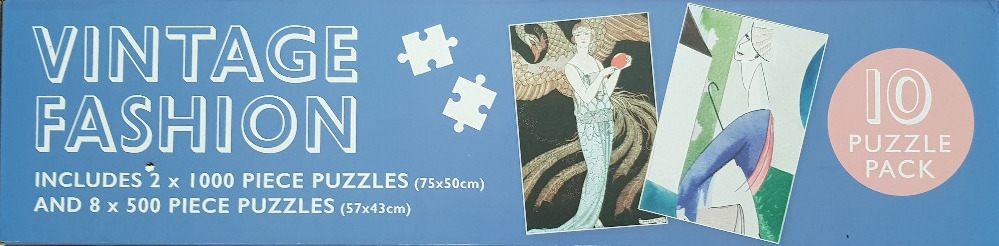
This collection features ten individual Art Deco illustrations organized in a grid against a solid periwinkle blue background. Each image highlights fashionable women from the early 20th century, captured in elegant poses and wearing period-specific attire like flapper dresses, long gowns, cloche hats, and stylish wraps. The artistic styles vary slightly across the panels, ranging from graphic, high-contrast silhouettes to softer, watercolor-like depictions of social scenes and leisurely strolls.
The layout includes two images overlapping near the top, while the remaining eight are arranged in a neat grid of two rows of four. The scenes are diverse: one shows a woman standing in shallow water, another captures a couple near a luxury automobile, and others feature individuals amidst lush gardens, against decorative trellises, or posing under elaborate umbrellas. Several include captions or signatures in the corners.
The overall mood is one of sophisticated nostalgia, celebrating the glamour and geometric elegance of the Roaring Twenties. The illustrations utilize a palette of muted tones—soft pinks, deep blues, and creamy whites—set against the bold, flat blue field of the background, creating a harmonious yet varied visual experience that emphasizes the grace and poise of classic fashion illustration.
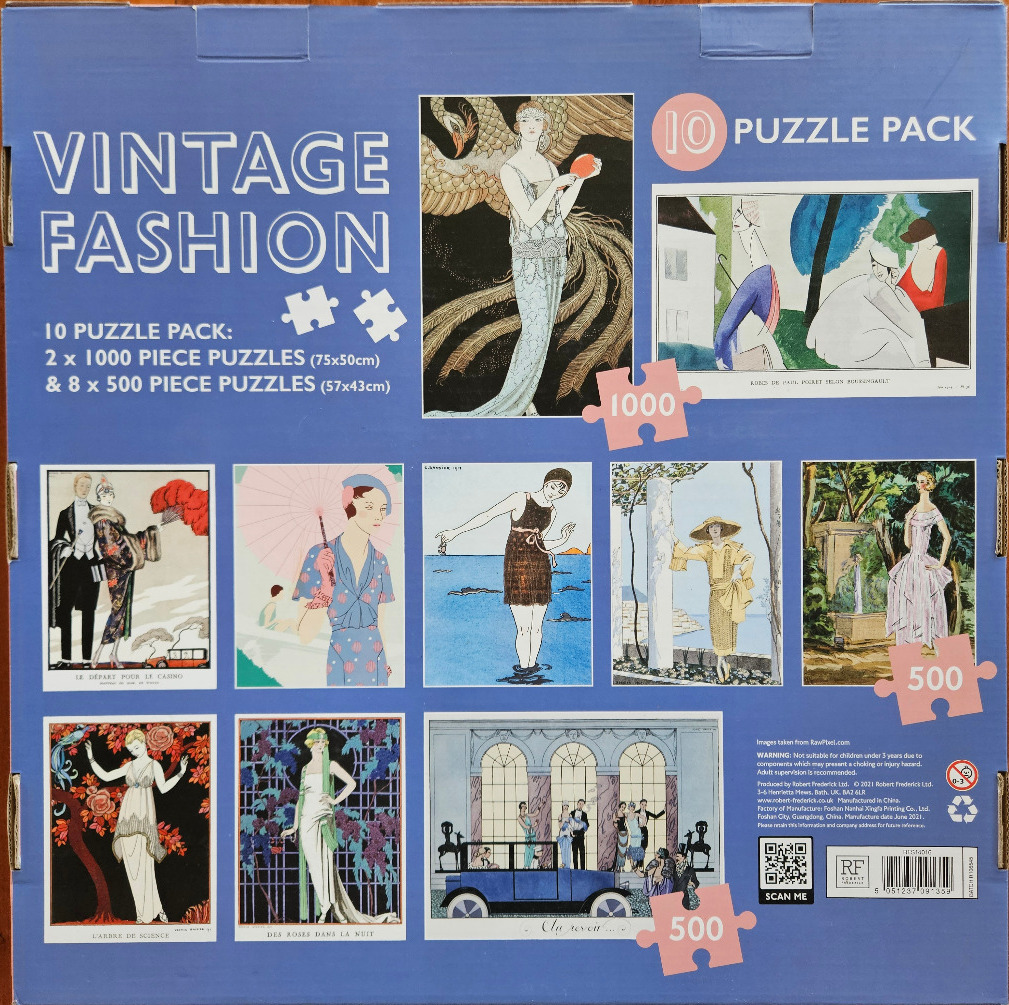
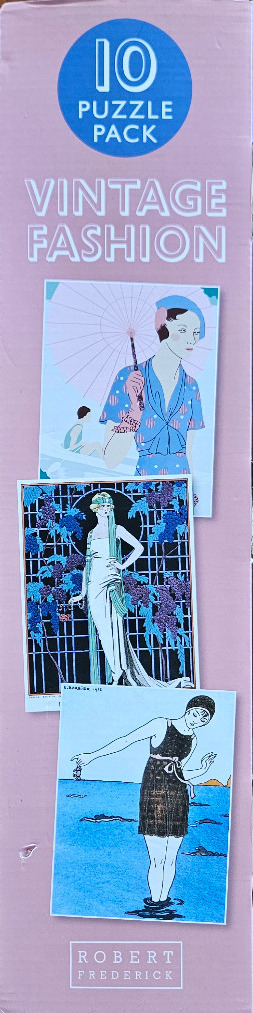
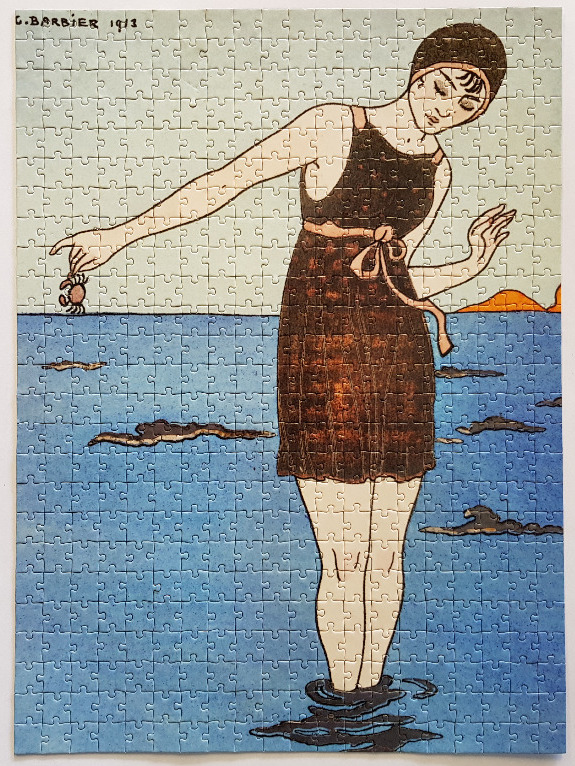
This vintage illustration from 1913, signed by G. Barbier, depicts a stylized woman standing in shallow seawater. The central figure wears a dark, patterned bathing dress with a waist tie and a matching dark bathing cap. She leans slightly to her left, extending her right arm to delicately hold a small crab between her thumb and forefinger, while her left hand is raised gracefully near her face.
The composition is divided horizontally by the shoreline. The upper portion, representing the sky, is a soft, pale cream colour, while the lower portion depicts the sea in shades of textured blue. Small, dark, abstract ripples or shadows are scattered across the water, and the base of the woman’s legs creates a darker reflection where she stands. In the distance, a simple, thin orange horizontal line suggests a low coastline or distant hills.
The artwork is rendered in the elegant, linear style typical of the early twentieth-century fashion illustration. It employs a limited, muted colour palette that emphasizes clean, bold outlines and graphic forms. The woman’s pose is graceful and poised, evoking a sense of calm, leisure-time nostalgia typical of the period's aesthetic.
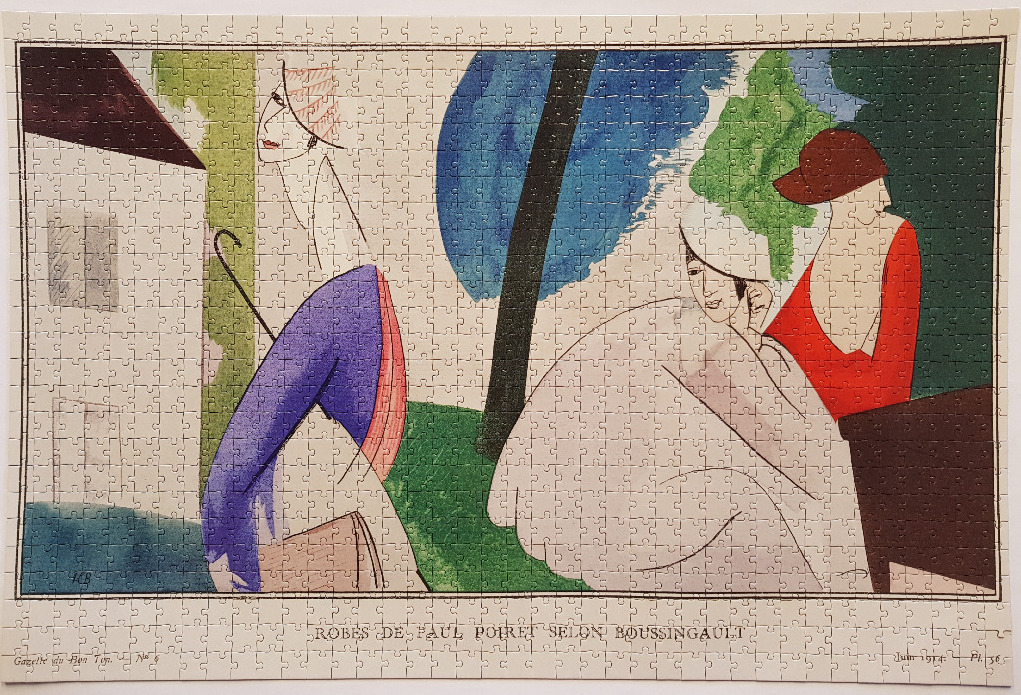
This art deco illustration depicts two stylized women in early 20th-century fashion set within a simplified, illustrative landscape. On the left, a woman stands near a stark white building, wearing a blue-sleeved garment and a striped hat, while holding a thin cane. To her right, a second woman is shown in profile, wearing a wide-brimmed reddish-brown hat and a red dress, seated or leaning against a dark table or structure.
The composition is minimalist and graphic, utilizing bold shapes and clean lines characteristic of early 1910s fashion plates. A large, circular blue form suggests a sun or moon behind a central tree trunk, creating a focal point between the two figures. Green foliage and grassy areas provide blocks of colour, contrasting with the negative space of the white building and the pale, ink-outlined bodies of the figures.
The aesthetic is reminiscent of a watercolour and ink drawing, featuring a muted yet vibrant palette of primary colours, including deep blue, bright red, and varied shades of green. The mood is sophisticated and elegant, evoking a sense of refined leisure. The text "ROBES DE PAUL POIRET SELON BOUSSINGAULT" is printed at the bottom, along with small archival notations like "Gazette du Bon Ton" and "Juin 1914," grounding the image as an authentic historical fashion illustration.
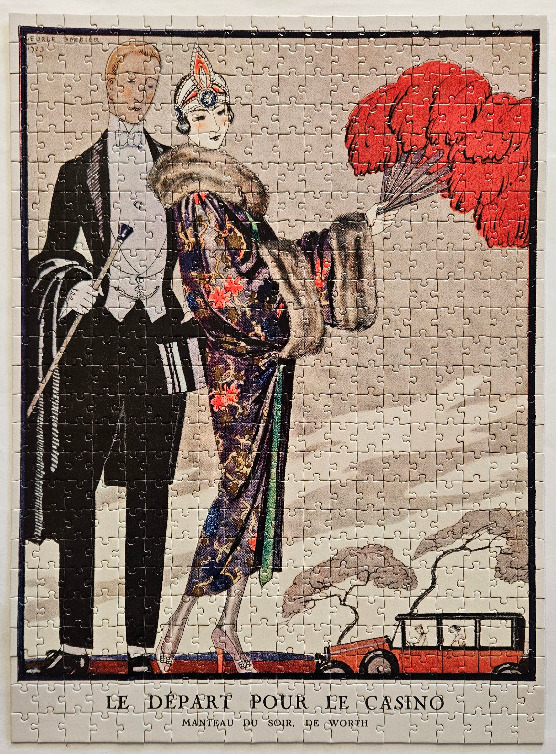
This Art Deco fashion illustration depicts a stylish couple standing in an outdoor setting, likely preparing for an evening at a casino. The woman is the primary focus, dressed in an ornate, dark, patterned evening coat trimmed with thick fur, and wearing an elaborate, jewel-toned headpiece. She holds a large, vibrant red feather fan. Beside her, a man stands in formal evening attire, including a black tailcoat, white waistcoat, and bow tie, while holding a walking cane.
The composition is vertical and stylized, reminiscent of early 20th-century fashion magazine plates. In the background, a simplified, flat-topped vintage automobile is parked near some sparse, stylized trees. The color palette is sophisticated, utilizing deep purples, golds, and blacks, contrasted sharply by the brilliant, saturated red of the fan and the car. The lighting is even and graphic, typical of the era's illustration style.
The artwork has a refined, elegant mood, evoking the glamour of the 1920s. Along the bottom edge, text reads "LE DÉPART POUR LE CASINO" and "MANTEAU DU SOIR, DE WORTH," identifying the fashion piece. The artist's signature and date, "GEORGES BARBIER 1923," are tucked into the upper-left corner of the image, grounding the work firmly in the high fashion aesthetic of the post-war Jazz Age.
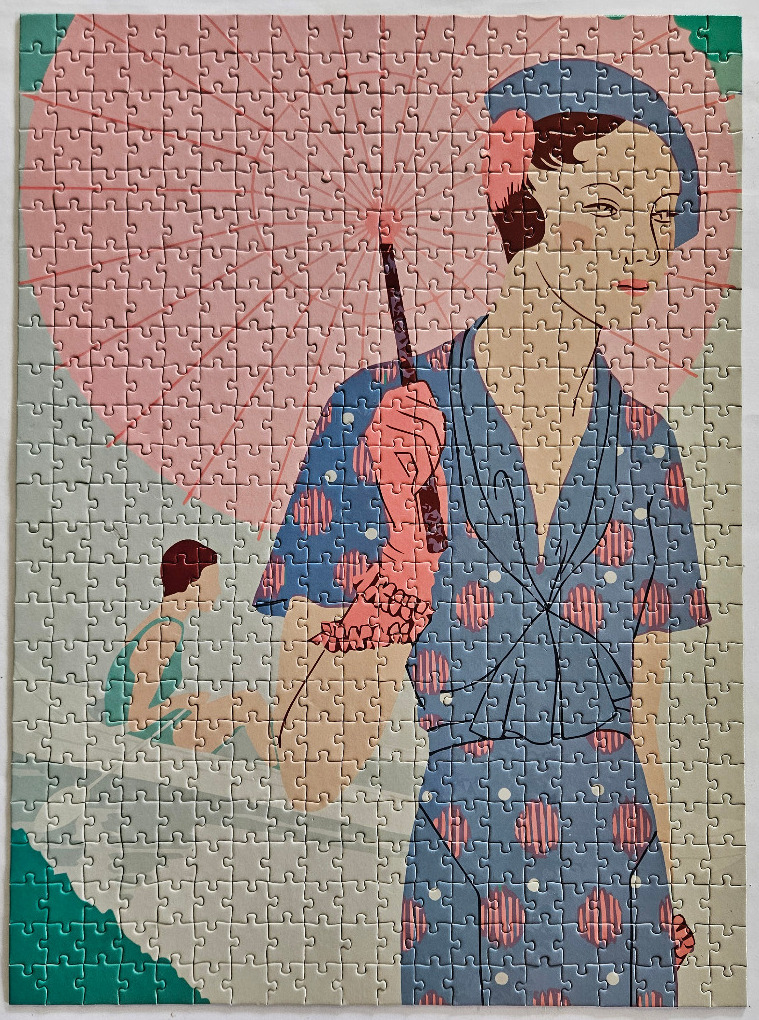
This Art Deco style illustration features a stylish woman in the foreground, standing on a beach. She is wearing a blue short-sleeved dress decorated with large pink polka dots and a matching blue cloche-style hat. She holds a large, translucent pink parasol over her shoulder, which creates a soft, circular focal point behind her head. Her expression is serene, with clean, defined features typical of early 20th-century fashion illustration.
In the background, a second figure is visible, sitting on the sand near the water's edge. This smaller figure is dressed in a simple green swimsuit and has a short, dark hairstyle, suggesting a quiet day by the sea. The composition uses flat planes of colour and bold, simplified shapes to evoke a nostalgic, coastal atmosphere.
The colour palette is dominated by muted, vintage tones, primarily dusty blues, warm flesh tones, and soft pinks, contrasted against the deep green of the foreground grass or dune edge. The light appears soft and diffuse, typical of a summer day at the shore. The overall medium is a graphic illustration that emphasizes geometric elegance and smooth, flowing lines, characteristic of the era's artistic sensibilities.
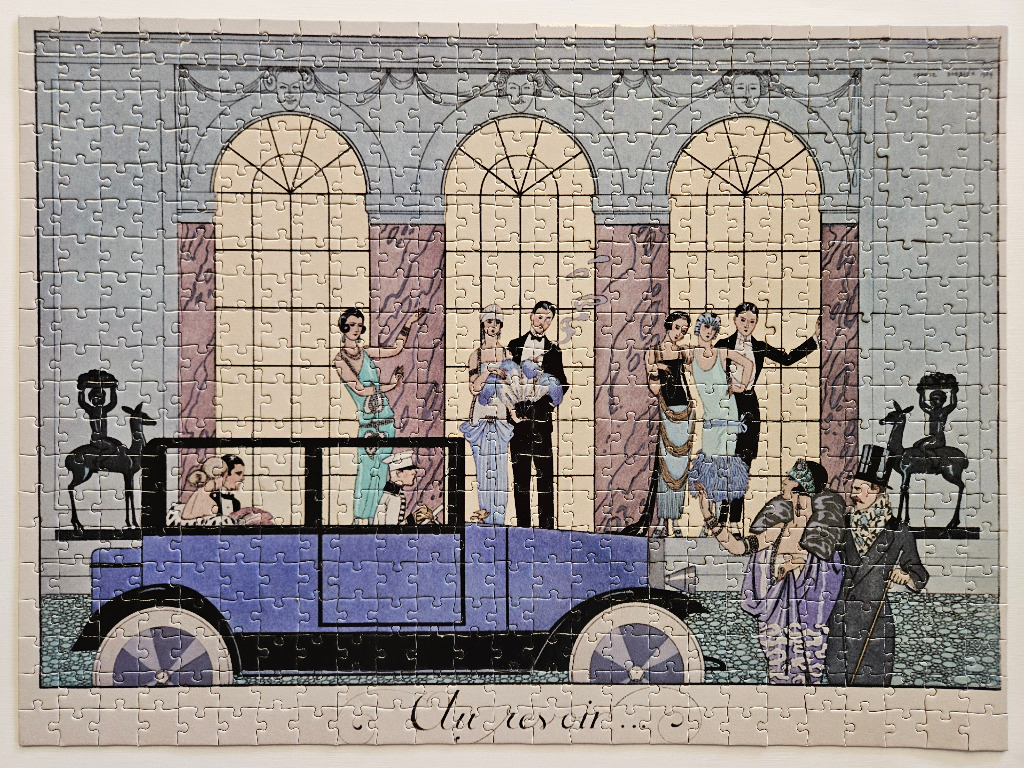
This Art Deco illustration captures a fashionable 1920s scene set before a grand, architectural backdrop. The composition features a sleek, blue vintage automobile parked in the foreground, with a chauffeur behind the wheel and passengers visible inside. To the right, a couple in formal evening wear—a woman in an elegant, ruffled gown and a man in a top hat and tailcoat—appear to be saying farewell, echoing the elegant text at the bottom that reads "Au revoir...".
Behind the vehicle, three large, arched floor-to-ceiling windows create a rhythmic, symmetrical structure. Within these arches, several figures are depicted in flapper-style dresses and formal suits, interacting in a social setting. Two stylized statues of deer being held aloft by silhouettes are positioned on either side of the car, grounding the scene and adding to the sophisticated, theatrical aesthetic of the era.
The color palette relies on muted, sophisticated tones, with the vibrant blue of the car providing a strong focal point. Soft purples, creams, and greys define the building walls and the cobblestone-like ground, while the line work is precise and elegant, characteristic of the stylized fashion illustrations of the Roaring Twenties. The lighting suggests a clear, ambient glow emanating from the arches, lending a dreamy, nostalgic quality to this high-society moment.
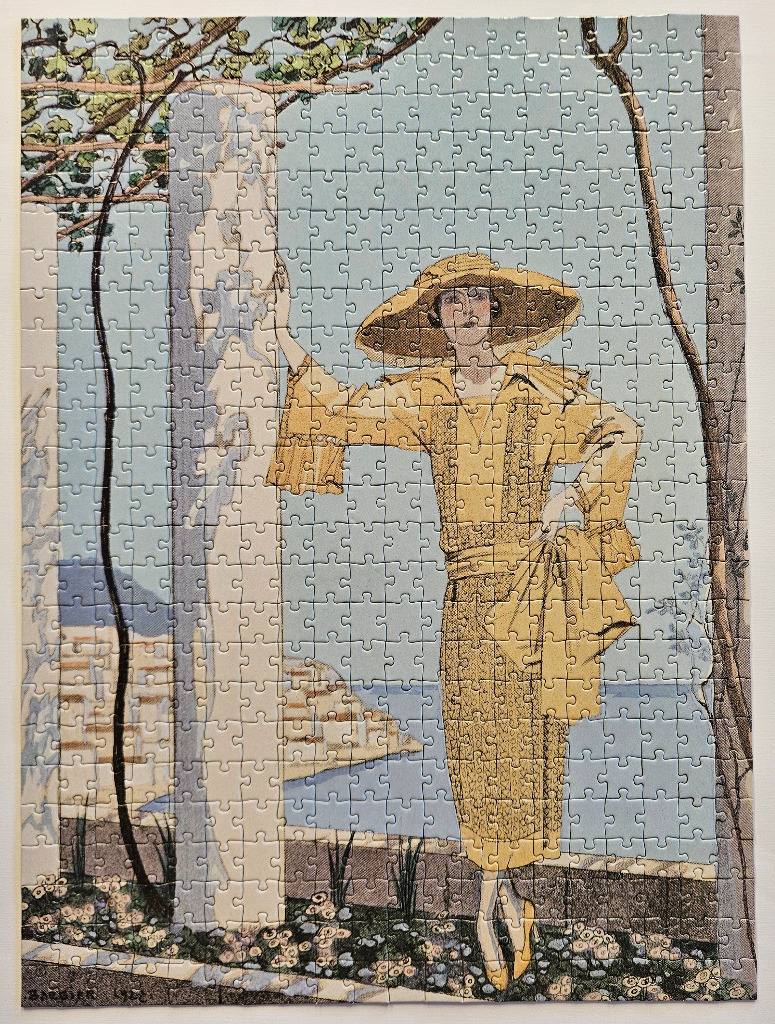
This Art Deco illustration features a graceful woman standing on a balcony, leaning against a tall, stone column. She wears a vibrant yellow dress with intricate lace-like patterns and a wide-brimmed hat that matches her outfit. Her pose is relaxed and elegant, with one hand resting on the column and the other on her hip, while her gaze is directed towards the viewer with a calm, serene expression.
Behind her, a scenic coastal view unfolds, revealing a turquoise sea and a distant hillside town filled with cream-colored buildings. The composition is framed by the vertical lines of the architecture and the delicate, dark branches of a tree that arch over the top of the scene. The foreground includes a low stone wall and a patch of blooming white flowers, creating a sense of depth that draws the eye from the lush garden into the expansive Mediterranean horizon.
The artwork is rendered in a soft, sun-drenched colour palette dominated by warm yellows and cool, muted blues. The lighting suggests a peaceful, bright afternoon. The style is classic 1920s graphic art, characterized by clear outlines, flat planes of colour, and stylized, decorative details that evoke a sense of leisure and travel in a coastal European setting.