Sleighing in Winter/Stourbridge Lion
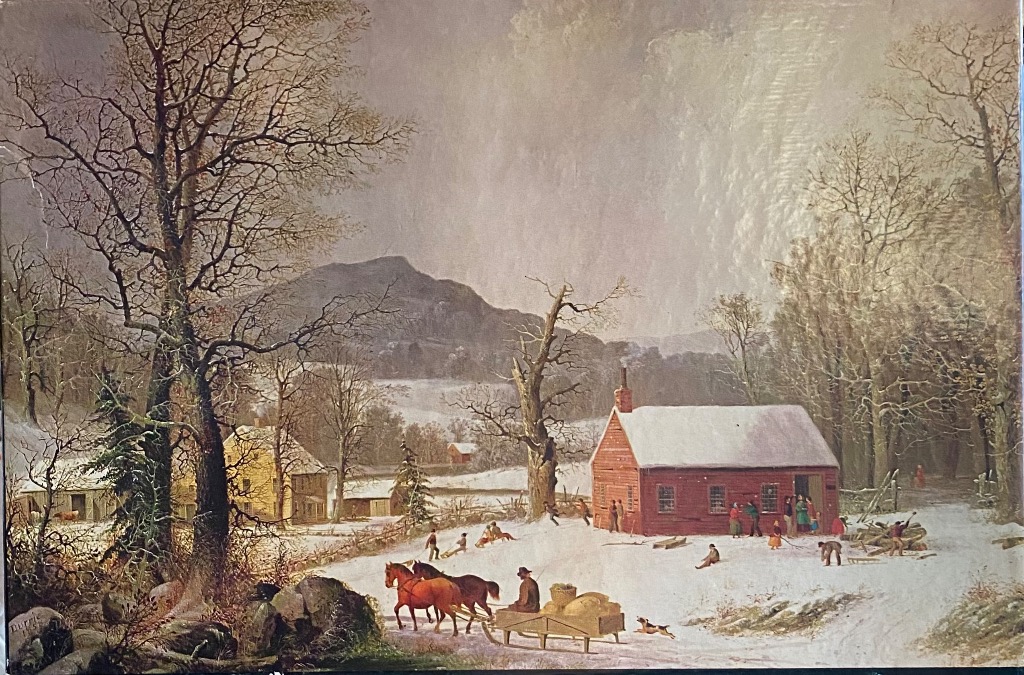
This pastoral winter scene features a sprawling, snow-covered landscape punctuated by rural buildings and leafless trees. In the foreground, a horse-drawn cart carrying burlap sacks moves across the snowy ground, driven by a man. To the right, a prominent red schoolhouse sits as the focal point, surrounded by small groups of figures in Victorian-era clothing who are socializing, playing, or performing chores in the wintry air.
Beyond the schoolhouse and the cart, the composition recedes toward a gentle hillside that rises in the distance. To the left, a cluster of houses and outbuildings nestles among skeletal trees, with a large, gnarled tree dominating the immediate left foreground. The layout creates a sense of depth, drawing the eye from the foreground activity toward the quiet, distant slopes. A small dog runs near the cart, adding a sense of life to the chilly, quiet setting.
The artwork uses a muted, naturalistic colour palette dominated by snowy whites, muted greys, and earthy browns, with the deep red of the schoolhouse providing a striking visual anchor. The lighting suggests a cold, overcast winter day, with soft, diffused shadows and a somber, atmospheric sky. The scene is rendered in an illustrative, painterly style typical of 19th-century American folk art, emphasizing detail in the architecture and human interaction to convey a peaceful, traditional country life.
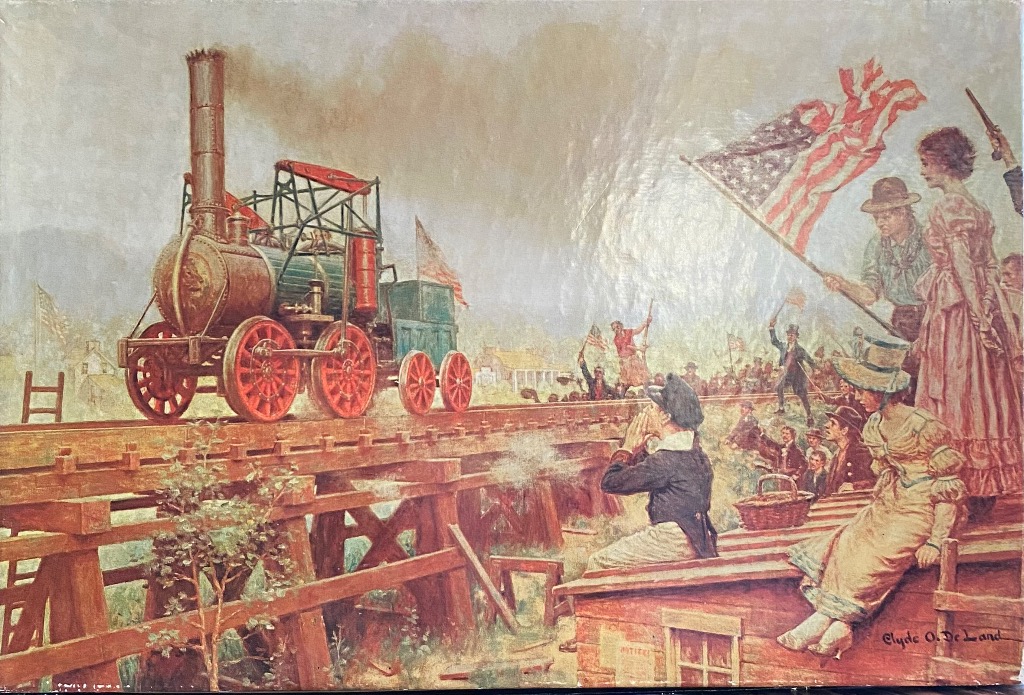
This historical illustration depicts a vintage, early 19th-century steam locomotive traveling across a wooden trestle bridge. The train features an upright boiler, prominent red-spoked wheels, and a square green tender carriage. Smoke billows from the tall smokestack, trailing back over the bridge structure and into the hazy sky. In the background, rolling hills suggest a rural American landscape.
To the right, a celebratory crowd gathers along the tracks to welcome the locomotive. A woman in a long Victorian-style gown and a man in a wide-brimmed hat wave American flags enthusiastically. Several other figures in period clothing stand nearby, cheering or gesturing toward the oncoming engine. In the foreground, a man in a dark frock coat and top hat kneels on the edge of the wooden platform, hands clasped as if in awe or anticipation.
The artwork is rendered in a traditional, painterly style with a muted, earthy color palette dominated by browns, ochres, and faded greens. Soft, atmospheric lighting enhances the historical feel, with the scene appearing somewhat washed in the hazy light of a bright day. The composition emphasizes the contrast between the rigid, mechanical lines of the steam engine and the organic, crowded scene of the cheering onlookers.