Heide Bij Laren
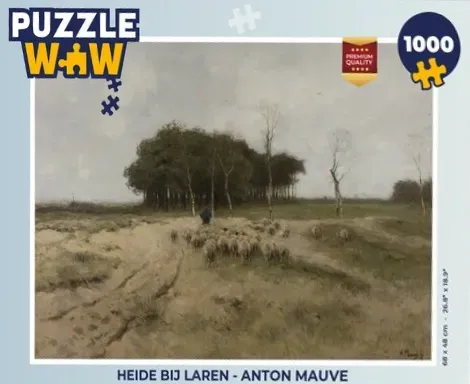
The central focus of this pastoral landscape is a small shepherd and their flock of sheep, which occupy the mid-ground. The sheep are clustered together, moving slowly across the uneven, sandy terrain of the heath. A solitary shepherd, dressed in dark clothing, leads the flock toward a dense, dark cluster of trees that rises from the flat landscape in the background.
Set in a wide, expansive open field, the composition emphasizes the vastness of the countryside. The ground is a blend of pale, sandy soil and sparse, dry patches of grass, showing the rugged texture of the heath. Several thin, bare trees stand starkly against the horizon, balancing the heavier weight of the woodland grove on the left. The scene is depicted from a low perspective, drawing the eye across the textured ground toward the hazy distant treeline.
The colour palette is intentionally muted, dominated by earth tones including soft browns, beiges, and muted olives. Above, a heavy, uniform sky of pale grey and off-white light casts a soft, diffuse glow over the entire scene, eliminating harsh shadows and contributing to a contemplative, melancholic atmosphere. The work is a 19th-century oil painting, characterized by loose, textured brushwork that captures the quiet, atmospheric essence of rural life during a cloudy day.
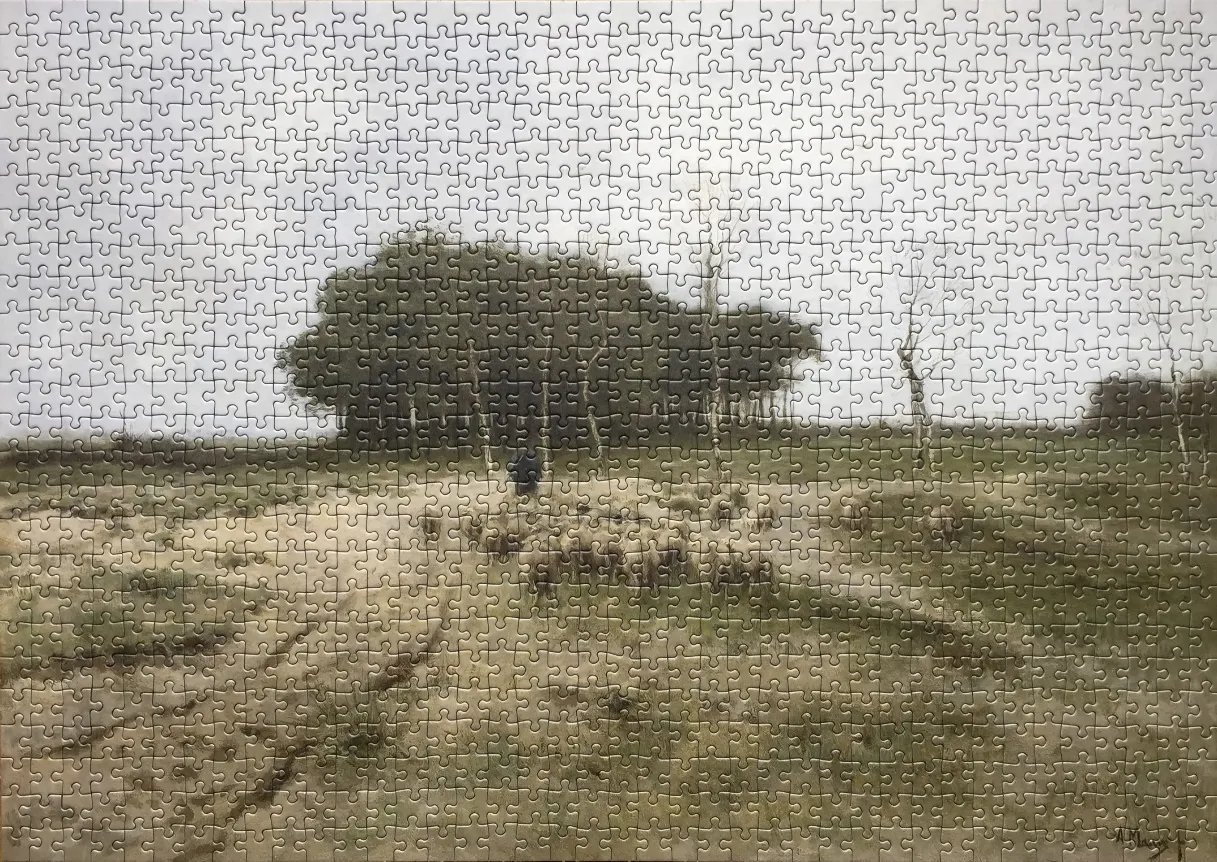
This atmospheric oil painting depicts a solitary shepherd tending to a large flock of sheep in a vast, open landscape. The shepherd is a small, dark figure positioned near the center of the composition, standing before a dense, shadowy cluster of trees that loom in the mid-ground. The sheep are clustered closely together, blending into the earthy tones of the terrain, forming a textured mass that occupies the lower portion of the frame.
The scene is characterized by a heavy, overcast atmosphere and a subdued colour palette dominated by shades of muted green, beige, ochre, and soft grey. A thick, low-hanging mist blankets the background, obscuring the horizon and creating a sense of infinite, quiet space. The light is diffused and flat, suggesting a damp, chilly day in late autumn or early spring. Sparse, thin tree trunks are scattered across the right side of the field, adding vertical interest to the otherwise horizontal landscape.
The painting style is impressionistic and somber, focusing on the moody interplay of light and shadow rather than crisp detail. The artist's brushwork is visible, contributing to the soft, hazy appearance of the distant trees and the rolling ground. A signature, "A. Mauve," is tucked into the bottom right corner of the work, indicating its origin as a classic 19th-century landscape composition.