The Dispatch Bearer
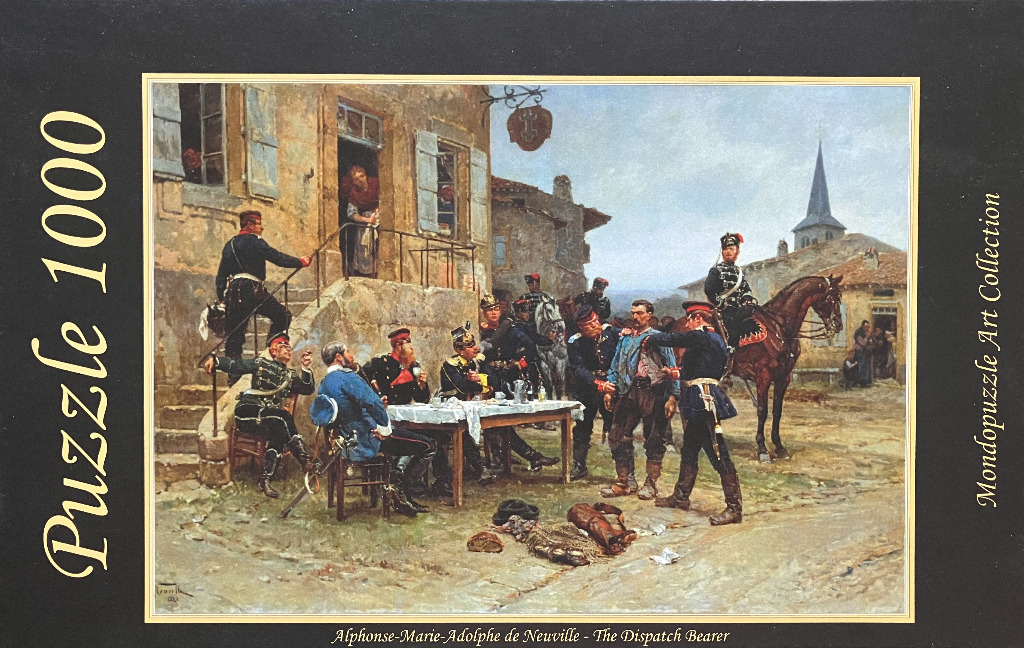
This 19th-century historical oil painting, "The Dispatch Bearer" by Alphonse-Marie-Adolphe de Neuville, depicts a group of French soldiers gathered in a dusty village square. The focal point is a disheveled man in tattered blue clothing standing in the center, being addressed by an officer. Surrounding him, several soldiers in dark uniforms with red accents sit around a makeshift table covered with a white cloth, while another officer sits tall on a brown horse to the right. A woman stands in the doorway of a rustic stone building in the background, observing the scene.
The composition is anchored by the stone architecture on the left and the horse on the right, creating a triangular grouping that emphasizes the interaction in the center. In the distance, the spire of a village church rises above simple dwellings under a soft, overcast sky. The foreground is cluttered with discarded items, including a hat and pieces of gear, suggesting a casual, weary respite for the troops.
The colour palette is earthy and subdued, dominated by stone greys, dusty browns, and the deep, muted tones of the soldiers' uniforms. The light is diffused, typical of a cloudy afternoon, casting soft shadows and highlighting the textures of the soldiers' wool uniforms and the weathered masonry of the inn. The painterly style captures a sense of realism, focusing on the human expressions and the gritty, weary atmosphere of military life during a campaign.

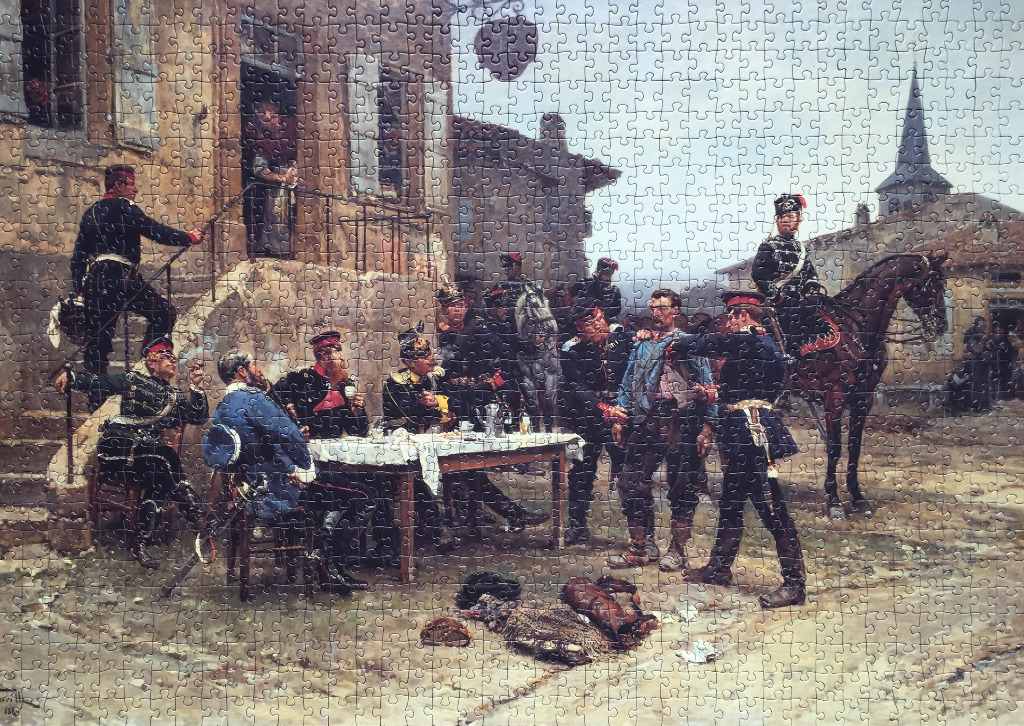
This historical genre painting depicts a group of 19th-century soldiers gathered in a dusty village square. The scene is centered around a group of officers seated at a table covered with a white cloth, enjoying drinks and conversation. To the right, a soldier in a blue tunic, who appears to be a captive or prisoner, is being held by two other uniformed men. One officer stands nearby, his hand firmly on the prisoner's collar, while another uniformed figure waits on horseback in the background.
Architectural elements frame the scene, including stone buildings with steep staircases and a distant church spire visible against the pale sky. The composition creates a narrative of military occupation, with figures positioned across the foreground and middle ground, suggesting a transient moment of leisure interrupted by the presence of a captive. A few discarded items lie on the dirt ground in the lower center, adding a sense of realism to the rustic setting.
The colour palette is dominated by muted, earthy tones—ochres, greys, and browns—which evoke the dusty environment of a mid-19th-century rural town. The soldiers' uniforms, featuring dark blues, blacks, and touches of red, provide sharp contrast against the light-coloured stone walls. The lighting is soft and diffused, characteristic of a cloudy day, creating long, subtle shadows that ground the figures in the space. The painterly style features fine brushwork that emphasizes the textures of the stone, the soldiers' fabric uniforms, and the weathered appearance of the village square.