Die Malkunst
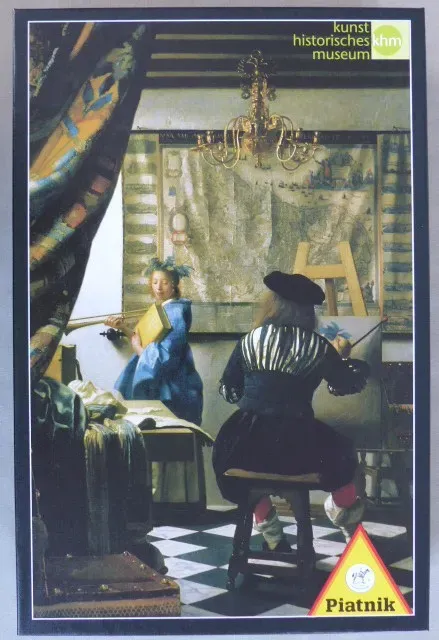
This iconic 17th-century oil painting, 'The Art of Painting' by Johannes Vermeer, captures an intimate view inside a Dutch master's studio. In the foreground, an artist sits with his back to the viewer, wearing a black doublet with slashed sleeves, diligently painting a model on his canvas. The model stands to the left, dressed in a flowing blue silk robe and a laurel wreath, holding a brass trumpet and a large book, symbolizing Clio, the muse of history. A heavy, decorative tapestry is pulled back on the far left, framing the scene and adding depth to the room.
The studio interior is defined by a striking black-and-white checkered marble floor that leads the eye toward the figures. A large, ornate map of the Netherlands hangs on the back wall, serving as a prominent backdrop, while a delicate brass chandelier hangs from the ceiling beams above. An easel stands prominently in the center, and the overall composition feels structured and serene, typical of the Dutch Golden Age.
The artwork is bathed in a soft, natural light, likely streaming from a window hidden behind the heavy foreground curtain. The color palette is rich and sophisticated, dominated by deep blacks, vibrant blues, warm gold tones in the chandelier, and the earthy textures of the wood and wall. The light creates subtle shadows and highlights on the model's drapery and the artist's costume, enhancing the realistic, three-dimensional quality of the oil-on-canvas technique.
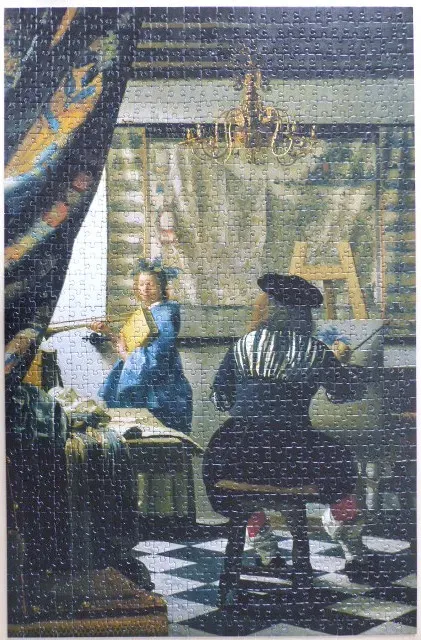
This painting depicts an interior studio scene in the Dutch Golden Age style. In the foreground, an artist sits with his back to the viewer, hunched over a canvas upon an easel, holding a palette and brushes. He wears a dark doublet with white puffed sleeves and a black beret. Facing him to the left, a young woman stands near a window as his muse, wearing a flowing blue gown and a laurel wreath, holding a brass trumpet and a book.
The studio is lit by natural light streaming from a window on the left, partially obscured by a heavy, ornate curtain draped in deep blues and ochre patterns. The floor is tiled in a classic black and white checkered pattern, leading the eye toward the rear wall. A large, intricate golden chandelier hangs from the ceiling in the center, and a large map is mounted on the wall behind the subjects. An empty wooden easel stands nearby, suggesting the work is in progress.
The colour palette is rich and atmospheric, dominated by deep shadows, cool blues, and warm golden highlights. The lighting is dramatic, emphasizing the contrast between the sunlit model and the focused, darker work area of the painter. The composition is structured and architectural, characteristic of classical interior genre paintings that emphasize perspective and realistic textures, from the folds of the heavy curtain to the reflective qualities of the metallic chandelier.