Hero Worship
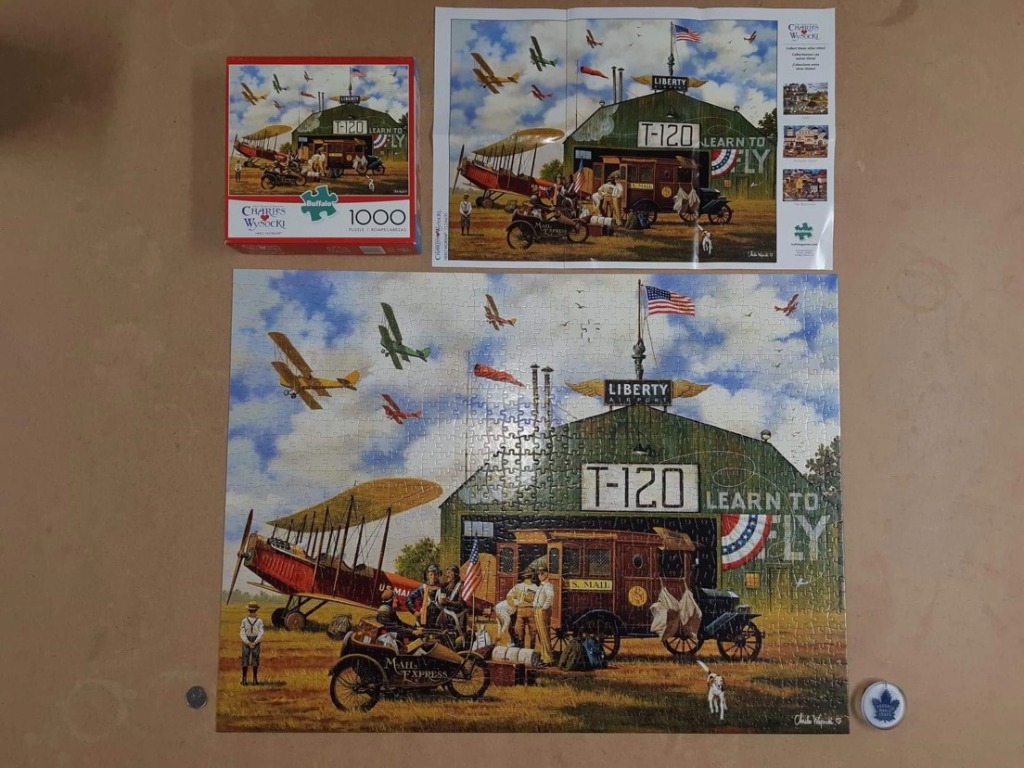
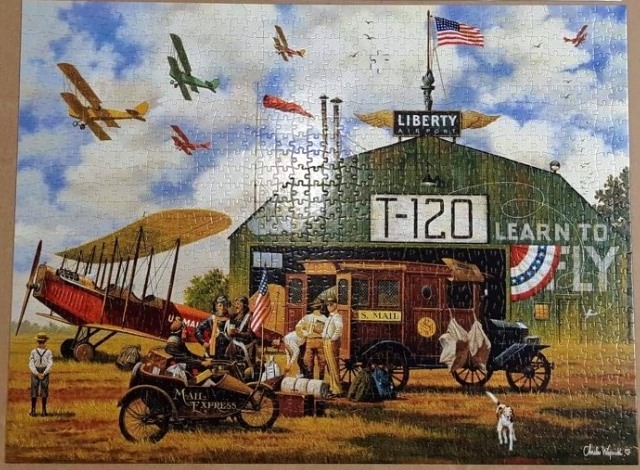
This nostalgic illustration depicts a bustling early 20th-century airfield centered around a large, green, corrugated-metal hangar marked "Liberty Airport" and "T-120." A bright red-and-white biplane rests in the foreground, while a vintage "U.S. Mail" transport truck is parked in front of the hangar doors. Several figures in period-appropriate attire, including aviators and ground crew, are gathered near a small "Mail Express" motorcycle sidecar, appearing to prepare for an incoming flight.
The setting is a vast, golden-brown grassy field under a bright blue sky filled with scattered white clouds. The composition is dynamic, with various biplanes of different colours—including yellow, red, and green—soaring through the air in the upper left and far distance. An American flag waves atop the hangar, and a banner reading "Learn to Fly" is draped prominently on the building's side. A small dog trots across the foreground, adding a sense of life to the scene.
The artwork style is realistic with a painterly touch, emphasizing warmth and historical charm. The colour palette is dominated by earthy browns, vibrant greens of the hangar, and the pops of primary colours from the planes and flags. The light appears to be that of a sunny, late afternoon, casting soft shadows across the field and highlighting the metallic textures of the aircraft and the weathered surfaces of the hangar.
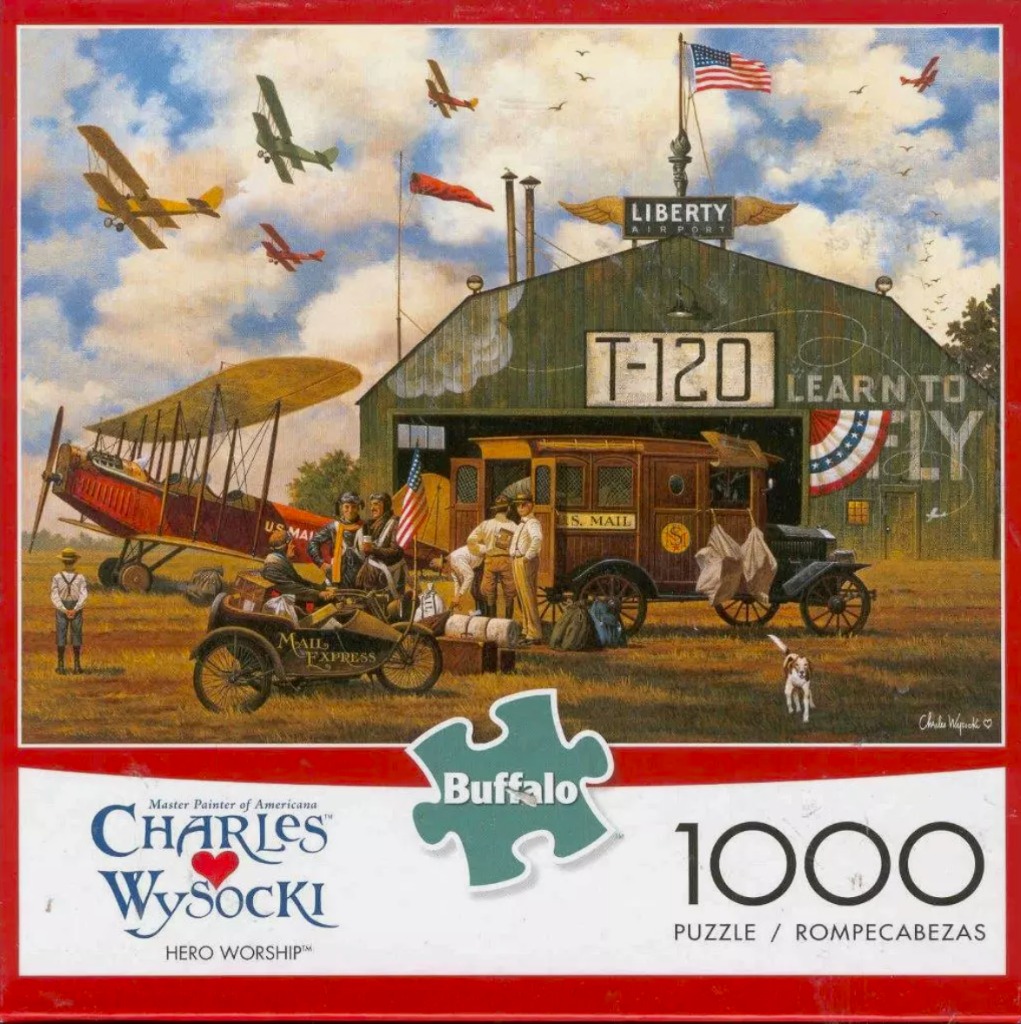
This Americana-style painting captures a busy scene at Liberty Airport, featuring early 20th-century aviation. A large green hangar labeled "T-120" and "LEARN TO FLY" serves as the focal point, with a vintage "U.S. MAIL" truck parked in front. Several figures dressed in period pilot gear stand near the vehicle, while a "Mail Express" motorcycle sidecar sits in the foreground. To the left, a large red biplane labeled "U.S. MAIL" is grounded, with a young boy looking on from the side.
The composition is filled with motion, as various vintage aircraft, including yellow, green, and red biplanes, soar through a vast, cloud-dappled sky. Above the hangar, an American flag waves from a pole. The setting is a grassy airfield under a bright, expansive sky that transitions from pale blue to warm, sunlit tones. A small dog trots across the foreground towards the right, adding a touch of life to the pastoral landscape.
The artistic style is nostalgic and detailed, reminiscent of folk art, with warm, earthy tones dominating the ground and deep greens for the wooden hangar structure. The light suggests a clear, pleasant day, highlighting the textures of the vintage machinery and the soft, painterly clouds. The overall mood is one of adventurous history, celebrating the early days of airmail and pilot culture.
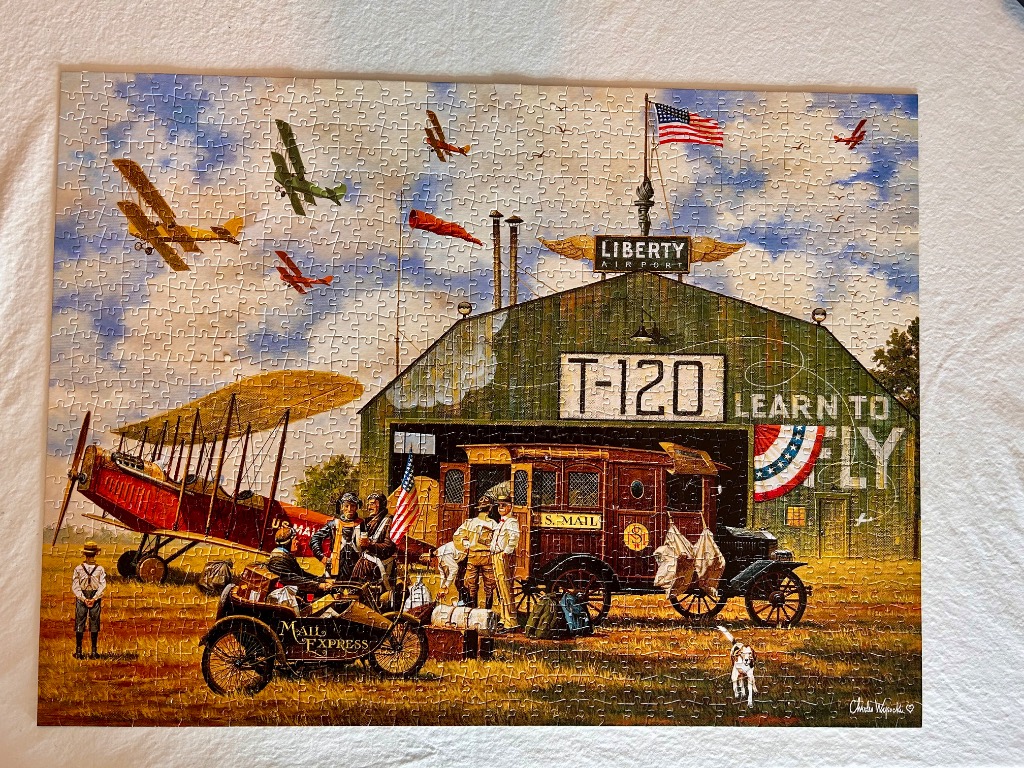
This nostalgic illustration depicts a bustling early 20th-century airfield, centered on a large, weathered green hangar labeled "Liberty Airport" and "T-120." In the foreground, pilots in vintage flight gear stand beside a classic "U.S. Mail" truck and a mail-carrying motorcycle. A large red biplane is parked on the grass to the left, while several other airplanes soar through the sky above.
The composition is set on a grassy airfield under a bright blue sky filled with puffy white clouds. The color palette features earthy greens, warm ochres, and muted reds, giving the scene a warm, historic feel. An American flag flies atop the hangar, and a red windsock hangs nearby, adding to the period-specific atmosphere.
Detail-oriented in style, the scene captures the charm of early aviation with painted textures and soft lighting. A small dog trots along the foreground, and the words "LEARN TO FLY" are painted prominently on the side of the hangar. The overall mood is whimsical and celebratory, evoking a bygone era of adventure and the golden age of mail delivery by air.
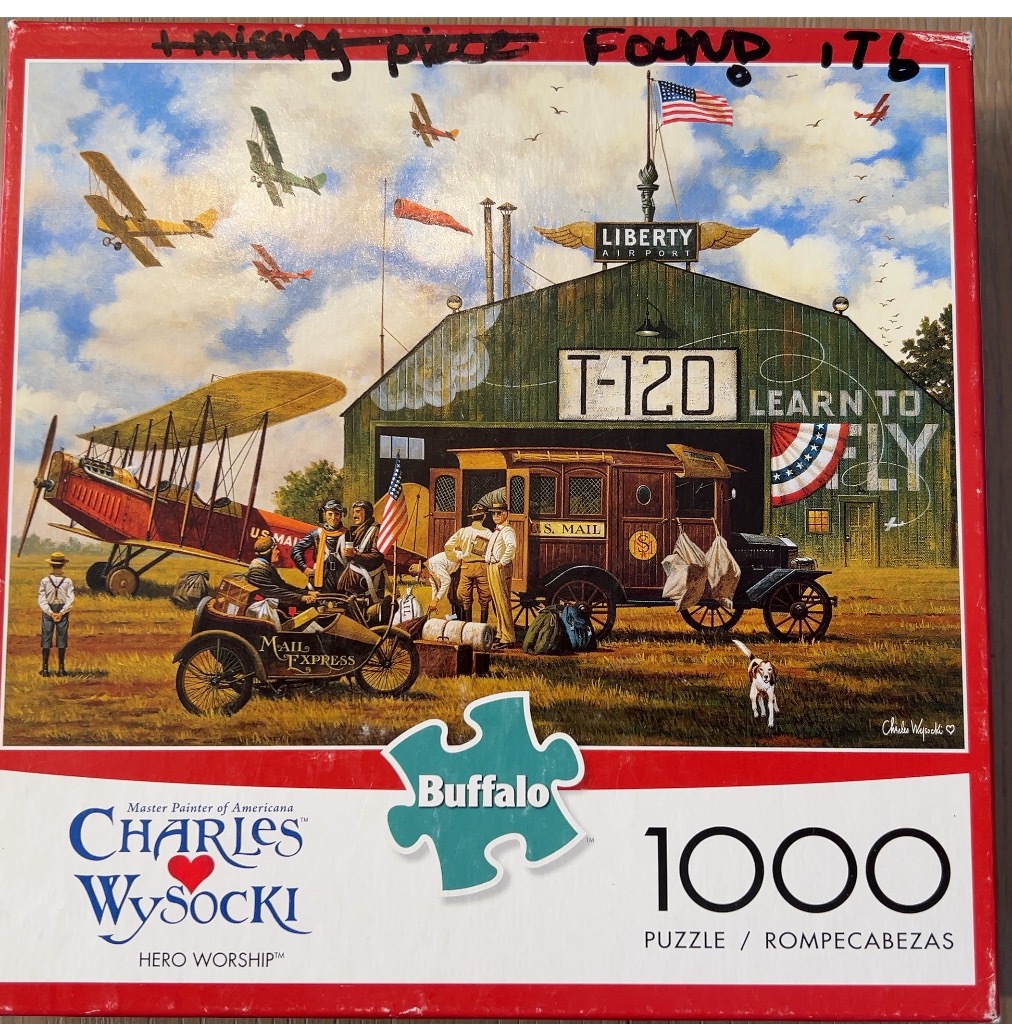
This nostalgic illustration depicts an early 20th-century airfield scene centered around a rustic green hangar labeled "Liberty Airport" and "T-120 Learn to Fly." A large, bright red biplane rests on the grass in the foreground, while a vintage U.S. Mail carriage sits near the open hangar doors. Several figures dressed in period attire, including pilots in leather caps and goggles, are gathered around the vehicle and aircraft, seemingly preparing for a delivery or flight.
The composition is filled with period-accurate details, including a classic "Mail Express" motorcycle with a sidecar, a small dog running across the grass, and a young boy standing nearby. Above the hangar, the sky is active with multiple biplanes flying among fluffy white clouds, with an American flag waving from the peak of the roof. A festive banner hangs by the side entrance of the structure, adding to the patriotic and historical atmosphere.
The artwork uses a warm, earthy palette dominated by the muted green of the hangar, the deep red of the biplane, and the sun-drenched golden grass of the field. The sky features soft blues and warm whites, giving the scene an optimistic, bright feel. The style is detailed and representational, characteristic of Americana folk art, emphasizing charm, historical accuracy, and a sense of bustling activity. The overall mood is peaceful and nostalgic, capturing a moment in the golden age of early aviation.
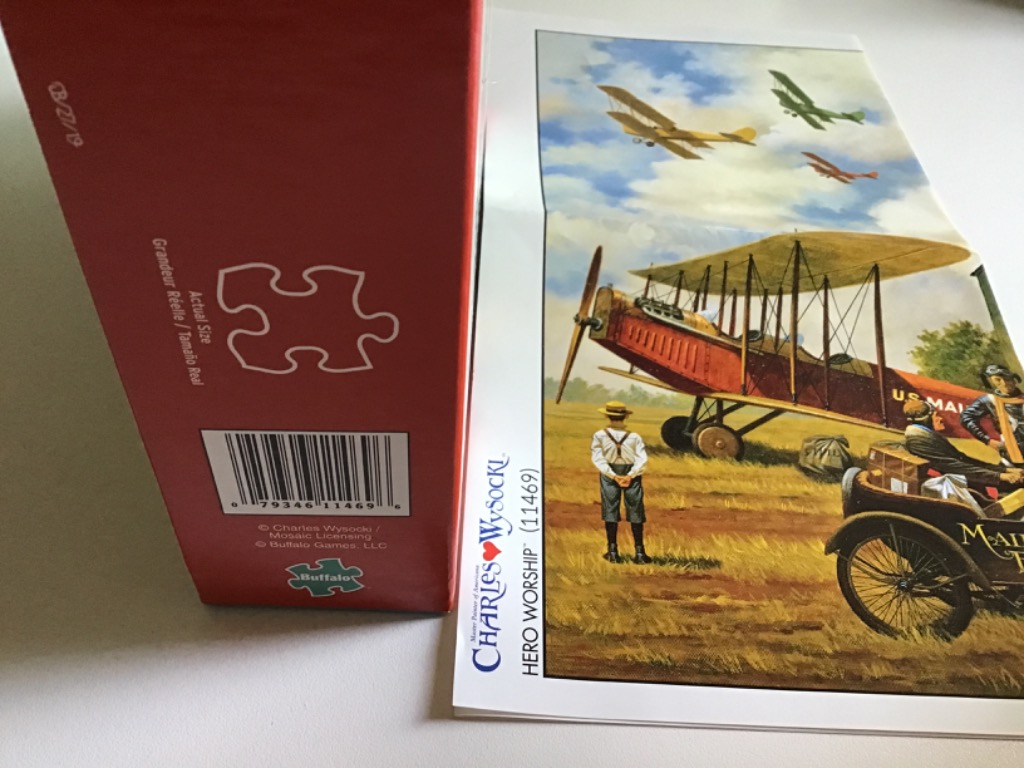
The scene depicts a sunny, nostalgic airfield from the early 20th century. A large, vintage biplane with a bright red fuselage, labeled "U.S. MAIL," sits prominently on a dry, golden-yellow grass field. In the foreground, a young boy wearing a straw boater hat and suspenders stands with his back to the viewer, looking up at the aircraft. To the right, a vintage automobile is parked with a person inside, appearing to interact with the cargo or mail being handled near the plane.
Above the scene, the bright blue sky is filled with soft, white cumulus clouds. Several other vintage biplanes are captured in flight at various distances, with one prominent yellow plane near the center and others appearing smaller in the distance. The overall composition evokes a sense of wonder and historical aviation, framed by the quiet, sun-drenched landscape.
The artwork is rendered in a realistic, painterly style characterized by warm, golden tones in the grass and earthy colors on the aircraft and vehicle. The light is bright and directional, casting long, subtle shadows across the field, which reinforces the peaceful, mid-day atmosphere. Fine details, such as the wire rigging on the biplanes and the period-accurate clothing, contribute to the nostalgic, Americana aesthetic of the piece.
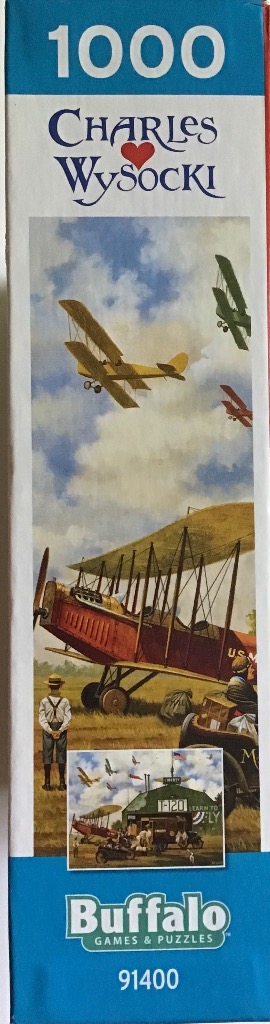
The main artwork depicts a nostalgic scene featuring vintage biplanes in flight and on the ground. A bright yellow biplane is captured soaring through a sky filled with soft, white cumulus clouds against a vibrant blue background. In the foreground, a large, weathered red biplane sits stationary on a grassy field. A person wearing a straw hat and vintage attire stands with their back to the viewer, gazing up toward the aircraft, while another individual is visible nearby near a vintage vehicle.
At the bottom of the image, an inset rectangular illustration shows a wider view of an airfield with a green hangar labeled "T-120." This smaller scene features multiple biplanes, figures on the ground, and a classic motorcycle, emphasizing a charming, early-20th-century aviation atmosphere.
The overall style is that of a traditional representational painting with rich, warm tones in the field and crisp detailing on the aircraft. The composition evokes a sense of wonder and historical discovery, utilizing a mix of earthy greens and golds for the landscape balanced against the clear, airy palette of the sky. The lighting is bright and sunny, highlighting the textures of the plane surfaces and the grassy textures of the field.

The image displays the side panel of a vertical rectangular package, featuring a uniform, deep brick-red background. The composition is strictly oriented vertically, with clean, sans-serif white typography and graphic symbols arranged along the central axis.
At the top, the text reads "CHARLES WYSOCKI" in a stylized, decorative font, with a small heart icon integrated into the lettering, followed by the title "HERO WORSHIP" and the number "1000" in large, bold characters. Below this is a simple, white line-art icon of a single puzzle piece shape.
Further down the panel, a larger white outline of a puzzle piece is presented next to the text "Actual Size" and its translations in French and Spanish. At the base of the panel sits a standard product barcode, followed by copyright information and a small, green puzzle-piece logo icon at the very bottom edge. The overall aesthetic is functional and minimalist, relying on high contrast between the bold white elements and the dark red field.
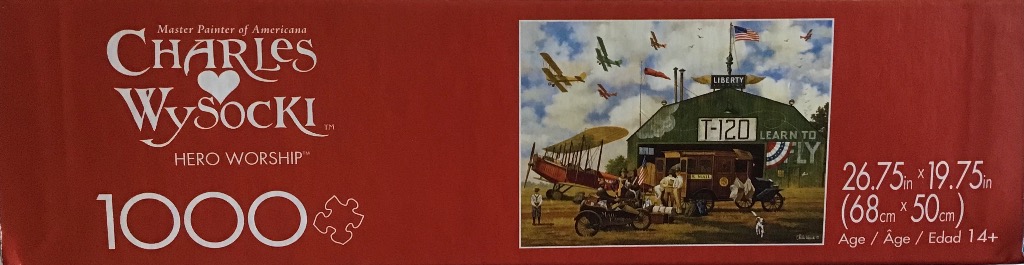
The central image depicts a nostalgic scene at a rustic airfield during the early era of aviation. A large, weathered green wooden hangar dominates the right side of the composition, marked with the text "T-120" and "LEARN TO FLY" in white block letters. A small sign atop the roof reads "LIBERTY," and an American flag waves from a pole above it. Several vintage biplanes in various colours, including yellow and green, are shown in flight against a bright blue sky filled with fluffy white clouds.
In the foreground, a large, weathered red biplane sits grounded in front of the hangar. Near the entrance, a small group of people in period-appropriate attire interact with a vintage mail delivery truck. A person sits in a small, low-profile vehicle near the center, while a small dog stands to the right. The field is composed of dry, golden-brown grass, grounding the scene in a sense of historical simplicity.
The artwork is rendered in a folk art style characterized by warm, inviting tones and a soft, painterly quality. The light suggests a pleasant, sunny afternoon, casting gentle shadows across the field. The overall mood is one of patriotic whimsy and historical curiosity, capturing the excitement of early flight through the lens of traditional American heritage art.
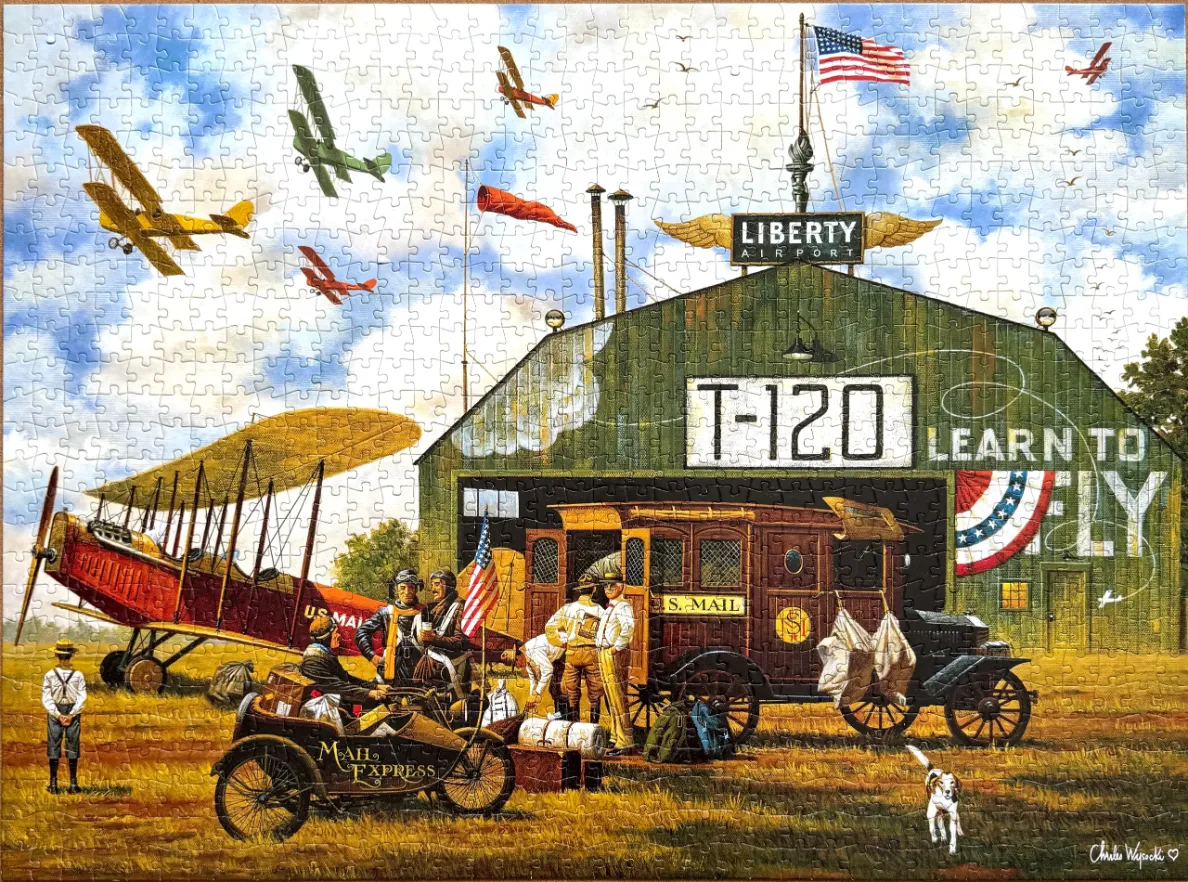
This nostalgic, Americana-style illustration depicts a bustling early 20th-century airfield titled "Liberty Airport." The focal point is a large, weathered green wooden hangar marked with the designation "T-120" and the words "Learn to Fly." In front of the structure, men in vintage flight gear and casual period attire gather around a horse-drawn mail carriage and a small motor-driven "Mail Express" vehicle. A small dog trots across the grassy foreground, while a young boy in suspenders stands to the left, watching the activity.
Surrounding the hangar are several biplanes in flight, showcasing various bold colours like yellow, red, and green against a bright, cloudy sky. An American flag flies prominently from the roof of the hangar, adding to the patriotic theme. To the right of the hangar entrance, bunting in red, white, and blue decorates the side, enhancing the historic atmosphere.
The painting uses a warm, earthy colour palette dominated by olive greens, toasted browns, and deep reds, contrasted by the vibrant blue of the sky. The light is soft and golden, suggesting a pleasant, clear afternoon. The style is detailed and representational, characteristic of early 1900s aviation art, capturing a sense of pioneering spirit and community around the golden age of flight.
I enjoyed this one. Nice combination of larger and smaller objects. No quality issues.
by LakeBird 2026-04-03