The Coronation of the Emperor and Empress, 1805-1807

This classical oil painting captures a grand historical ceremony, specifically the coronation of the Emperor and Empress. The central focus is a large group of figures gathered inside a vast, opulent cathedral. Napoleon stands prominently in the center-right, while the Empress is kneeling before him. They are surrounded by an assembly of dignitaries, clergy, and attendants dressed in elaborate 19th-century court attire, including velvet cloaks, military uniforms, and ornate gowns.
The setting is an imposing architectural space defined by soaring stone pillars and deep, emerald-green drapery that hangs from the high ceiling. The composition is balanced and theatrical, drawing the viewer's eye across the expansive floor toward the altar area. In the background, tiered seating balconies are filled with additional spectators, adding depth and a sense of scale to the event. To the left, a raised platform with red curtains and golden trim highlights the significance of the participants.
The palette is rich and warm, dominated by deep crimsons, regal golds, and dark greens, punctuated by the stark white of the Empress’s dress. The lighting is dramatic, suggesting the flickering warmth of candlelight mixed with natural rays filtering through unseen upper windows, creating soft highlights on the satin fabrics and gilded decorations. The artistic style is Neoclassical, characterized by smooth, detailed brushwork and a realistic, documentary-like approach to capturing the scale and importance of the historical moment.
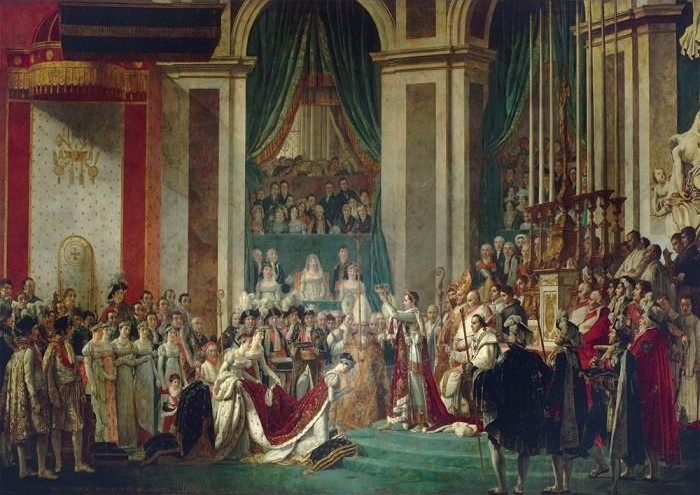
This grand historical painting depicts the elaborate coronation ceremony within a vast, ornate cathedral. At the center of the composition, a central figure stands on a dais, holding a crown high above his head to crown a kneeling woman, who wears a luxurious, flowing gown with a long, velvet train. They are surrounded by an immense crowd of dignitaries, clergymen, and attendants, all dressed in formal, high-status attire of the period, including military uniforms and elegant gowns.
The setting is marked by massive stone architectural elements, tall archways, and heavy, deep green velvet curtains that add a sense of solemnity and enclosure. A gallery in the background is filled with additional spectators looking down upon the event. Tall, thin candles and religious icons stand to the right, emphasizing the formal, ritualistic nature of the scene. The composition is horizontally expansive, with the subjects distributed in a way that suggests a dense, bustling gathering.
The color palette is rich and regal, dominated by deep crimsons, golds, and emerald greens against the muted, light-colored stone of the cathedral interior. The light is soft and diffuse, appearing to emanate from unseen sources, highlighting the textures of heavy fabrics, metallic embroidery, and the varied expressions on the faces of the multitude. The style is classicist, characterized by precise detail, balanced structure, and a polished finish typical of 19th-century history painting.