Tree of Life
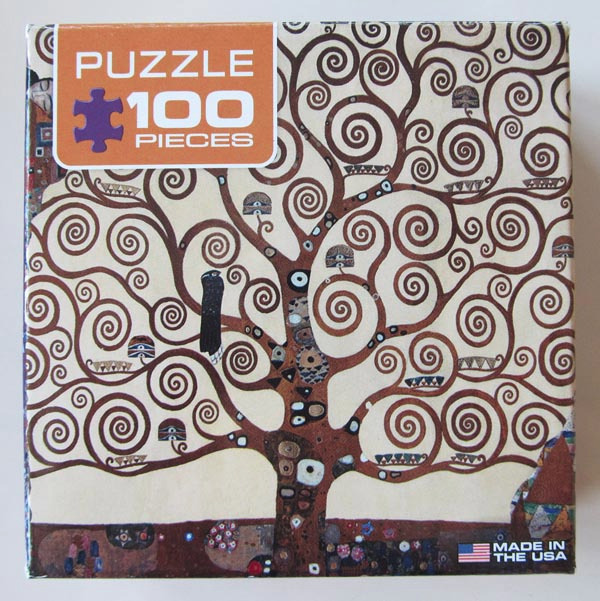
The central focus is a highly stylized, decorative tree inspired by Gustav Klimt's famous work. The tree features a sturdy, textured trunk that rises from a dark, mosaic-like base. Its sprawling branches extend outwards and upwards, curling into intricate, repetitive spirals that create a dense, web-like canopy across the entire image.
The composition is balanced and symmetrical, dominated by the contrast between the dark, ornate lines of the tree and the smooth, pale cream-colored background. Small, scattered geometric symbols and patterns are embedded within the branches, including semi-circular motifs and eye-like shapes that add a layer of abstract detail to the organic structure. A singular, tall, dark bird silhouette is perched on one of the branches to the left.
The artwork uses a muted, earthen color palette, relying primarily on deep browns, blacks, and soft creams. The style is classic Art Nouveau, characterized by flowing lines, rhythmic patterns, and ornamental detail. The bottom edge of the frame depicts a dark, segmented landscape reminiscent of a garden or forest floor, further grounding the abstract tree in a rich, textured setting.
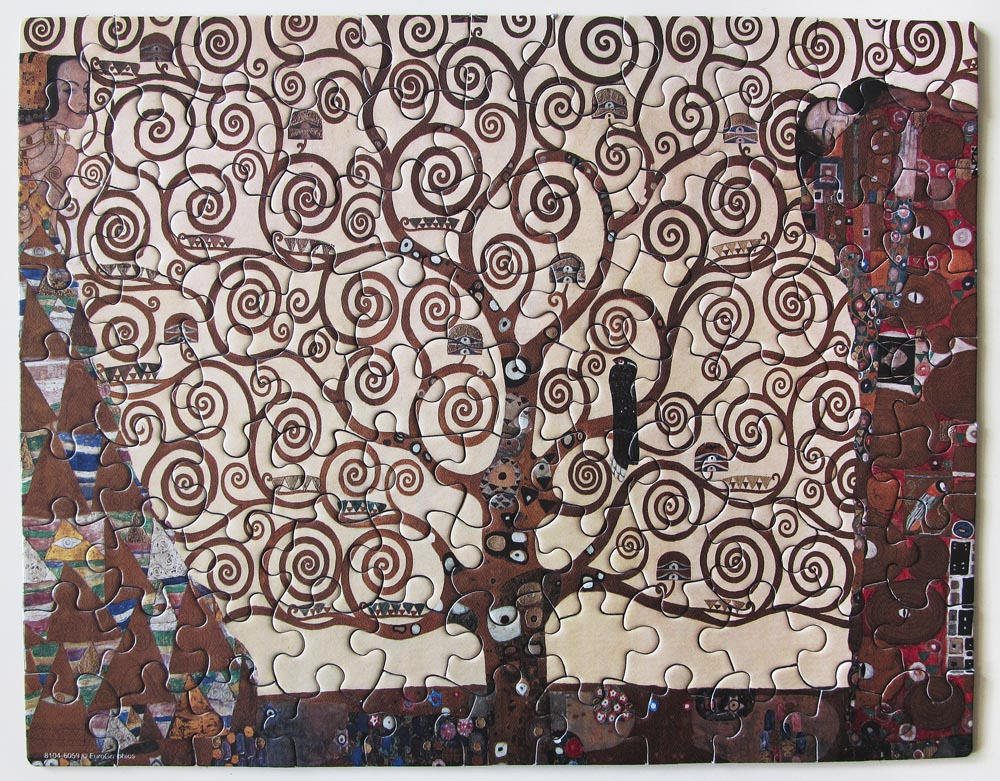
This image is a reproduction of the iconic "Tree of Life" painting, characterized by its intricate, flowing composition and decorative symbolism. The central focus is a large, stylized tree with thick, dark brown branches that extend outward in a series of dramatic, golden-hued spirals. These ornamental curves fill the majority of the frame, creating a rhythmic and hypnotic pattern that draws the eye across the expanse of the canopy.
On the far left and right edges, the composition is anchored by two standing figures draped in patterned garments. The figure on the right is shown in profile, leaning toward the tree, while the figure on the left is partially visible at the edge of the frame. Below the branches, the base of the tree is set against a dark, earthy foreground adorned with mosaic-like details, geometric shapes, and small, abstract floral patterns that add depth and contrast to the lighter background.
The artwork uses a rich, warm palette dominated by shades of cream, gold, and deep brown, accented with small pops of colour in the decorative elements. The style is distinctly Art Nouveau, featuring flat perspective, complex ornamentation, and a focus on symbolic representation rather than realism. The overall mood is one of elegance and timelessness, reflecting the refined aesthetic of the late nineteenth and early twentieth-century Viennese Secession movement.