The Sunflower Quilting Bee at Arles
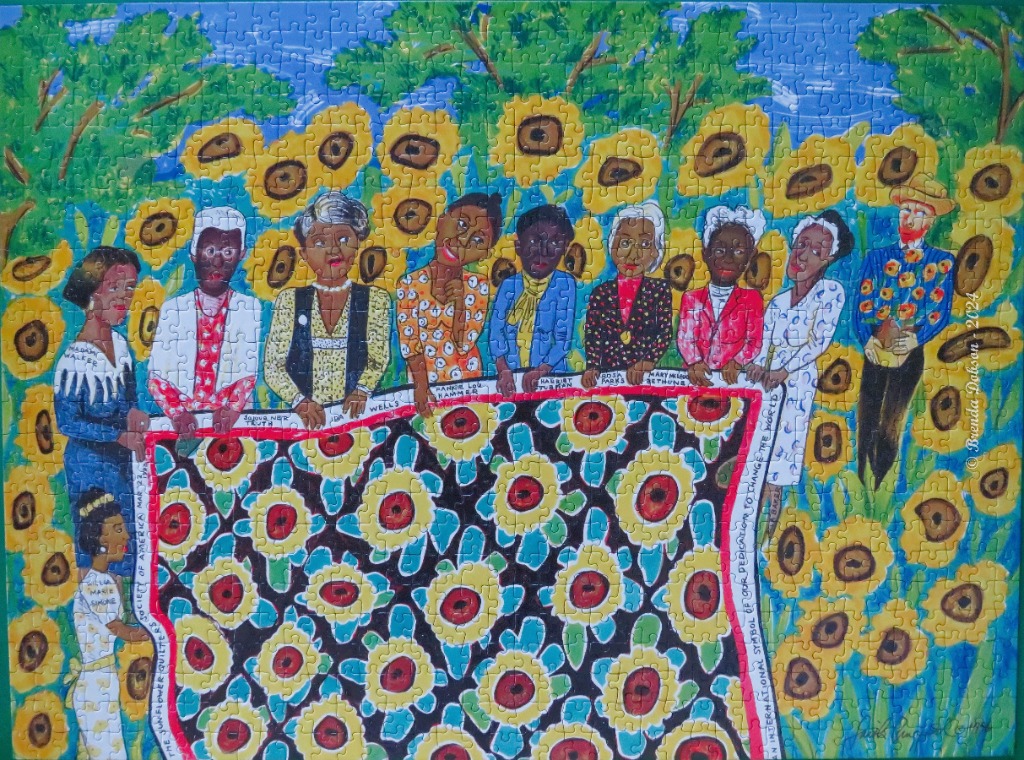
This vibrant illustration portrays a group of celebrated Black women standing in a field of sunflowers, collectively holding a large, ornate quilt. The quilt itself features a recurring pattern of yellow sunflowers with red centers on a dark, almost black background. The women are lined up horizontally behind the quilt, while another figure stands to the bottom left, assisting with the display. To the far right, a male figure wearing a hat and a sunflower-patterned shirt stands among the tall flowers.
The setting is a dense, lush sunflower patch under a clear blue sky. The composition is grounded by the horizontal line of the women and the quilt, which serves as a central focal point. Each woman is depicted with a distinct outfit and hairstyle, and small, hand-lettered names are inscribed along the edge of the quilt, identifying figures such as Sojourner Truth, Ida B. Wells, Fannie Lou Hamer, Harriet Tubman, Rosa Parks, and Mary McLeod Bethune. The overall style is expressive and painterly, characterized by bold outlines and a rich, saturated colour palette.
The scene is rendered in an folk-art aesthetic, with emphasis on pattern and symbolism. The bright yellows of the flowers contrast sharply against the dark tones of the quilt and the blue sky, creating a cheerful, commemorative atmosphere. The figures are captured in a gentle, dignified manner, reflecting a sense of community and shared legacy. The artwork includes the signature of the artist, Brenda Dalson, in the bottom right corner.
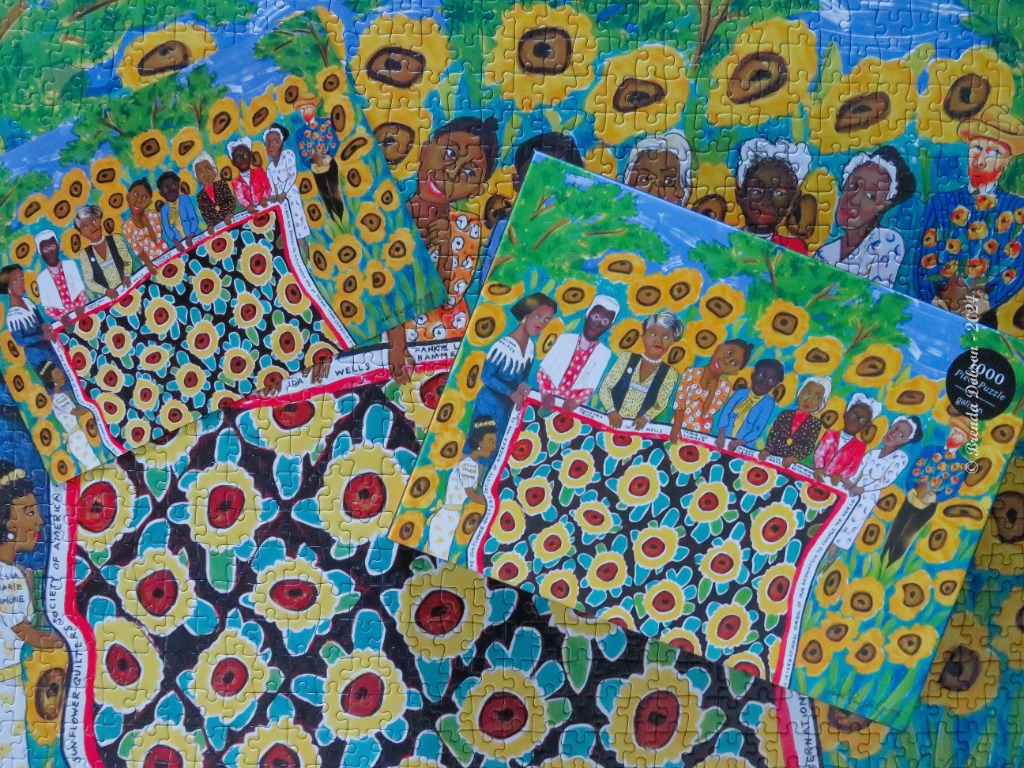
This illustration depicts a vibrant, layered scene centered around a quilt decorated with a repetitive pattern of sunflowers. The sunflowers feature bright yellow petals and deep red centers, set against a dark, possibly black, background. The quilt is being held by a line of Black historical figures, who are depicted in a stylized, folk-art manner. These figures are dressed in varied, colorful clothing and are positioned behind the quilt, looking forward. The arrangement of the figures and the quilt creates a sense of community, celebration, and historical reverence.
Behind the figures, a lush field of sunflowers stretches across the background, creating a bright and sunny atmosphere. The sky is a soft blue, complementing the yellow and green tones of the floral motif. The overall composition is layered and complex, with parts of the image overlapping, creating a sense of depth and movement. The artistic style is expressive, utilizing bold colors and clear, distinct lines to emphasize the figures and the sunflowers.
The mood of the piece is celebratory and dignified, evoking a feeling of strength and connection to heritage. The repetition of the sunflowers, both on the quilt and in the surrounding field, creates a cohesive and visually striking scene. The use of vibrant colors, such as the bright yellows and deep reds, against the darker elements, creates a dynamic contrast that draws the eye and highlights the central figures and their collective effort.
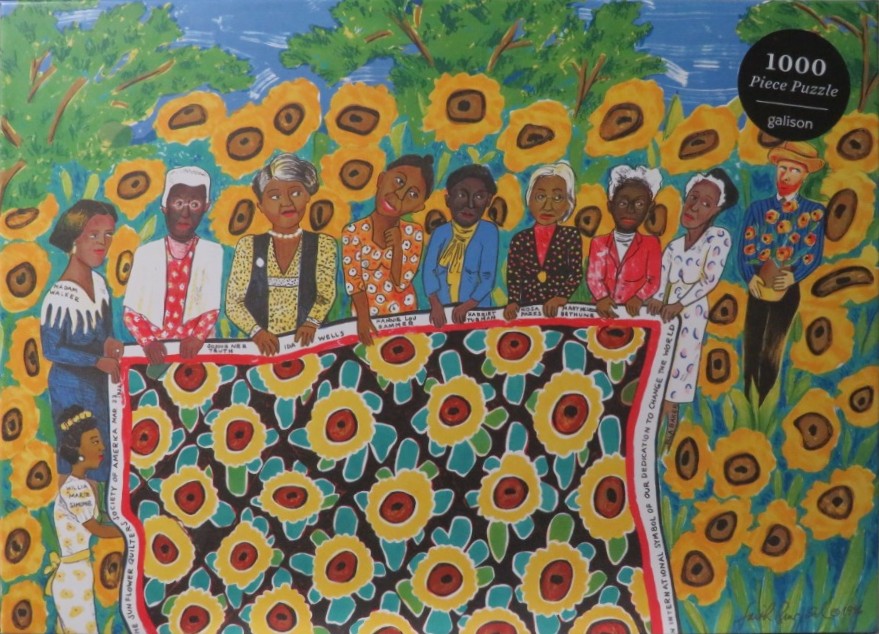
This painting features a group of historical figures standing in a dense, vibrant field of sunflowers against a bright blue sky. Centered in the foreground, the group holds a large, decorative quilt decorated with a repeating sunflower and leaf pattern. The figures are depicted with distinct facial features and varying styles of dress, representing an ensemble of iconic women, with one man standing to the far right. The overall composition is symmetrical, with the sunflowers acting as a framing device around the figures.
The artistic style is folk-inspired and representational, characterized by bold outlines and a vivid, saturated color palette dominated by bright yellows, deep greens, and a sky-blue backdrop. The quilt itself serves as a focal point, featuring a striking black background with stylized floral motifs that echo the surrounding sunflowers. The figures are painted in a somewhat flat, graphic manner, emphasizing their presence as a collective unit.
The artwork is infused with a warm, celebratory tone. Details include subtle labels on the figures or the quilt, such as "Madam Walker," "Ida Wells," and "Rosa Parks," anchoring the scene in a historical and cultural context. The light is bright and even, casting no deep shadows, which gives the entire scene a hopeful, mural-like quality. The brushwork is visible and expressive, contributing to the hand-painted, textured feel of the illustration.
by Brenda Dobson 2024-07-15