Solar System
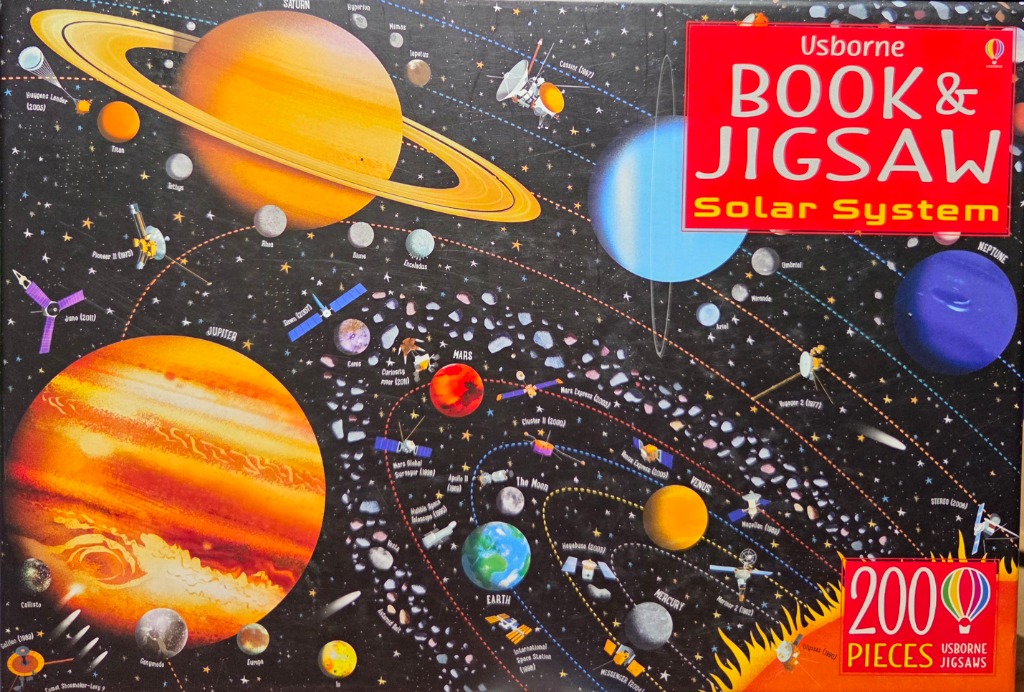
This illustrative depiction of the solar system displays the planets and various man-made space probes against a deep black, star-flecked background. The composition is anchored by large, detailed renderings of Jupiter in the lower left and Saturn in the upper left, complete with its iconic golden ring system. Earth, Mars, Venus, Mercury, Neptune, and Uranus are scattered across the scene, surrounded by an asteroid belt that curves through the center of the frame.
Fine dotted lines trace the trajectories of various space missions, connecting the planets and the asteroid belt to illustrated models of satellites and probes. Each celestial body and spacecraft is labeled with its name and the date of exploration, such as the International Space Station, the Hubble Space Telescope, and the Huygens Lander. The style is educational and graphic, using vibrant, saturated colours for the planets—ranging from Earth’s blue and green hues to Jupiter’s banded oranges and reds.
The overall layout is dynamic, suggesting orbital paths and the vast, interconnected nature of our planetary neighborhood. The light sources appear soft and ambient, emphasizing the rounded forms of the planets and the technical details of the metallic probes. The artwork has a clean, diagrammatic quality typical of scientific illustrations designed for clarity and information, effectively organizing a complex array of astronomical data into an accessible, artistic format.
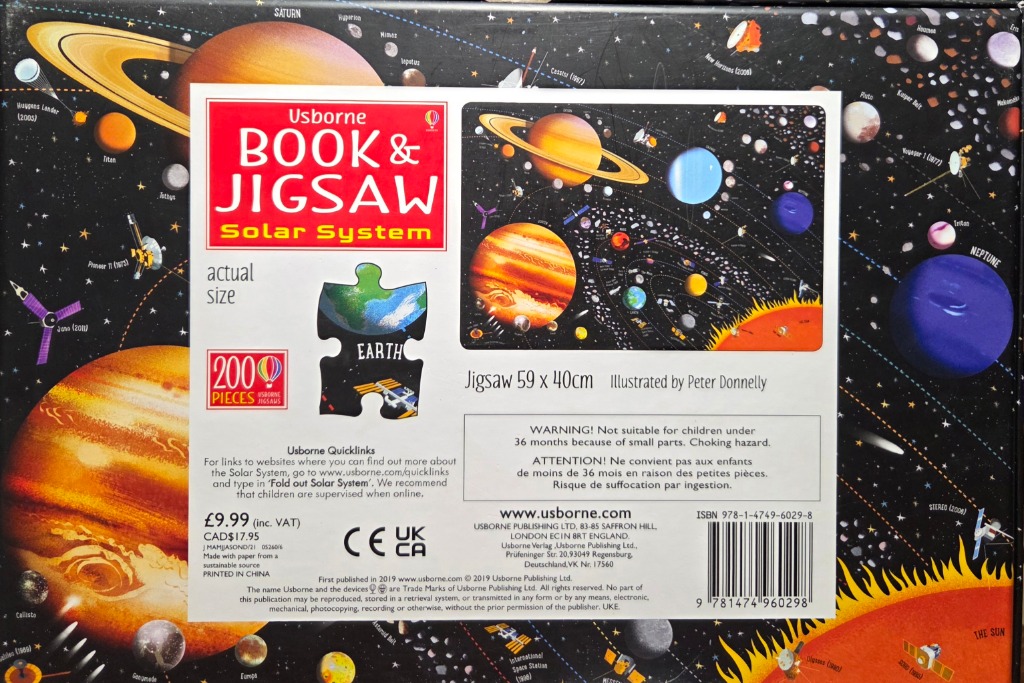
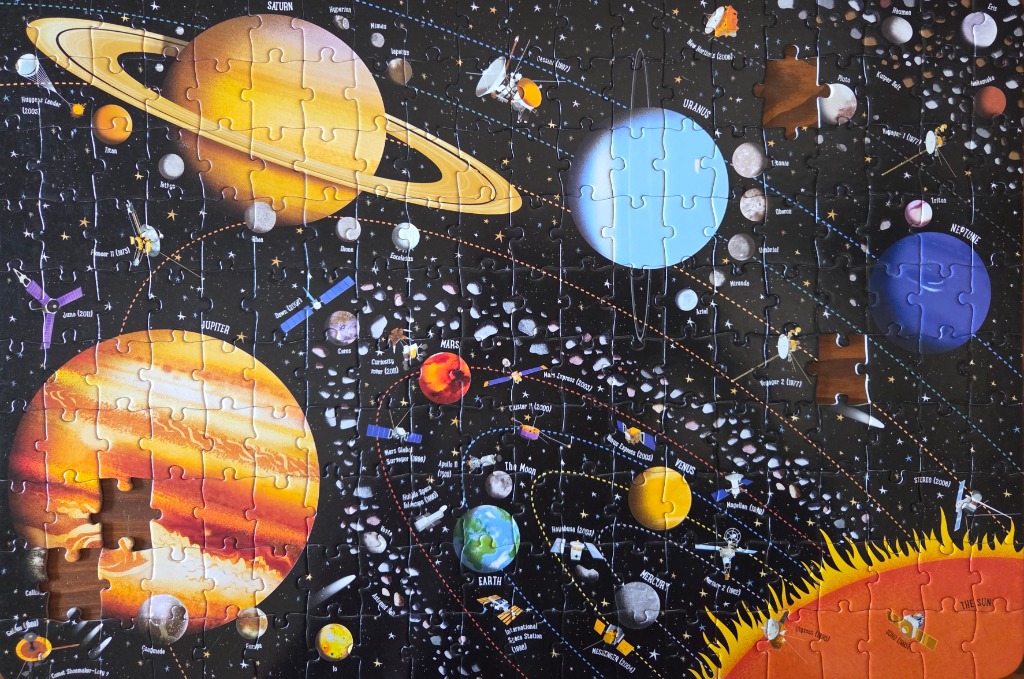
This illustration depicts an expansive view of the solar system set against a deep black, starry background. The composition is anchored by the Sun in the bottom right corner, radiating outward with jagged yellow and orange flares. From this focal point, the planets Mercury, Venus, Earth, Mars, Jupiter, Saturn, Uranus, and Neptune are arranged in their respective order, each rendered with distinct colours, textures, and ring systems where applicable.
The layout is dense and educational, filling the dark void with numerous moons orbiting the larger planets and a scattering of asteroids and comets. Dotted white lines trace the orbital paths of various spacecraft, which are interspersed throughout the scene. These probes and satellites are labelled with their names and the years of their missions, adding a historical and scientific dimension to the illustration.
The overall colour palette relies on the stark contrast between the luminous planets—ranging from the golden hues of Saturn and Jupiter to the vibrant blues of Neptune and the swirling greens and whites of Earth—and the uniform blackness of space. The artistic style is clear and diagrammatic, typical of an educational poster or textbook illustration, prioritizing the identification of celestial bodies and the technological feats of human space exploration.