On the Evening of the Battle of Waterloo
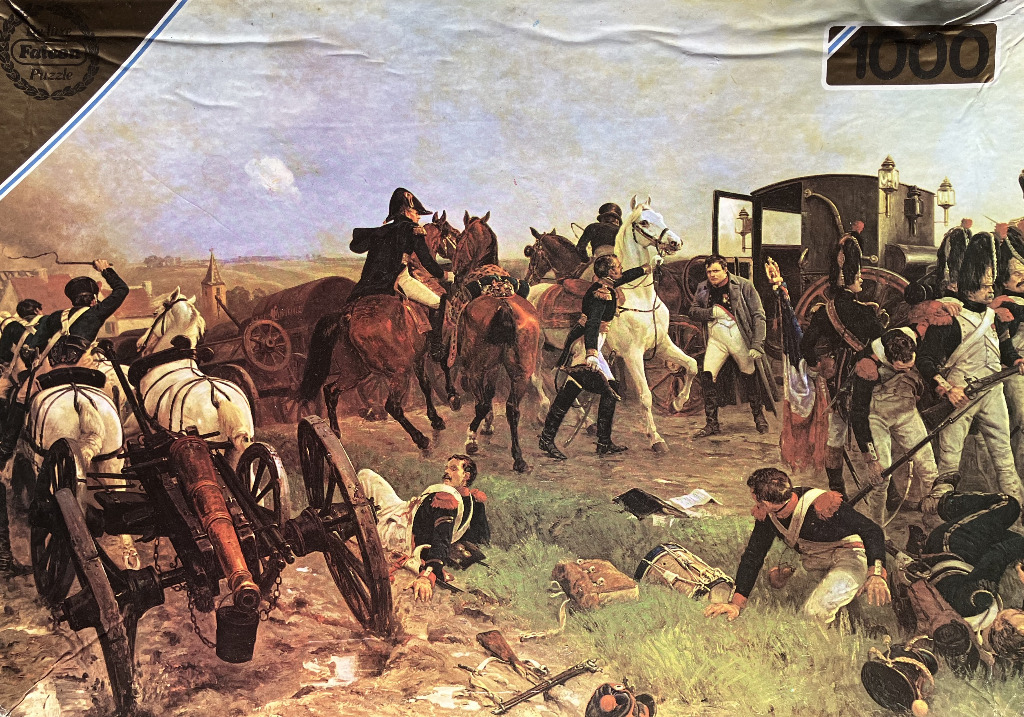
This historical oil painting depicts a chaotic battlefield scene during the Napoleonic era, featuring Napoleon Bonaparte standing near a horse-drawn carriage. The focal point is a central cluster of officers and cavalry, including a striking white horse, with Napoleon positioned slightly to the right, wearing his signature bicorne hat and a grey overcoat. In the foreground, weary soldiers are scattered across the muddy, uneven terrain, with one man lying on his back and another crouching near discarded military equipment.
Compositionally, the scene is busy and expansive, stretching out toward a distant, hazy landscape with a church steeple on the horizon. To the left, a large, heavy cannon is positioned in the foreground, ready for action. The composition creates a sense of immediate movement and fatigue, with cavalry mounts and infantry personnel arranged to guide the viewer’s eye through the dense atmosphere of the field.
Technically, the artwork uses a palette of earthy tones—browns, ochres, and muted greens—to capture the reality of the mud-caked battlefield. The lighting is diffused and overcast, suggesting a gray, late afternoon sky that casts soft shadows. The style is classic nineteenth-century military realism, with meticulous attention paid to the period-accurate uniforms, brass buttons, leather saddles, and the intricate construction of the artillery pieces and carriage.
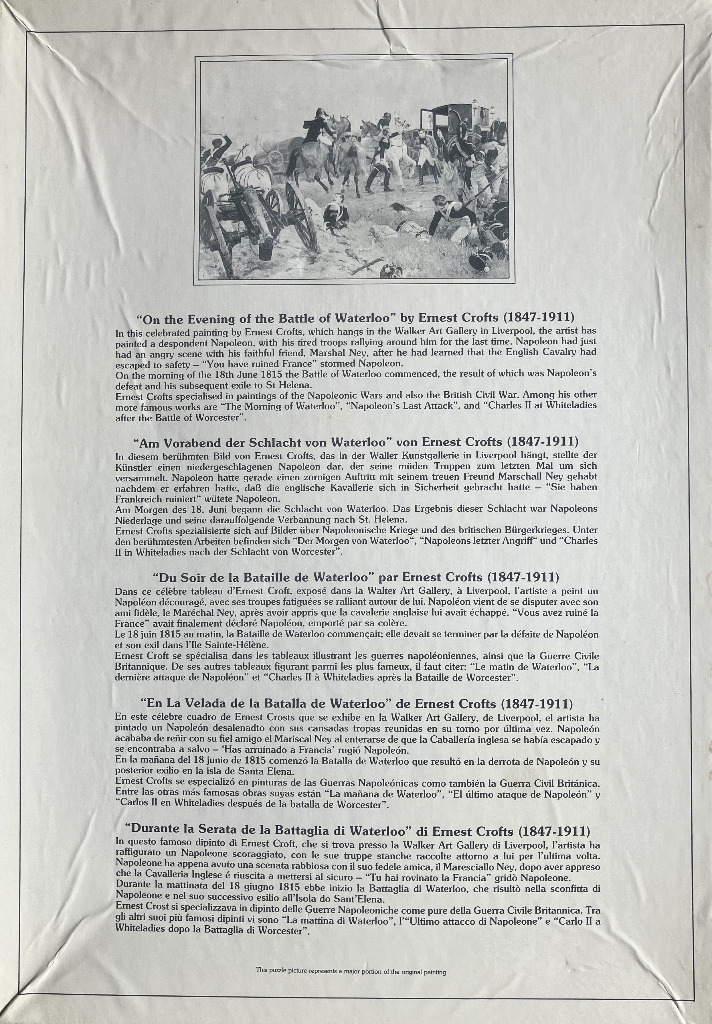

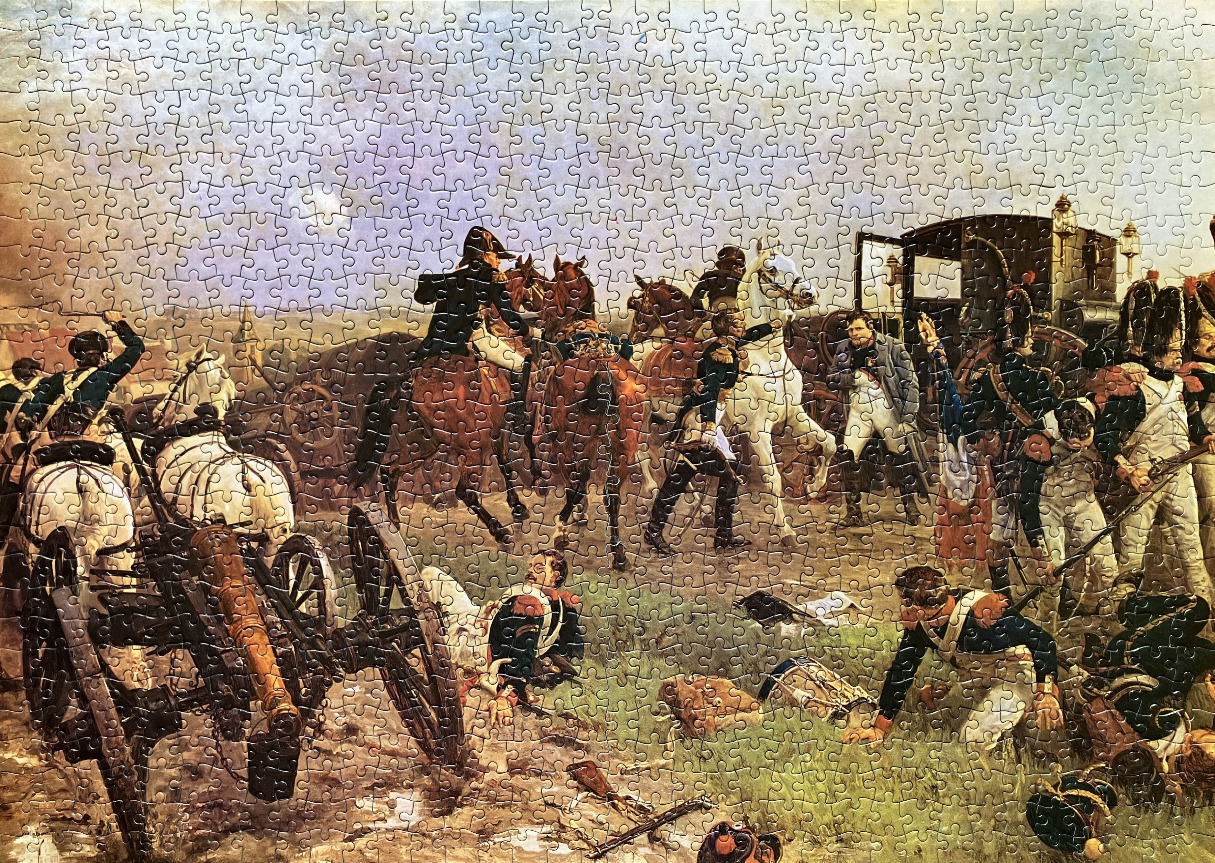
This historical painting depicts a scene from the Napoleonic Wars, featuring Napoleon Bonaparte standing near a carriage while surrounded by his military officers and infantrymen. In the foreground, an artillery piece on a wheeled carriage dominates the left side, while soldiers in uniform are dispersed across a grassy, muddy field. Some troops are mounted on horses, including a prominent white steed near the center, while others are on foot, gesturing or moving toward the coach.
The composition is densely populated, capturing a moment of strategic deliberation during a military campaign. The background reveals a wide, hazy horizon under a soft, overcast sky, suggesting the cool light of dawn or dusk. The distant landscape is muted and somewhat indistinct, focusing the viewer's attention on the activity of the figures in the mid-ground and foreground.
The colour palette is earthy and realistic, dominated by deep greens of the uniforms, dark browns of the horses and artillery, and the muted tans of the terrain. The lighting is diffused, casting soft shadows that ground the figures in the environment without harsh contrast. The style is that of a 19th-century oil painting, characterized by detailed period attire, expressive poses, and a cinematic approach to historical storytelling that emphasizes the grit and movement of the battlefield.