Napoleon at the Battle of Abukir
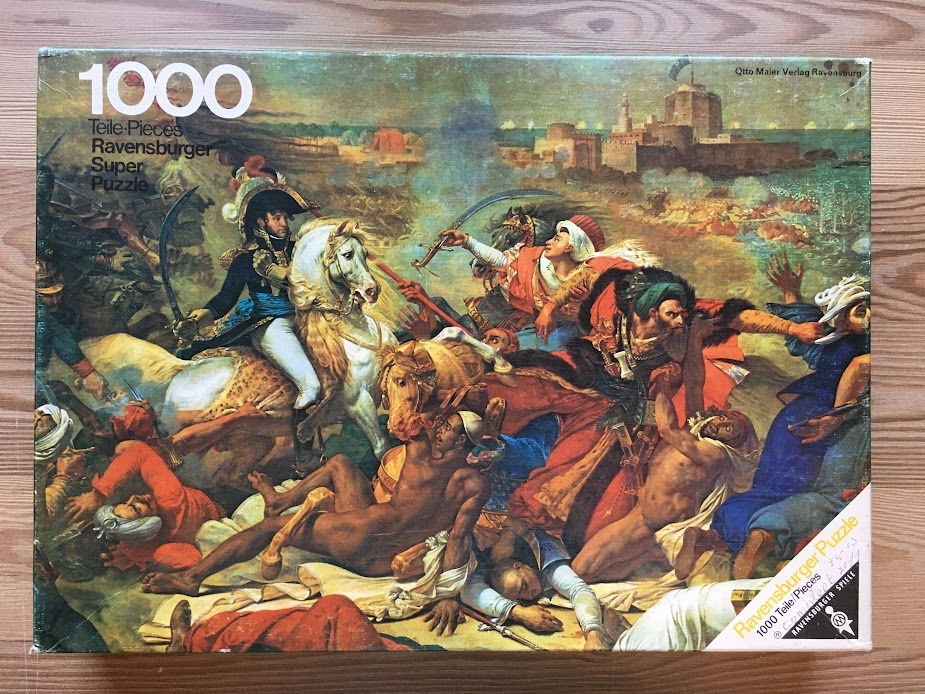
This historical oil painting captures a chaotic and violent scene from the Battle of the Pyramids. In the left-center, a military leader wearing a dark uniform with gold trim and a bicorne hat sits atop a prominent white horse, brandishing a curved sword. Surrounding him is a dense, swirling melee of figures engaged in hand-to-hand combat. Several individuals are depicted on the ground, some semi-nude or dressed in traditional Middle Eastern attire, amidst scattered weaponry and fabric. To the right, another rider on a dark horse strikes out with a blade, while further figures appear in varying states of struggle, including a woman in a bright blue garment.
In the background, a sprawling desert landscape unfolds, obscured by the haze and smoke of cannon fire. A fortified, stone-walled citadel stands on the horizon, punctuated by towers and under a sky filled with grey and golden smoke. The composition is dynamic and crowded, utilizing a diagonal motion that draws the eye from the foreground struggles toward the distant battle lines.
The colour palette is dominated by warm, earthy tones of sand and terracotta, contrasted by the deep blues of clothing and the stark white of the leader's horse. The lighting is dramatic and diffused, suggesting a dusty, sun-drenched environment, while the visible brushstrokes and rich textures emphasize the intense, frantic nature of the combat. The overall mood is one of epic, historical turmoil.
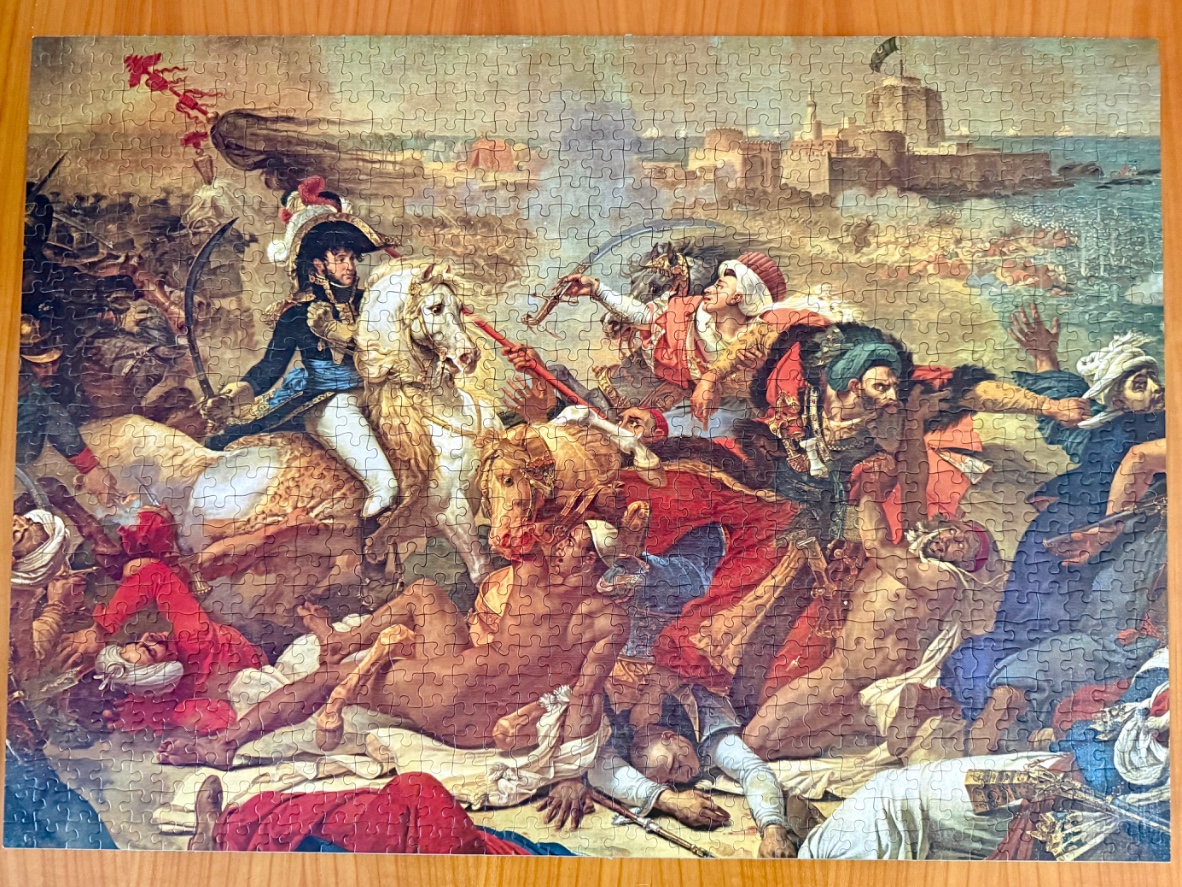
This historical artwork depicts a chaotic, intense battle scene, likely representing a conflict from the Napoleonic Wars. At the center left, a military officer, clearly identifiable as Napoleon Bonaparte, sits atop a light-colored horse. He is dressed in a dark blue military uniform with gold trim and a distinctive bicorne hat. He wields a curved sabre, appearing calm amidst the violent turmoil surrounding him.
In the foreground and throughout the middle ground, a fierce struggle unfolds between opposing forces. Figures are engaged in close-quarters combat, with several soldiers depicted in dynamic, prone positions on the ground. The combatants wear a variety of costumes, ranging from European-style uniforms to traditional middle-eastern attire, including turbans and robes. Their postures suggest desperation and high-energy action, with swords drawn and bodies contorted in the heat of the fight.
In the background, a massive fortress stands on a coastal cliff, overlooking the sea. Smoke from the battle drifts across the horizon, partially obscuring the view of the shore. The color palette is dominated by earthy tones, ochres, and muted blues, punctuated by the vibrant reds of the soldiers' garments and the stark white of the leader's horse. The style is that of a grand 19th-century oil painting, characterized by dramatic lighting, complex composition, and an emphasis on epic, historical storytelling.
by Larry Hostetter 2025-10-29