The Boat Yard
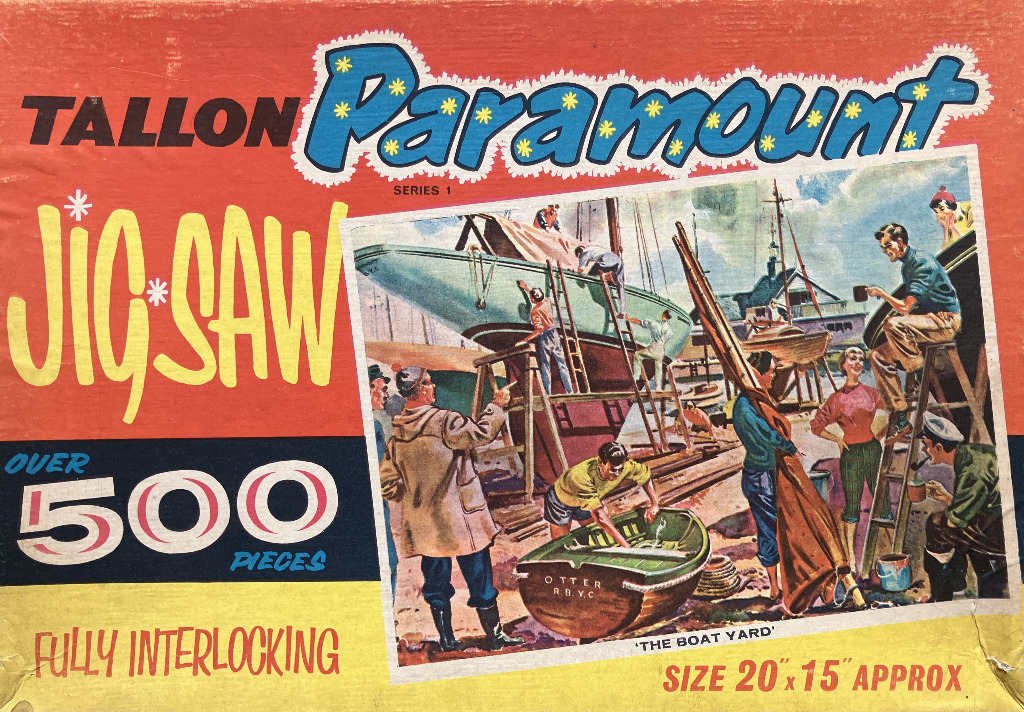
The central illustration depicts a lively, bustling boatyard scene where men and women are actively maintaining sailing vessels. A large, light-green hull rests on wooden scaffolding in the background, with workers ascending ladders to reach the deck. In the foreground, a smaller rowboat labeled "OTTER R.B.Y.C." sits on the ground, where a man in a yellow shirt is inspecting the interior. Other individuals are scattered throughout the scene, some holding tools, others observing or conversing, creating a candid, industrious atmosphere.
The composition is angled and dynamic, utilizing ladders and boat masts to draw the viewer’s eye through the depth of the yard toward a distant workshop. The setting appears to be a coastal facility during the day, with soft, natural light illuminating the scene. The color palette relies on realistic, earthy tones—muted greens of the boat hulls, browns of the wooden structure and ground, and the varied, casual clothing of the figures.
This artwork is rendered in a nostalgic, mid-century illustrative style, reminiscent of 1950s or 60s magazine art. The characters have expressive, slightly stylized features typical of the era's commercial illustration. Broad, clear brushstrokes define the figures and structures, emphasizing the activity and community aspect of the boatyard rather than hyper-realistic detail.

The image displays a bold graphic design centered on a bright yellow, textured background. The words "PARAMOUNT" appear in a large, tilted, blue, sans-serif font. Beside this, the word "JIGSAW" is written in a similar, chunky, orange-red typeface. Below the text, the words "SERIES 1" are printed in a smaller, simple black font.
To the right of the main text, a whimsical, minimalist cartoon character is depicted. The figure has a long nose, a wide grin, and wears a hat. It is holding a rectangular sign that reads "another TALLON product" in black text. The entire composition uses a flat, mid-century graphic style, reminiscent of vintage advertising or retro packaging design, with high-contrast colors and simple line work.

The image displays a list of four titles set against a horizontally divided background. The left section is a solid yellow, followed by a narrow vertical panel of dark blue, and a wide orange section to the right. The text is printed in white, sans-serif capital letters.
On the dark blue background, the phrase "Titles in the series:-" is written in two lines. The orange section contains the following list, each preceded by a white circular bullet point: 'THE BOAT YARD', 'THE LORD MAYOR'S PROCESSION 1850', 'SPANISH FIESTA', and 'OLD WORLD COURTESY'.
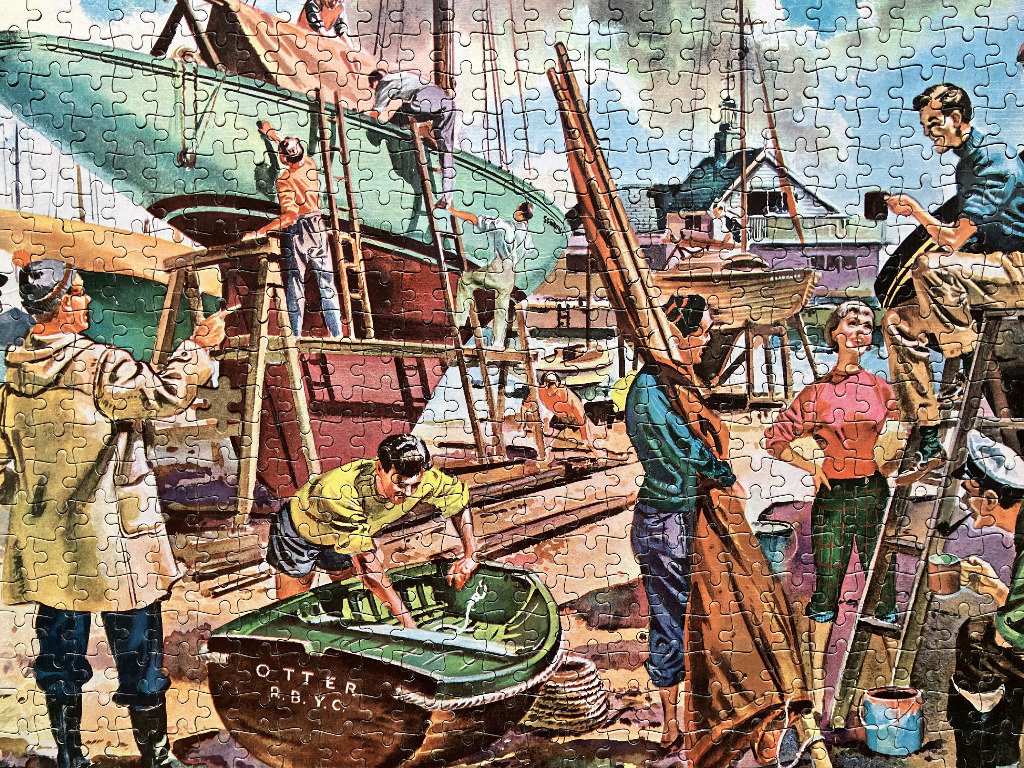
This vintage-style illustration depicts a busy maritime shipyard where several people are engaged in maintenance and repair of sailboats. The central focus is a large, light-green hull raised on scaffolding, with workers actively climbing ladders and tending to the vessel. Below, a man in a yellow shirt works on a small green dinghy labeled "OTTER R.B.Y.C.", while other figures in casual, mid-century attire stand by, some holding mugs or chatting, adding a sense of daily life to the industrial setting.
The composition is layered, using ladders, wooden beams, and rigging to create depth and frame the various work areas. In the background, hints of a waterside building and additional boat hulls suggest a sheltered harbor or club environment under a cloudy, overcast sky. The overall atmosphere is productive and leisurely, reflecting a nostalgic maritime scene.
The colour palette features muted, earthy tones typical of mid-century illustrative art, punctuated by the vibrant green of the boats and the contrasting yellows and reds of the workers' clothing. The light is diffused, consistent with a cloudy day near the water, casting soft shadows that emphasize the three-dimensional structures of the scaffolding and boats. The style is detailed and representational, characteristic of a mid-20th-century magazine or narrative painting.