Eiland Urk 1845
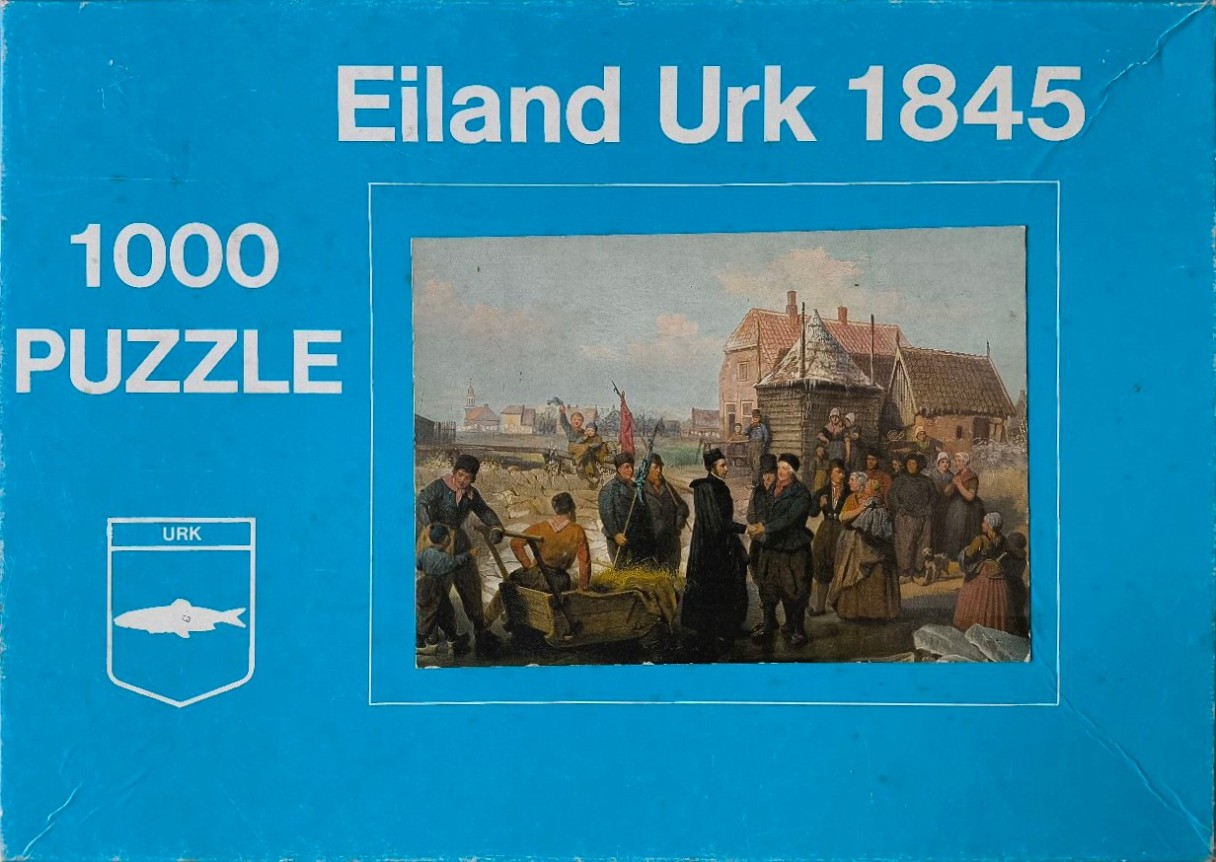
The central artwork is a detailed historical scene depicting life on the island of Urk in 1845. The focal point is a gathering of villagers, including men and women in traditional period clothing, positioned in an open, somewhat rugged outdoor space. A central figure dressed in a long, dark coat appears to be conversing with other men, while to their left, a man leans over a wooden handcart filled with hay or fodder, with a young child nearby. Further back, a small group of villagers stands near wooden structures and farm-like buildings, adding to the rural, domestic atmosphere of the era.
The composition is grounded by the figures in the foreground, with the background revealing a glimpse of the village landscape under a light, cloudy sky. Faint architectural elements, perhaps a church tower or distant houses, are visible in the far distance, providing depth and context to the island setting. The painting uses a muted, naturalistic palette of earth tones, browns, and grays, which contrasts with the soft, diffused daylight that casts gentle shadows across the scene.
The style is reminiscent of 19th-century Dutch genre painting, focusing on the everyday lives of common people. The figures are rendered with careful attention to their period attire—the men in hats and heavy coats, and the women in traditional caps and long dresses. The overall mood is one of quiet, historical observation, documenting a specific moment of social interaction in a coastal village community.
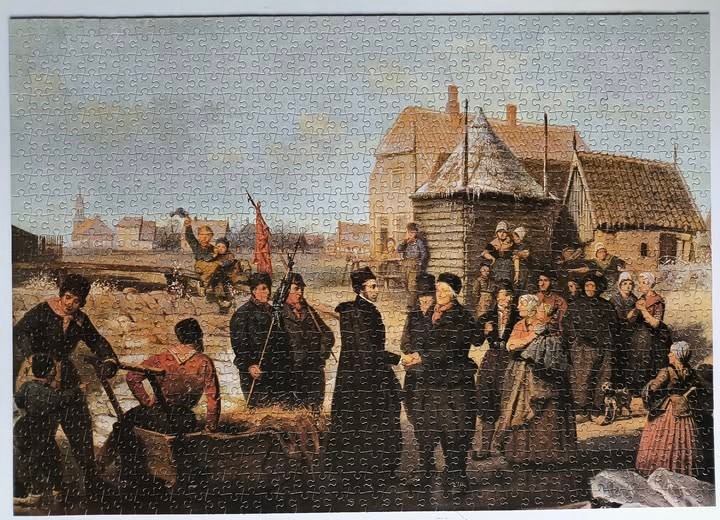
This detailed 19th-century genre painting depicts a lively outdoor gathering in a rural village during the winter. The focal point is a man dressed in a formal black overcoat and top hat shaking hands with another man in the center of the scene. Surrounding them is a crowd of villagers, including men in dark work clothing and women wearing traditional bonnets and layered dresses. To the left, a man works near a wooden cart filled with straw, while children play nearby, including one child waving a red flag.
The setting is a rustic, frozen environment with modest farm buildings and houses in the background. The architecture features timber structures, one with a prominent conical roof, and a distant church spire visible on the horizon. The composition is structured with the human figures clustered in the foreground, creating a narrative scene that suggests a communal event or market day. A small dog can be seen standing among the crowd members on the right side.
The colour palette is muted and earthy, dominated by deep blacks, browns, greys, and faded reds, reflecting a typical winter atmosphere. The lighting is diffused and cool, characteristic of an overcast day, which casts soft shadows and lends a somber, realistic mood to the painting. The artistic style is representational and detailed, emphasizing the textures of the clothing, the rough wooden structures, and the individual expressions of the townspeople.