Kaiserin Maria Theresia
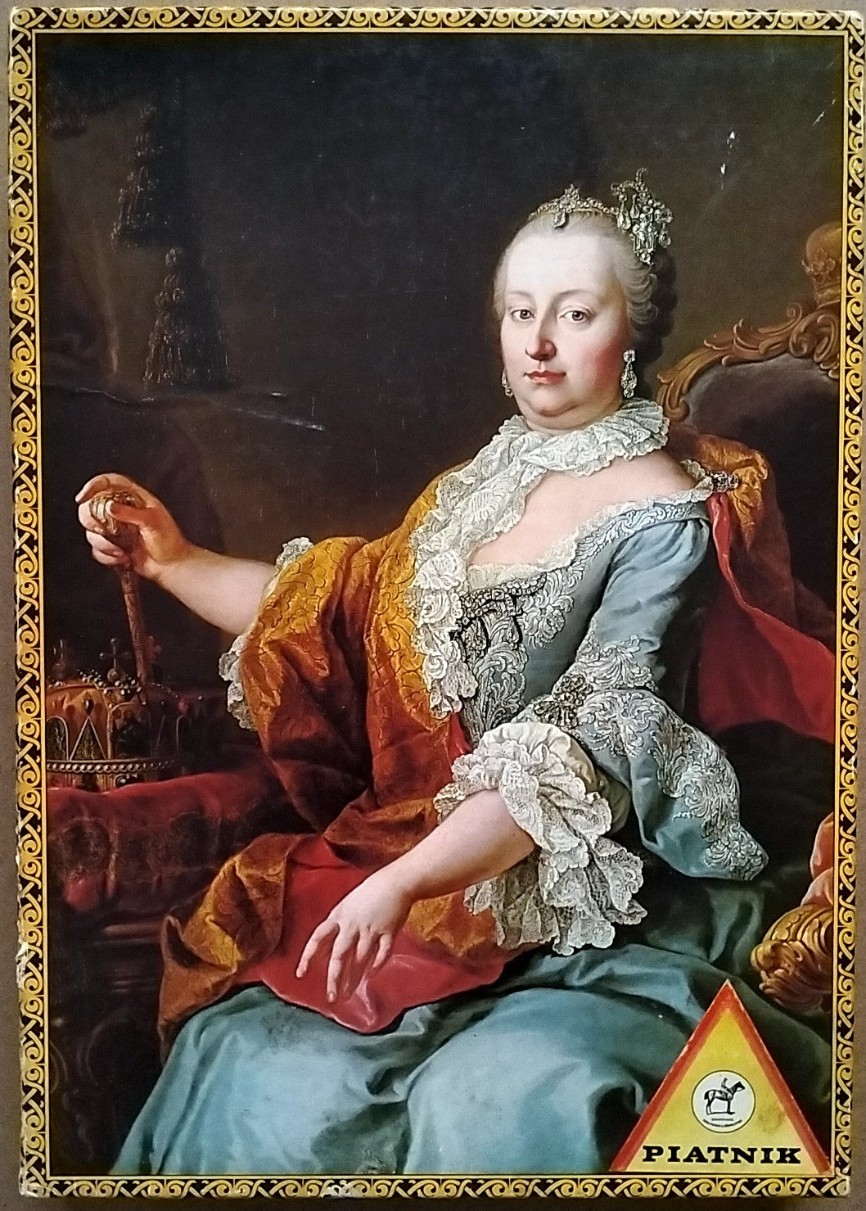
This formal oil painting depicts Empress Maria Theresa, captured in a regal three-quarter view. She sits with a poised, confident expression, her gaze directed toward the viewer. Her dark hair is styled upward and adorned with an intricate, glittering tiara, and she wears matching drop earrings that catch the light.
She is dressed in an elegant gown of muted slate-blue silk, accented by a high, ruffled white lace collar and voluminous lace cuffs that drape over her forearms. Draped over her shoulders is a rich, textured ochre and deep red mantle. In her right hand, she rests her fingers atop a tall scepter, positioned near a bejeweled royal crown placed on a velvet cushion. She sits in an ornate, high-backed wooden chair with gilded details.
The background is dark and indistinct, focusing all visual weight on the subject and her fine garments. The lighting is focused and dramatic, highlighting the sheen of the fabric, the delicate translucence of the lace, and the fine jewelry, typical of 18th-century court portraiture. The composition is balanced and dignified, conveying the authority and status of an empress.

The image displays a vertical text-based graphic oriented for reading from the bottom to the top. The primary background is a solid, vibrant red block of color that spans the center of the vertical orientation. Dominating this area is the bold, dark text reading "GLANZVOLLES ÖSTERREICH," positioned above the subtitle "Serie IMPERIAL." Below this, smaller white text identifies the subject as "Kaiserin Maria Theresia" from the "Kunsthistorisches Museum, Wien."
To the right of the red panel is a narrow, decorative vertical strip featuring a repeating golden fleur-de-lis pattern set against a black background. At the very top, there is a small circular logo featuring a stylized figure. At the bottom, a white rectangular section provides further technical information, including the piece count and a specific order number.
The overall aesthetic is structured and formal, characteristic of traditional archival or museum-related educational materials. The contrast between the deep red, the stark black-and-gold decorative border, and the clear, bold typography creates a formal and historical presentation, focusing entirely on textual information and institutional branding rather than a pictorial scene.