Beaufighter - Long Run Home - RAF Beaufighters in the North Sea
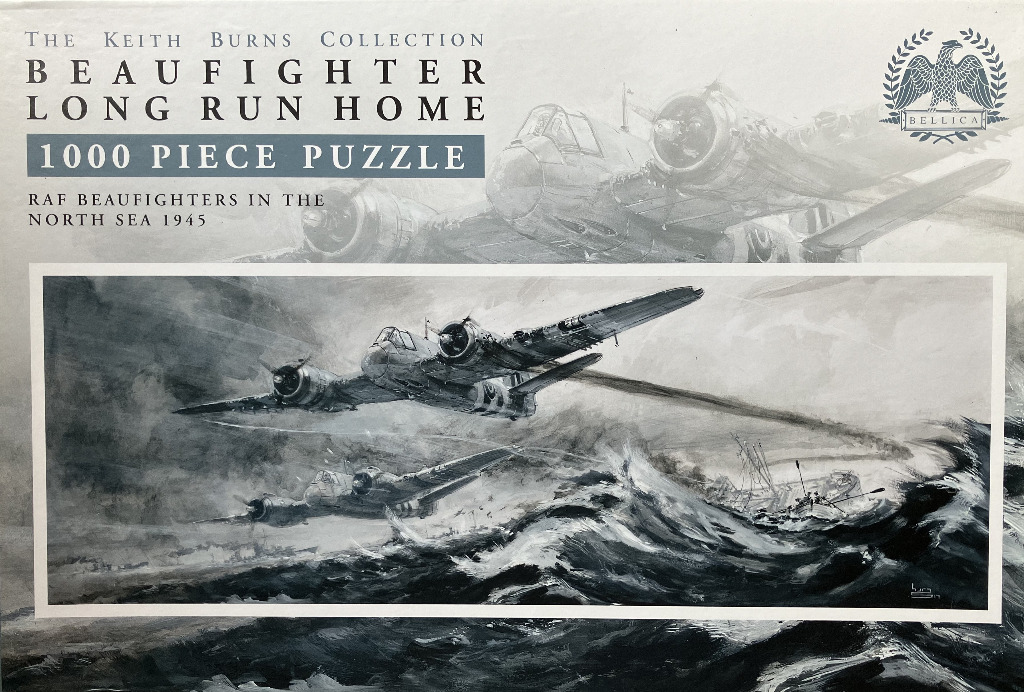
The main artwork depicts a dynamic aviation scene showing two British Beaufighter aircraft flying low over the turbulent waters of the North Sea. The lead plane is in the center, banking slightly as it descends, while the second aircraft appears lower and further back, emerging from the misty spray. To the right, a ship is caught in the midst of the rough, white-capped waves, with a plume of dark smoke trailing from one of the aircraft toward the vessel, suggesting a wartime engagement.
The illustration is rendered in a monochromatic palette of stark blacks, greys, and whites, creating a dramatic, high-contrast atmosphere. The artist uses expressive, gestural brushstrokes to capture the violent movement of the sea and the heavy, overcast sky. The lighting is diffused and stormy, emphasizing the sense of isolation and intensity inherent in an aerial maritime mission. The style is painterly and atmospheric, focusing on the kinetic energy of the machines and the harshness of the ocean environment.
Compositionally, the scene is framed horizontally, with the aircraft positioned to lead the eye from left to right, intersecting with the diagonal lines of the waves. The composition suggests speed and imminent action, with the foreground waves providing depth and texture that contrast against the smoother, more abstract depiction of the sky. The work captures a gritty, historical moment with a focus on movement and technical detail of the twin-engine planes.


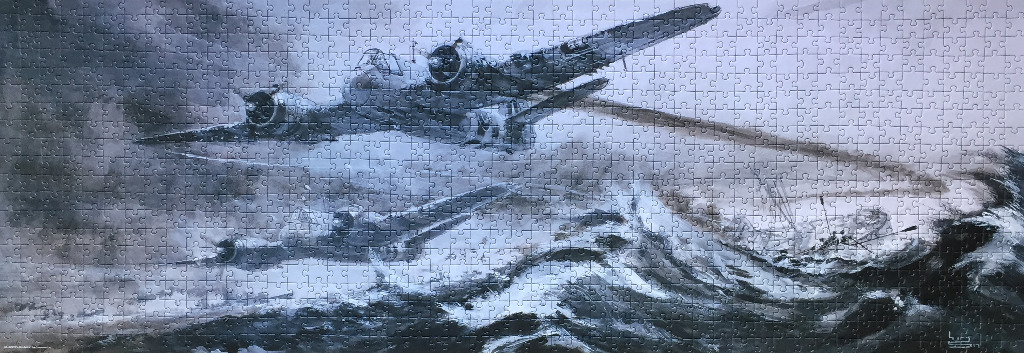
This panoramic illustration depicts two military bomber aircraft flying at low altitude over a turbulent, dark ocean. The lead aircraft, positioned centrally in the upper portion of the frame, is seen in a slight banking maneuver. A second plane is visible below and to the left, flying closer to the water's surface. The composition creates a sense of tension and motion, with the planes angled as if navigating through a challenging environment.
Beneath the aircraft, the sea is depicted with dramatic, frothing waves. The water is painted in deep shades of navy, charcoal, and white, suggesting a stormy or wintry day. A faint trail or wake appears to stretch across the mid-ground, linking the movement of the aircraft to the chaotic surface of the water. In the bottom right corner, a small, dark object—possibly a buoy or marker—is visible amidst the crashing whitecaps.
The overall colour palette is monochromatic, dominated by shades of grey, slate, and black, punctuated by stark white highlights representing sea spray and reflective light on the fuselage. The artistic style is expressive and painterly, utilizing visible brushstrokes to convey the raw energy of the wind and sea. The light is diffused and overcast, casting the entire scene in a somber, cinematic atmosphere consistent with historical aviation art.