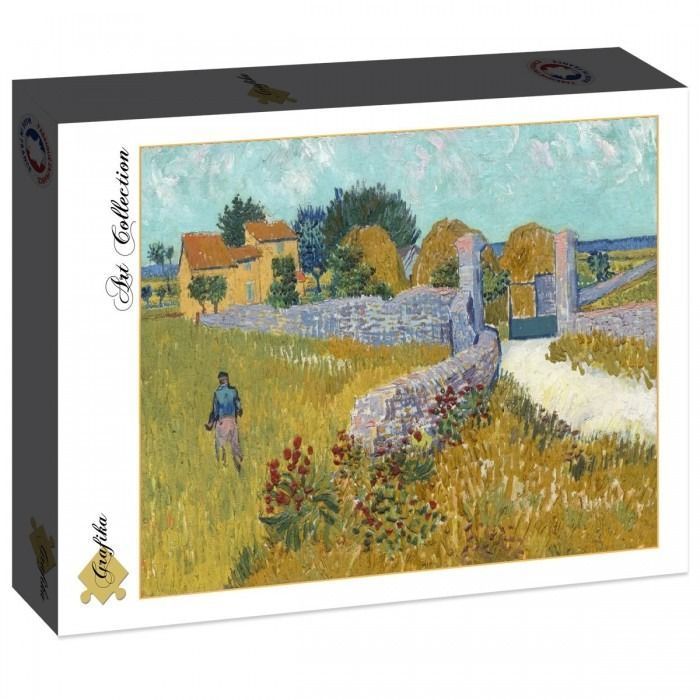
The scene depicts a rustic country landscape painted in a Post-Impressionist style, likely by Vincent van Gogh. The central focus is a golden-hued field of grain stretching toward the middle ground, where a lone figure wearing a blue jacket and light-coloured trousers walks away from the viewer. To the right, a low, curved stone wall snakes through the grass, adorned with patches of reddish-brown flowers or shrubs near its base. Beyond the wall, a dirt path leads to a gate flanked by tall stone pillars.
In the background, a small farmhouse with an orange roof nestles among dark green trees. Beside the buildings, two large, rounded haystacks rise up, echoing the shapes of the nearby foliage. The entire scene is set under a pale, turquoise-blue sky filled with light, wispy clouds. The composition is balanced by the contrast between the open, sunlit field in the foreground and the more dense, structured elements of the farm and gate.
The painting is characterized by visible, rhythmic brushstrokes and a palette dominated by warm yellows and ochres, complemented by the cool, muted blues and greys of the sky and the stone wall. The mood is tranquil and pastoral, capturing the essence of a rural summer day. The medium is oil paint on canvas, featuring the heavy, expressive impasto technique typical of late 19th-century French landscapes.