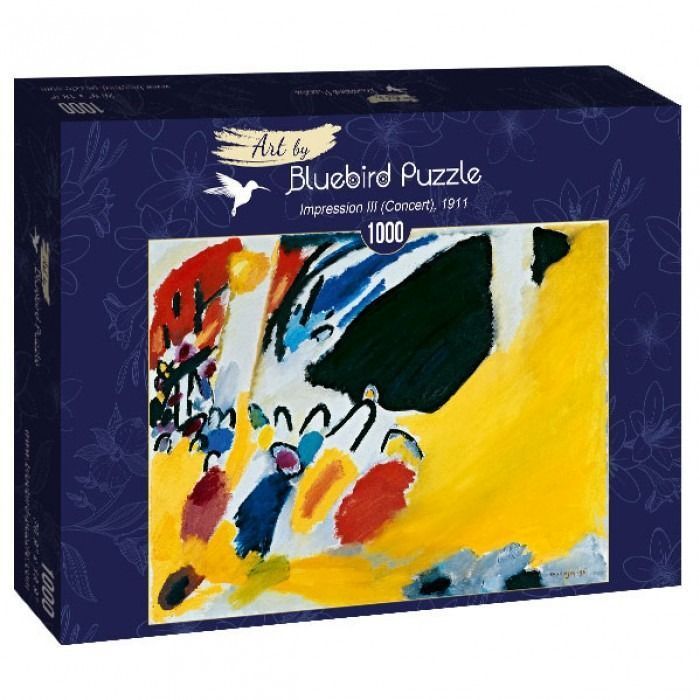
This artwork is Wassily Kandinsky’s "Impression III (Concert), 1911," an iconic piece of abstract expressionism. The composition is dominated by a large, sweeping black triangular shape that draws the eye toward the upper right, contrasting sharply against a vibrant, expansive background of sunny yellow. Below this dark mass, the scene is populated by a playful array of colorful, curved, and gestural brushstrokes in red, blue, and orange, suggesting the chaotic and rhythmic atmosphere of a musical performance.
Technically, the painting utilizes a bold, non-representative style typical of the artist's early experiments in abstraction. The application of paint is fluid and expressive, with thick, energetic strokes that maintain a sense of spontaneity. The white spaces between the colored forms act as a neutral canvas, allowing the bold primary and secondary colours to vibrate against one another. There is no clear horizon or perspective, emphasizing the emotive power of shape and colour rather than realistic depiction.
The mood is lively, rhythmic, and intellectually stimulating, capturing the essence of sound through visual motifs. The balance between the massive, brooding black form and the scattered, lighthearted color accents creates a dynamic tension across the frame, inviting the viewer to interpret the work as a translation of auditory experience into a purely visual language.