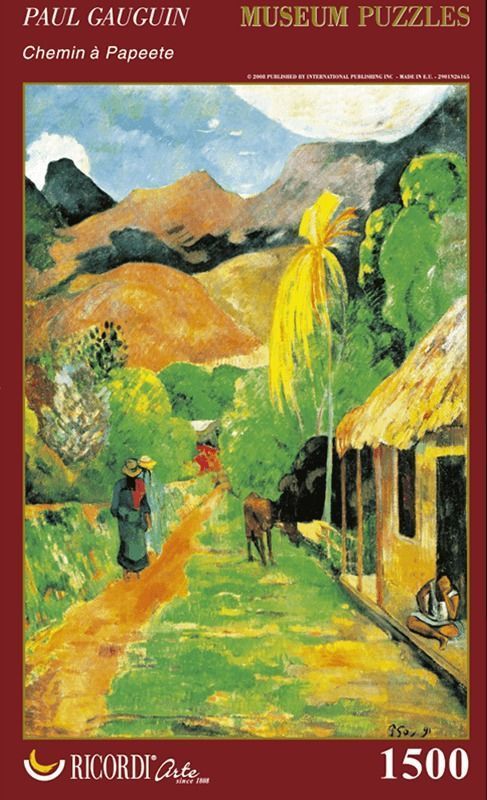
This post-impressionist painting depicts a rural, tropical scene in Tahiti. In the foreground, a sandy dirt path winds through lush, vibrant green vegetation. To the right, a simple hut with a thatched roof stands prominently, with a person sitting in the doorway. A small animal, appearing to be a calf, grazes near the path. On the left side of the path, two figures wearing hats walk away from the viewer, appearing as if they are heading deeper into the landscape toward the mountains.
In the background, rolling, sun-drenched hills rise up to meet a bright sky filled with thick, stylized clouds. A prominent, bright yellow palm tree stands tall near the center, acting as a vertical accent that contrasts with the softer, organic shapes of the surrounding foliage and mountain peaks. The composition is balanced by the hut on the right and the walking figures on the left, creating a sense of depth as the path leads the eye toward the distant horizon.
The painting is characterized by a bold, expressive use of color and visible brushstrokes, typical of Gauguin’s style. Warm ochres, earthy oranges, and deep yellows define the hills and the path, while the vegetation is painted in varied, saturated shades of green. The light feels bright and tropical, casting soft shadows and highlighting the texture of the thatched roof and the foliage. The overall mood is serene and rustic, capturing a quiet moment in a natural, pastoral setting.