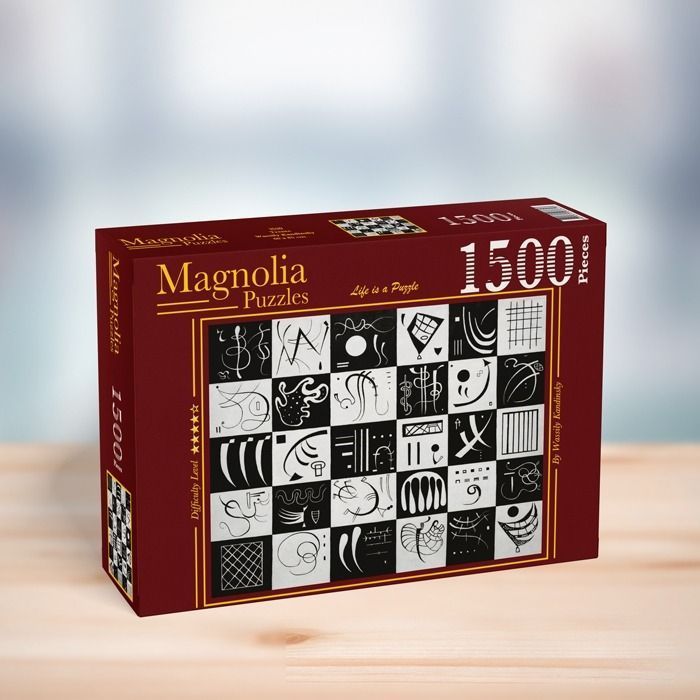
The main artwork features a structured grid composed of twenty-five distinct squares, arranged in a five-by-five format. Each square contains a unique, minimalist design rendered in either black ink on a white background or white ink on a black background. The imagery within these squares is abstract, consisting of calligraphic flourishes, flowing organic lines, intersecting grids, geometric circles, and rhythmic vertical dashes. The overall effect is reminiscent of a collection of elemental symbols or musical notation.
Compositionally, the piece is highly ordered and symmetrical, contrasting sharply with the fluid and erratic nature of the individual line work contained within each frame. The alternating high-contrast pattern of the squares creates a checkerboard-like visual rhythm that guides the eye across the surface. This work, attributed to Wassily Kandinsky, emphasizes the interplay between structural geometric order and the expressive, spontaneous quality of individual marks and lines.
The aesthetic is monochromatic, relying entirely on the stark polarity of black and white to define the shapes and forms. The light is flat and even across the composition, lacking shadows or gradients, which highlights the precision of the graphic design. The style is distinctly modernist, focusing on the reduction of form to its essential components, creating a balanced tension between the static grid and the dynamic, dance-like movements of the hand-drawn elements inside.