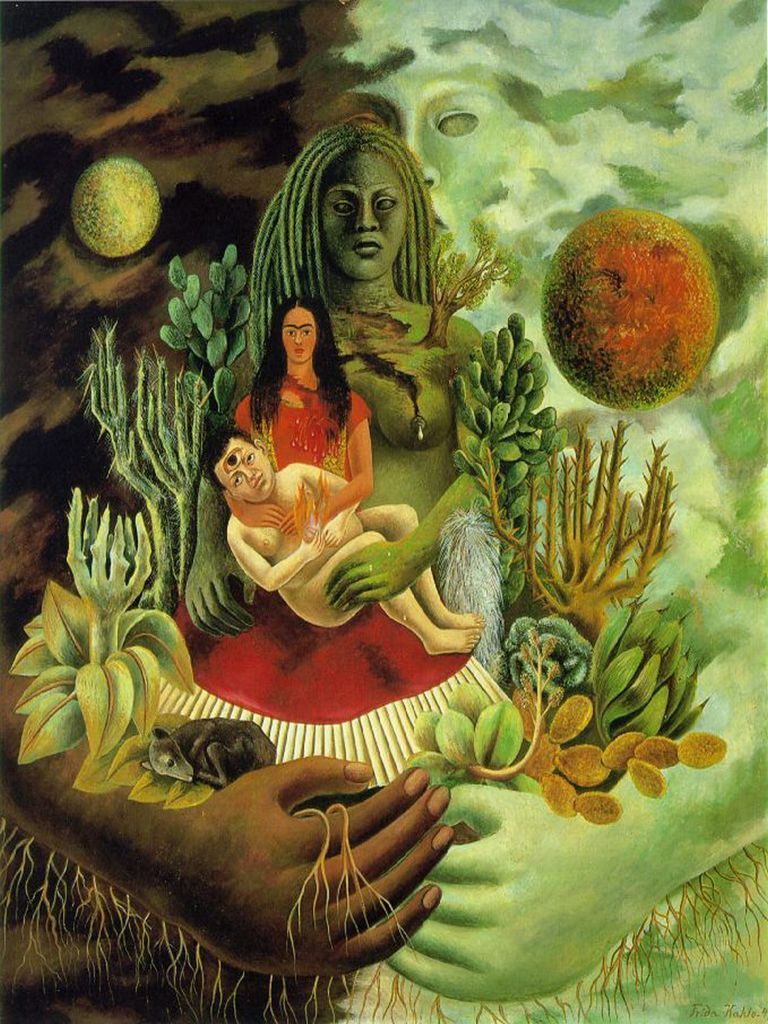
This surrealist composition centers on a dark-skinned, greenish-hued earth mother figure with flowing, root-like hair, cradling a fair-skinned child who has a third eye on his forehead. The mother wears an expression of stoic sorrow, her form blending into the landscape and vegetation. She holds the child on her lap, while the child clutches a small, burning flame against his chest. Above the mother, a spectral, ghostly face fades into the cloudy sky, and the entire scene is anchored at the bottom by a pair of large, disembodied hands—one dark and one light green—that hold the entire world, including the cacti, animal, and figures, like a cradle.
Surrounding the central figures are various species of cacti, reflecting a desert landscape. A small, dark creature resembling an opossum or dog rests near the bottom left corner. The color palette is divided between a dark, nocturnal side on the left, illuminated by a pale crescent moon, and a warmer, more vibrant side on the right, dominated by a large, glowing orange-red sun. The contrast between these celestial bodies suggests the passage of time or the duality of day and night.
The artwork uses oil on masonite, characterized by meticulous detail and smooth, dreamlike brushwork typical of surrealist portraiture. The mood is solemn, mystical, and deeply connected to themes of fertility, nature, and the cycle of life, as symbolized by the roots dangling from the large hands at the base.